Should You Start Your Black Friday Sale Early?
Rivals already went early. Go all in now, run a narrow early offer, or hold for the weekend? Decide on your margin, stock and promises, then their evidence.
Thomas Pham · · 8 min read
Your competitors have early Black Friday deals up, and Black Friday itself is not until 27 November. Should you start your Black Friday sale early too? For most small stores the answer is a narrow early offer, not your full sale: one product, one bundle or your email list only, with the main discount kept for the weekend. Go all in early only if your margin can carry the discount for every extra day.
That answer rests on three inputs, in this order: your own numbers, what your rivals have actually done, and what you can honestly call a Black Friday price. Rivals come second on purpose. Their sale date tells you about their margin, not yours.
Why is this decision live right now?
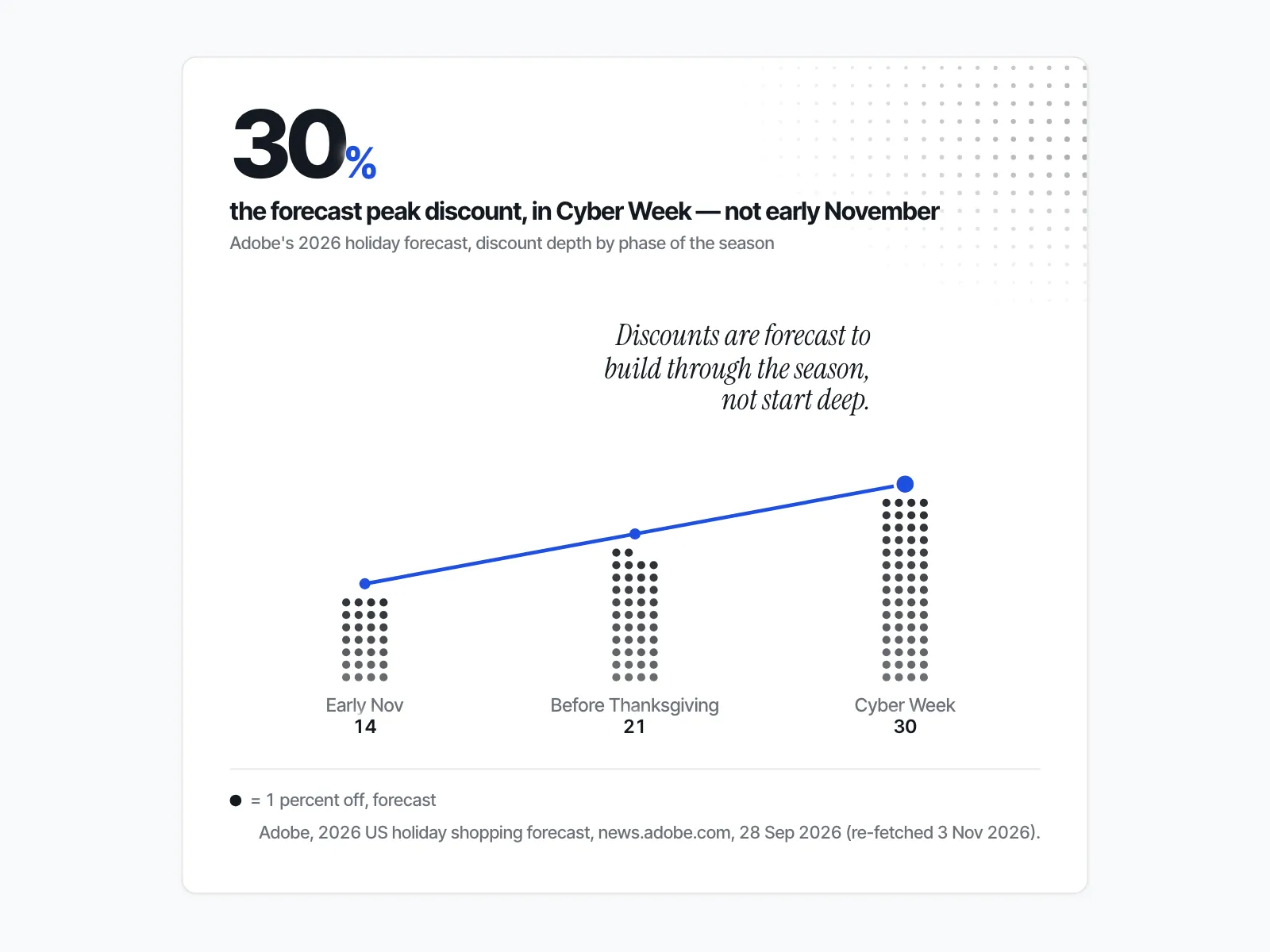
Early Black Friday deals are normal in 2026. Adobe's 2026 US holiday forecast expects shoppers to see deals "up to 14% in early November, up to 21% just before Thanksgiving." Rivals discounting in the first week of November are doing what the forecast predicts, not proving you are late.
Black Friday 2026 is Friday 27 November, the day after Thanksgiving, which US federal law fixes as "the fourth Thursday in November". Cyber Monday is 30 November. That leaves about three and a half weeks of season before the weekend.
Adobe released that forecast on 28 September. Two lines in it matter for timing. Discounts are forecast to build through November rather than start deep, peaking "up to 30% off listed price" during Cyber Week. And across categories, Adobe says deals "will be on par with the 2025 season", so the market as a whole isn't expected to discount harder this year.
Shoppers do move early. The National Retail Federation (NRF) reported that last year, "As of the Thanksgiving weekend, 84% of consumers had already begun their holiday shopping." That is a 2025 figure, not a 2026 one. It is the honest reason to have something on offer before the weekend. It is not a reason to put your deepest discount on early.
What are your three options?
You have three options, not two: start the full sale now, run a narrow early offer and keep the main discount for the weekend, or hold everything until Black Friday week. Each fits a different store. The table shows when each one fits and what to watch the week after.
| Option | What it is | When it fits | What to watch next week |
|---|---|---|---|
| Full sale now | Your Black Friday discount, sitewide or on the main range, from today | High margin, deep stock, and nothing you promised says "starts on the 27th" | Orders per day against your margin clock (below), stock on the top sellers |
| Narrow early offer | One product, one bundle, or early access for your email list or a customer segment | Most stores: you want to be in the market without spending the weekend's margin | Whether the early offer sells, and whether rivals deepen before the 27th |
| Hold for the weekend | No discount until Black Friday week | Thin margin, short stock, or a launch planned for the weekend | Rivals' prices and ads, so you know what you're walking into |
The narrow offer is the middle path, and it is easy to dismiss as a half-measure. It isn't. It lets you answer "do you have a Black Friday deal?" with yes, while the deep cut still lands on the weekend itself.
How long can your margin carry the discount?
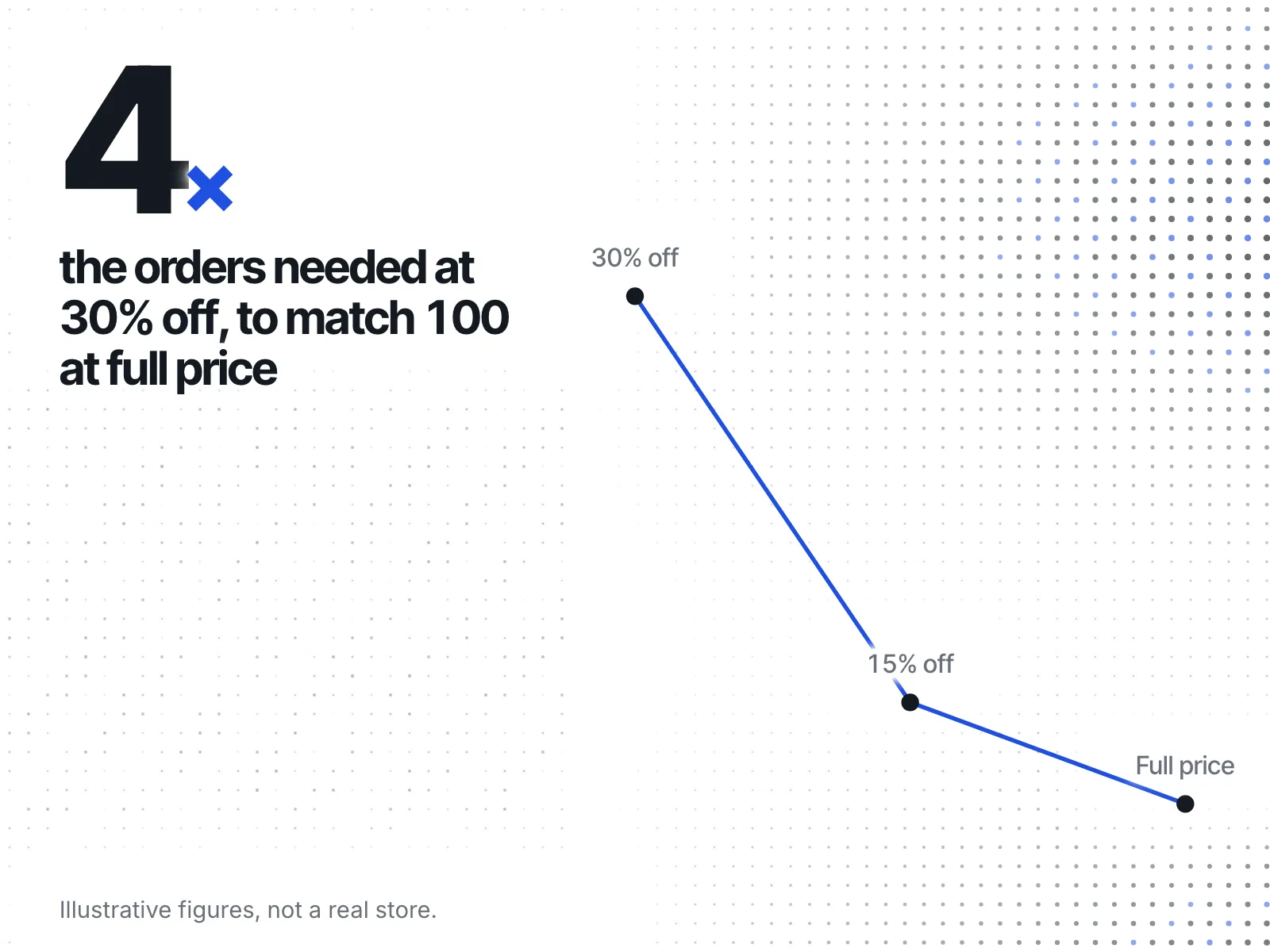
Work out profit per order at full price and at each discount you're weighing, then count how many discounted orders it takes to earn what 100 full-price orders would. That ratio is your margin clock. Every extra sale day has to beat it, or starting early just spreads the same profit thinner.
Here is a worked example. The numbers are made up to show the method, not taken from any real store.
Say you sell candles at $40. Each one costs you $16 to make and ship, and on average you spend $8 on ads to win an order. At full price you keep $16 per order. Now look at two discounts:
| Price point | Price | Product and shipping | Ad cost per order | Profit per order | Orders to match 100 at full price |
|---|---|---|---|---|---|
| Full price | $40 | $16 | $8 | $16 | 100 |
| Early teaser, 15% off | $34 | $16 | $8 | $10 | 160 |
| Weekend cut, 30% off | $28 | $16 | $8 | $4 | 400 |
Hypothetical figures for illustration only.
At 15% off you need 1.6 times the orders to stand still. At 30% off you need four times. Run the 30% cut for three and a half weeks and, to match a normal month's profit, you'd need roughly four times your usual order volume across that stretch. A 15% teaser now and 30% for the weekend asks far less of the weeks in between.
Then run the two checks that sit next to margin:
- Stock on the hero products. List the few products that will carry most of your orders. If an early discount sells them out before the 27th, you go into the busiest weekend with nothing to put in the ads. What to do if a competitor sells out mid-sale covers the other side of that.
- What you already promised. Open the last two emails you sent and any ad still running. If they said "Black Friday starts on the 27th" or "our biggest sale of the year", a deeper discount on the 3rd breaks that promise to the people who read it.
Write the three answers down before you open a rival's site.
What have your competitors actually done?
Before you assume rivals have started, check three things on each one. Open each rival's best sellers and note the sale price and compare-at price, look for a new sale banner or collection, and search their brand in the Meta Ad Library to see whether Black Friday creative is running yet. A banner alone is not a sale.
The full method, store by store, is in how to see when competitors start their Black Friday sale. The short version is three questions:
- Is it real or a banner? A homepage that says "Early Black Friday" with prices unchanged on the products you compete with isn't a sale you have to answer.
- How deep, on what? A rival with 10% off one collection is running a narrow early offer, whatever the banner says.
- Are they paying to push it? Meta's Ad Library lets anyone "search for all active ads running across products from Meta." Creative that names Black Friday means they're spending on the early start, not just hoping.
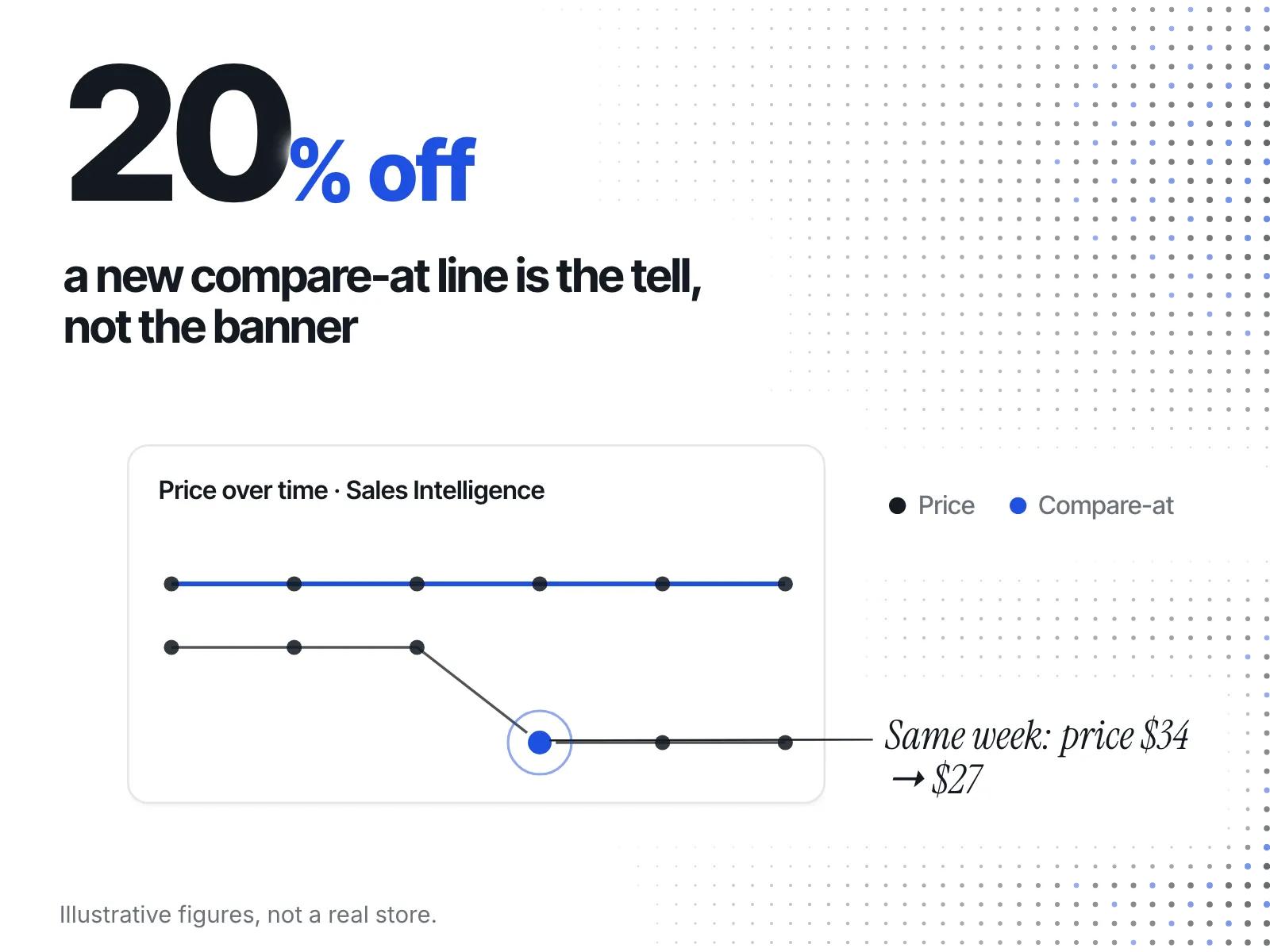
Doing this by hand shows you only today. ecvision, a competitor-tracking app for Shopify stores, keeps the history for the stores you watch. The Dashboard's "This week" view shows each watched store's "New products", "New ads" and "New sales" next to the period before. On the Products page, the Sales Intelligence tab charts a rival product's "Price over time" with its Price and Compare-at lines, marks each price change as old price → new price, and shows the discount as a percentage. You can see when the rival's compare-at price appeared, which tells you whether their early deal is a cut or a relabel.
What you find feeds the decision, not replaces it. If rivals are 10% off on a few products, your narrow offer already matches them. If one went 30% off sitewide on 1 November, look at your margin clock again before you follow. Then decide how deep to go as a separate question.
Can you still call an early price a Black Friday deal?
An early price can be a Black Friday deal if the discount is real; the "was" price is where stores slip. Under the US Federal Trade Commission's former-price guide, a compare-at price must be what you charged the public, regularly, for a reasonably substantial period. Raising it in October so November's cut looks bigger is a false comparison.
The guide, 16 CFR §233.1, says a former price is a legitimate basis for a comparison "if the former price is the actual, bona fide price at which the article was offered to the public on a regular basis for a reasonably substantial period of time." In Shopify, that former price is the Compare-at price field, which Shopify tells you to set to "the original price of the product." Leave it at your real regular price. The plain-English version is in what compare-at price means on Shopify.
Two more limits come from your customers rather than the regulator:
- An early price that drops again on the 27th. If you sell something at "Black Friday 15% off" on 5 November and then at 30% off on the day, the early buyers will notice. Call the early offer what it is, an early-access or preview price, and keep the Black Friday name for the weekend.
- An early-access claim. If you say "early access for subscribers", make it subscriber-only. Shopify's discount eligibility lets you pick "Specific customers" or a customer segment, which Shopify describes as "groups of customers who have similar characteristics." That's set on the discount, per Shopify's guide to managing discounts.
How do you set up a narrow early offer in Shopify?
Create the early offer as its own discount, limit who can use it, and give it its own active dates. Keep the weekend discount separate. Two discounts with two date ranges are easier to check than one discount you edit on the 26th.
- Make a separate discount for the early offer. One product, one collection or one bundle.
- Narrow the eligibility to a customer segment, such as your email subscribers or past buyers, or to specific customers.
- Set its active dates so it ends before the weekend discount starts. A discount "keeps its own active dates", per Shopify's discount help page.
- Schedule the weekend discount ahead of time. Shopify lets you "add a discount to a rollout to schedule when the discount is activated or deactivated." Rollouts are "available on the Basic plan or higher".
- Check the timeline. Shopify's discount timeline "displays the date and time that a discount is created, as well as when a discount is active or expired." Look at it the evening before each switch.
The checklist
Your ads are a separate timing call, covered in when to start Black Friday ads. So is the end of the sale: whether to extend into Cyber Monday is easier when you planned the start.
- Work out profit per order at full price and at each discount.
- Count the orders each discount needs to match 100 at full price.
- List your hero products and the stock you have on them.
- Re-read what your emails and ads already promised about dates.
- Check rivals' product pages, compare-at prices and active ads, not just their banners.
- Pick one option: full sale now, narrow early offer, or hold.
- Keep compare-at prices at your real regular price.
- Build the early offer as a separate Shopify discount with its own dates and eligibility.
- Schedule the weekend discount ahead.
- Watch orders, stock and rivals for a week, then hold or adjust.