When to Start Black Friday Ads: A 2026 Timeline
Start Black Friday ads in early November, not on the day. Why Meta's learning phase rewards a warm-up, how to read a rival's timing, and dated steps.
Thomas Pham · · Updated · 8 min read
Start Black Friday ads between 6 and 13 November 2026, two to three weeks before Black Friday on 27 November and Cyber Monday on 30 November, so your ad sets are warmed up, not starting from zero on the day.
Updated 6 November 2026: Adobe forecasts $275.1 billion for the season, with Cyber Week at $47.5 billion (up 7.4%), Black Friday $12.9 billion (up 9.2%), Cyber Monday $15.1 billion (up 6.2%) and discounts up to 30% off listed price in Cyber Week (Adobe).
Shoppers will see Black Friday prices weeks early. Target's Early Black Friday sale runs 5–7 November (Target, 21 October 2026). Walmart's early event runs 12–15 November, with a second event 23–29 November (Walmart, 26 October 2026). Amazon and Best Buy have not yet announced Black Friday sale dates.
When should Black Friday ads go live?
Warm-up and teaser ads should go live two to three weeks before Black Friday, which in 2026 means 6 to 13 November. The ad sets that will carry the sale should be live, with warm-up creative, well before Thanksgiving on 26 November. The sale creative then switches on inside them when your sale opens, so the weekend is spent selling, not setting up.
The dates come from the calendar. US law fixes Thanksgiving as "the fourth Thursday in November", which puts Black Friday on 27 November and Cyber Monday on 30 November this year.
The lead time matches what Shopify tells its own merchants. Among the tips in its BFCM campaign guide is "Begin social and email promotions two to three weeks before BFCM." It gives other windows for other tactics; the pattern is that the build-up starts weeks out.
Why is launching on the day a bad idea?
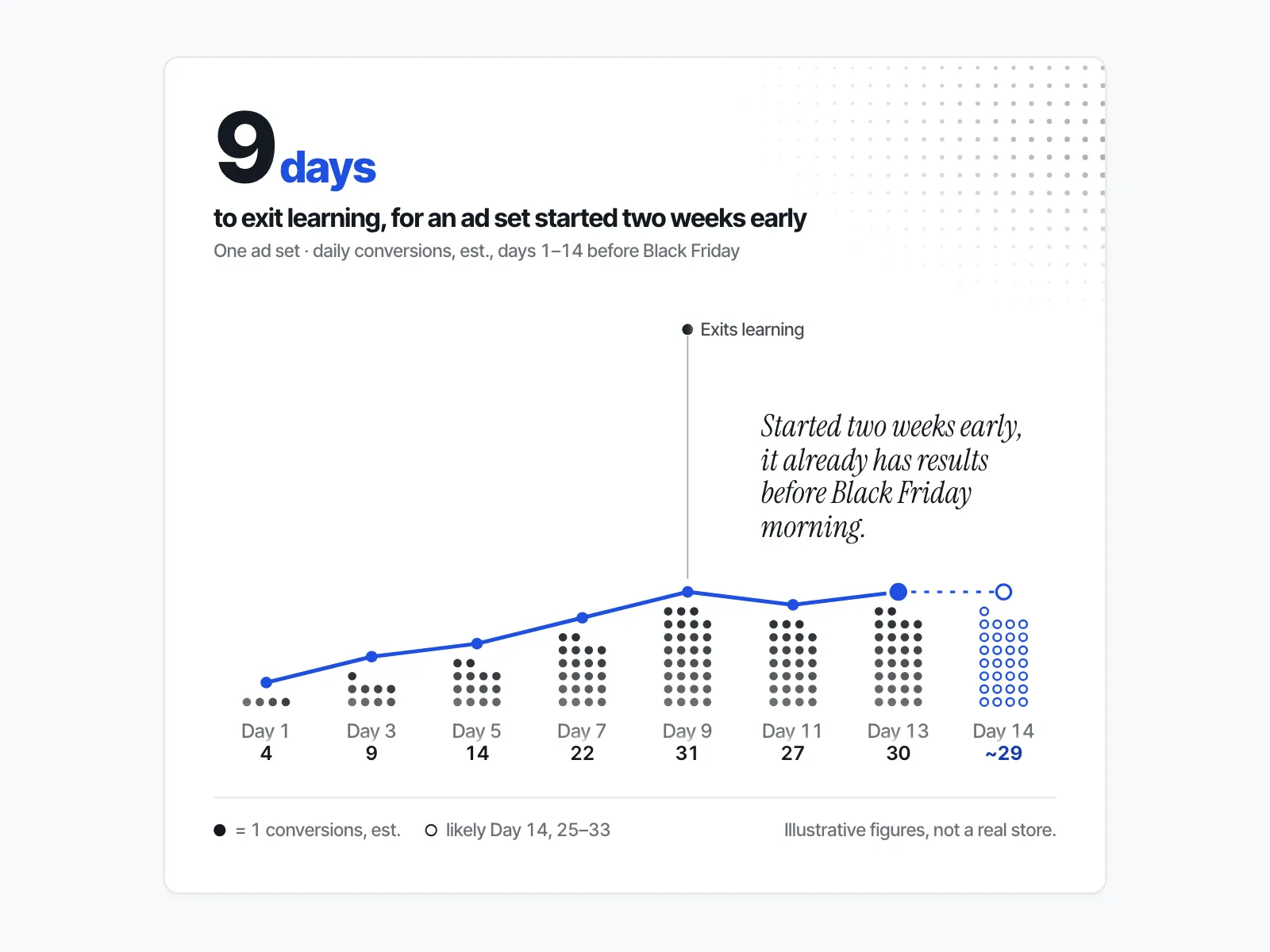
A brand-new Meta ad set starts in a learning phase, with no results of its own yet. Created on Black Friday morning, it is still learning during the hours that matter most. An ad set switched on a week or two earlier has had time to collect results before the rush.
Meta's own Marketing API reference describes three states for an ad set:
LEARNING: "The ad set is still learning."SUCCESS: "The ad set exited the learning phase."FAIL: "The ad set isn't generating enough results to exit the learning phase."
The same page counts conversions "since the time of its last significant edit during the learning phase." The learning clock runs on results, and results take time.
Meta does not publish a fixed number on that reference page. It lists fields for a "New conversions threshold for dynamic learning phase status" and a "Day to exit for dynamic learning phase", which means the bar is worked out per ad set rather than printed as one figure. So don't plan around a magic number. Plan around giving each ad set as many quiet days as you can before the weekend.
What puts an ad set back into learning?
A significant edit puts a Meta ad set back into the learning phase. Meta says: "Significant edits cause ad sets to reenter the learning phase." It even stores the "Timestamp of the last significant edit that caused ad set to reenter the learning phase." A big change on Thanksgiving night can undo the warm-up you paid for.
The page doesn't list which edits count, so treat any large change to a warmed-up ad set as a possible reset, and make it early.
Rewriting the audience and doubling the budget the night before the sale may put a warmed-up ad set back in learning on the day it matters most.
Two habits avoid it:
- Build the sale ad sets early. Launch them as early-access or list-building ads in the warm-up weeks, so the ad set that carries the sale already has history.
- Decide the weekend changes in advance. If a change has to happen, make it days before 26 November, not on the night.
How can you tell if a rival has already started warming up?
Search each rival's name in the Meta Ad Library and Google's Ads Transparency Center now, then weekly, and write down the date of every visit. A rival whose library shows early-access, teaser or "join the list" ads in the first half of November is warming up. A rival with only evergreen ads until the sale is launching on the day.
Here is what each library promises, from its own help pages.
| Library | What its help page says it shows | What it does not say |
|---|---|---|
| Meta Ad Library | "People can search for all active ads running across products from Meta." (Meta) | How long an ordinary, non-political ad stays visible once it stops running |
| Google's Ads Transparency Center | "the ads they have served over a certain time period", across "Search, Display, Gmail, and YouTube" (Google) | What that time period is, or whether an ad is still live |
Two things follow from that table.
First, you cannot count on last year's Black Friday ads still being there. Meta's page keeps social-issue, election and political ads "for 7 years", but says nothing about how long an ordinary shop's ad stays once it stops. Google gives no date range at all. Start keeping your own record this year.
Second, your own dated notes are the evidence. A library search shows you what is live at the moment you look. Compare two visits a week apart and you have something neither help page promises you: when the new ads appeared. For the full tour of what each library's screens show, see our comparison of Meta's Ad Library, Google's Transparency Center and TikTok's library.
A worked example
Say you sell scented candles, and you watch two rivals. This example is made up.
On your first visit in early November, both rivals show only their usual product ads. A week later, Rival A has new ads offering early access to its Black Friday sale for people who sign up. Rival B looks exactly the same as before.
Rival A is warming up. Its sale ad sets are already collecting results, and it is building a list it can email the moment the sale opens. Rival B is either launching on the day or not advertising much at all. That second reading is a real possibility: a brand on a small, always-on budget may never show a warm-up, so treat silence as "unknown", not as a plan.
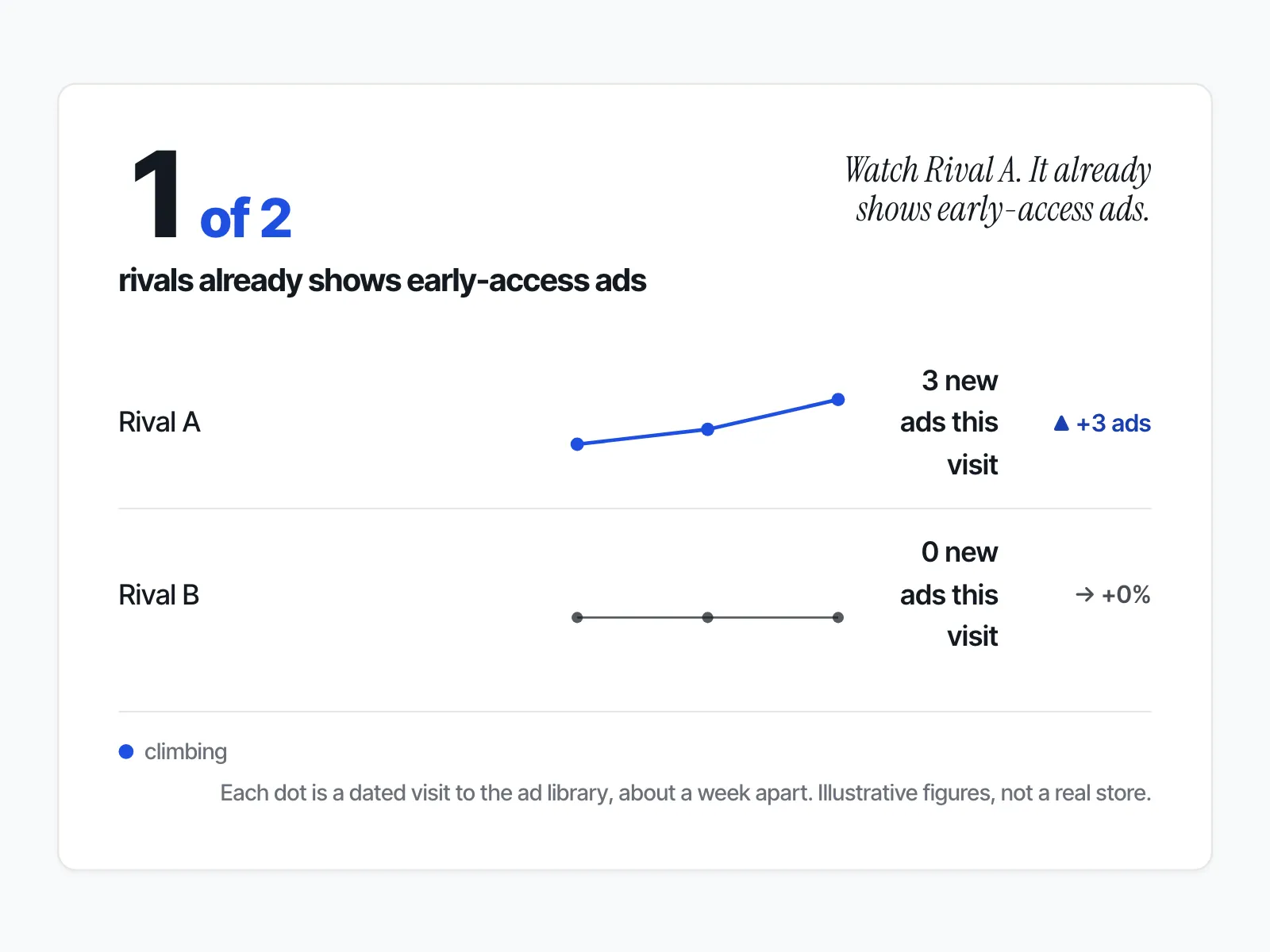
What you do with it: Rival A's early access tells you its shoppers will hear about the sale before yours do, so your own list-building ads should already be live. If you want to know when Rival A's sale itself starts, that is a different check, covered in how to see when competitors start their Black Friday sale.
One warning. A rival's ad that has run for weeks is a sign of what it chose to keep, not proof that it works. If you are tempted to copy one, read how long to watch a competitor's ad before copying it first.
What does a Black Friday ad timeline look like for 2026?
Work backwards from Black Friday, 27 November 2026. Have creative ready by early November, put warm-up ads live from 6 to 13 November, settle the sale ad sets by the week of 16 November, and plan the Cyber Monday change before the weekend starts. Each step leaves room for learning before the next one.
| Date (2026) | Step | What to do |
|---|---|---|
| By Fri 6 Nov | Creative ready | Teaser, early-access and sale ads written and approved. Sale creative ready even if it is not live yet. |
| Fri 6 – Fri 13 Nov | Warm-up live | List-building and early-access ads running in the ad sets you will use for the sale. First dated check of each rival's library. |
| Mon 16 – Fri 20 Nov | Settle | Last significant edits to targeting and budget. Second dated check of rivals. |
| Mon 23 – Wed 25 Nov | Hold | No big edits. Sale ads queued. Third rival check: who has switched to sale copy? |
| Thu 26 Nov | Thanksgiving | Sale ads switch on in the warmed ad sets, if your sale opens early. |
| Fri 27 Nov | Black Friday | Watch, don't rebuild. |
| Mon 30 Nov | Cyber Monday | The change you planned in advance, not one made up on Sunday night. |
What rivals change between Friday and Monday is its own question. We wrote it up in what competitors change from Black Friday to Cyber Monday.
What should you write down about each rival?
For each rival, note the date of your visit, whether any new ads appeared since the last visit, and whether those ads name a sale, early access or a sign-up. Three or four dated visits between now and Thanksgiving tell you more than one long session on Black Friday.
Keep it to a short list, one line per rival per visit:
- Date of the visit. Everything else depends on it.
- New ads since last time. Yes or no, and roughly what they offer.
- Sale language. Does the copy now name a discount, early access or a deadline?
- Where they run. Meta, Google, or both. TikTok has its own library, covered in the comparison post above.
How ecvision keeps that log for you
Doing those visits by hand works for two rivals. It gets old fast at five. ecvision, a competitor-tracking tool for Shopify stores, does the dated part on its Dashboard for the stores you track.
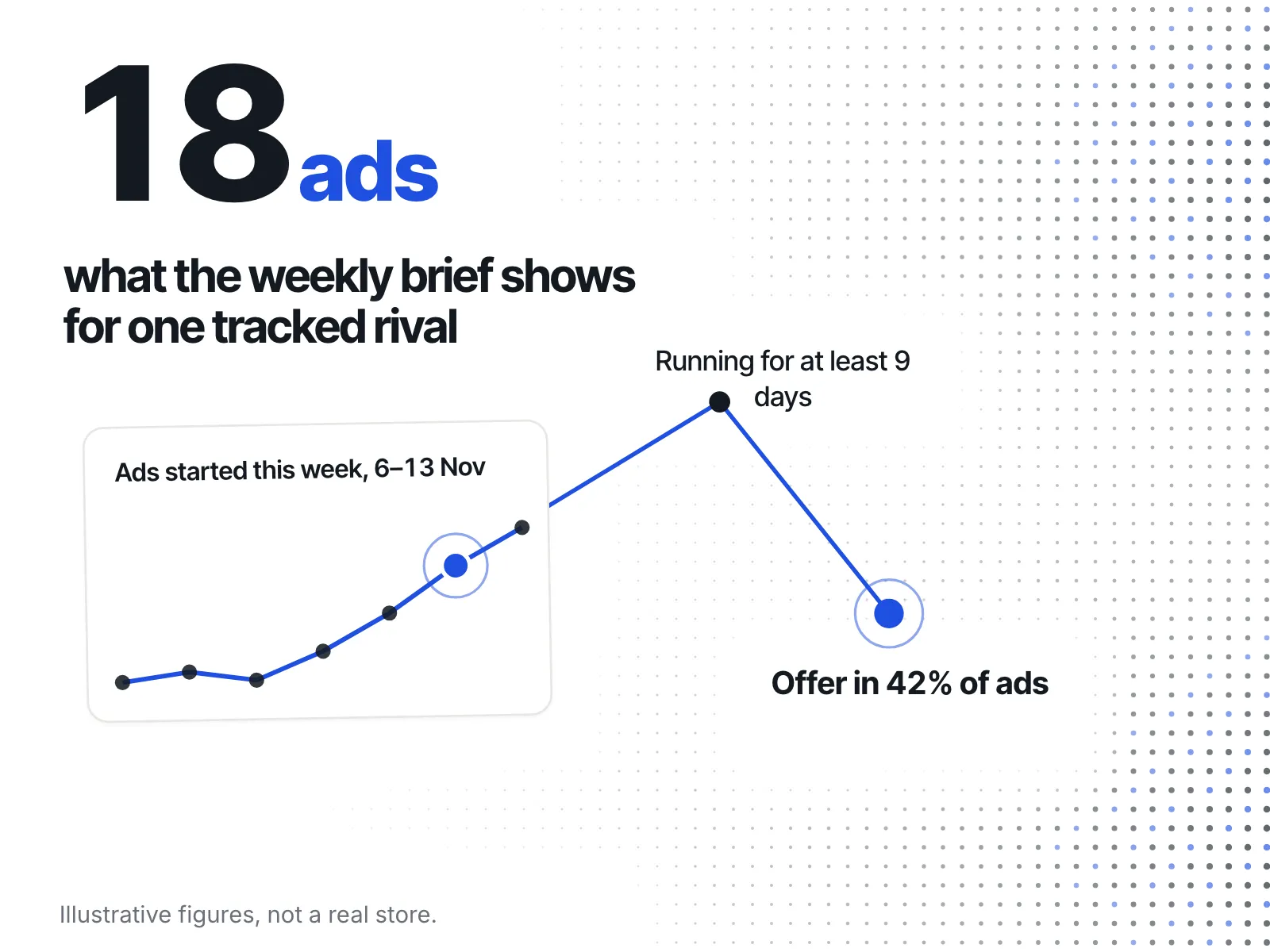
The weekly brief has a strip headed "Ads started this week", followed by the week's dates, so a rival's new warm-up ads show up with the week they started. When nothing new started that week, the strip reads "Newest ads" instead, which is itself an answer. Each store's weekly detail also shows "New ads" this week next to the week before, so a jump in early November stands out.
On the Ads screen, every ad carries a "Running for" figure. For a live ad it is shown as at least that many days, because Meta reports a live ad's end as the date it was last seen, so the true run can only be longer. The same screen has an "Offer" mix across the ads in view, with a caption that reads "Offer in" a share of the ads, then "urgency" and its share, plus a "No offer" slice. Open it on each visit and you can see whether a rival's live ads are moving toward sale copy. That reading is yours to make across visits; the screen shows the current mix, not an alert when it changes.
If you want that log running before the warm-up weeks start, the plans are on the pricing page.
Your Black Friday ad checklist
- Black Friday is 27 November 2026; Cyber Monday is 30 November.
- Warm-up ads live between 6 and 13 November.
- Sale ads built in ad sets that already have history, not new ones made on the day.
- Big edits done by 20 November, because significant edits send an ad set back into learning.
- A dated check of each rival's ad library every week until Thanksgiving.
- Silence from a rival logged as unknown, not as "not running a sale".