Should a clothing brand match a rival's Black Friday sale?
A rival clothing brand just went 30% off for Black Friday. Before you match, run the returns maths: in apparel it decides whether the discount pays.
Thomas Pham · · Updated · 8 min read
A rival clothing brand has announced 30% off for Black Friday, and you're wondering whether to match it. A clothing brand should match a rival's Black Friday sale only if the discount still makes money after returns, because roughly one in four online apparel orders comes back (Coresight Research). That is why the same 30% can pay for one brand and lose money for another. Work out your own number before you copy theirs.
Updated 27 October 2026.
Black Friday 2026 key facts (as of 27 October 2026):
- Black Friday 2026 is Friday, 27 November, the day after US Thanksgiving (5 U.S.C. § 6103).
- Cyber Monday 2026 is Monday, 30 November.
- Shopify merchants sold a record $14.6 billion worldwide over Black Friday Cyber Monday 2025, up 27% on 2024 (Shopify, 2 December 2025).
This is the clothing version of a question every store faces. Home goods have their own version; otherwise, start with the general match-or-hold framework. What follows is the apparel part: size runs, compare-at prices and returns.
What does a rival's Black Friday price actually tell you?
A rival's sale page tells you their current price and the "was" price they chose to show next to it. It doesn't tell you their margin, their return rate, or whether that "was" price was ever really charged. The useful number is the price they are actually selling at now, compared with what they sold at before the sale.
The strike-through price is the rival's own claim. The US Federal Trade Commission's guide on former-price comparisons says a "was" price should be "the actual, bona fide price at which the article was offered to the public on a regular basis for a reasonably substantial period of time". So a banner reading "50% off" may be measured from a price the shop raised a fortnight ago, or from one it held all year. The banner can't tell you which.
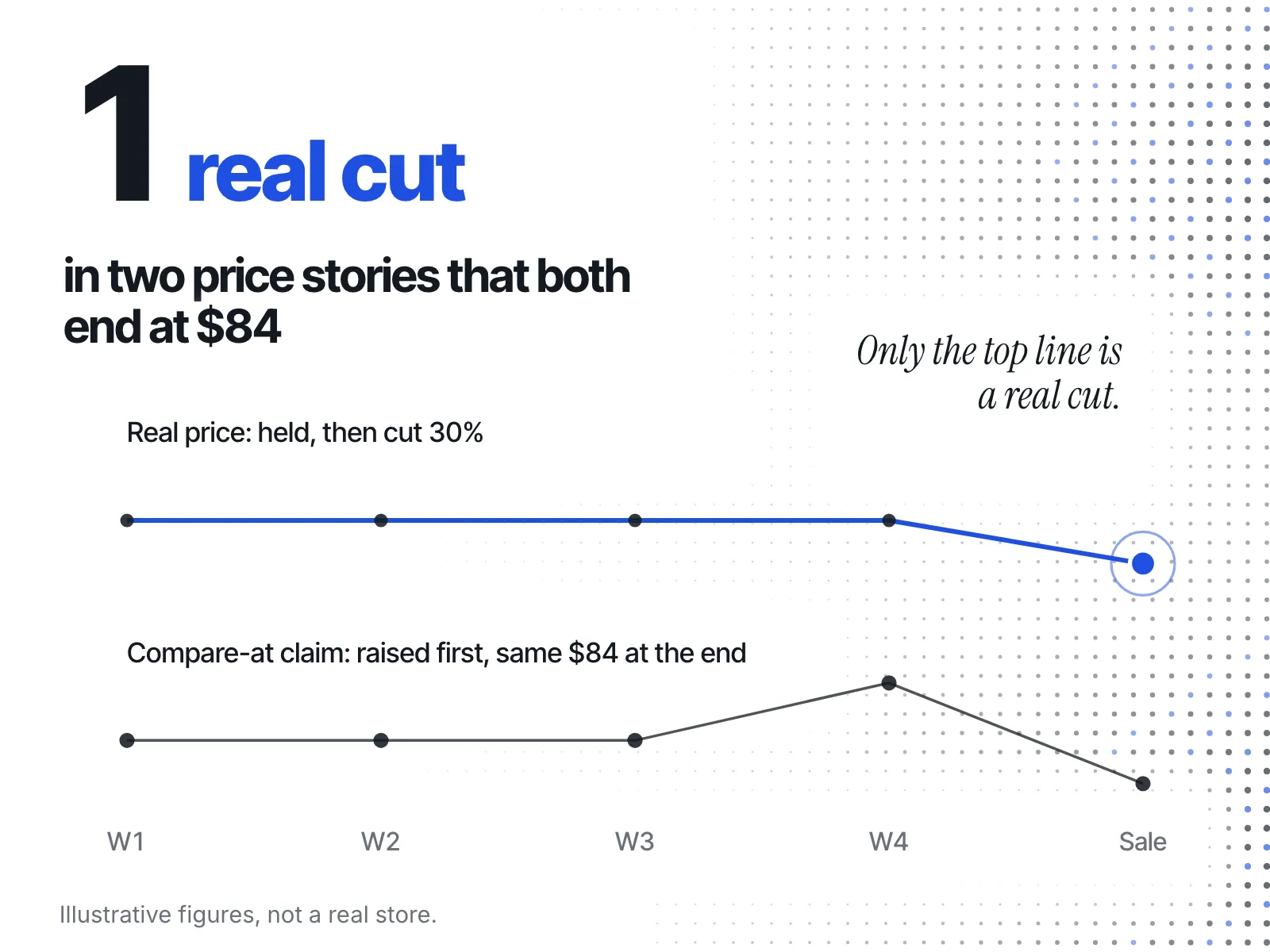
Look at the price history instead. If a jacket sold at $120 for months and is now $84, the real cut is 30%. If its compare-at price jumped to $168 just before the sale, the banner can say 50% off while the customer pays the same $84. Matching that banner would mean matching a number the shopper never paid.
Two apparel signals are worth reading alongside the price:
- Which sizes are left. A discount on a style with only the smallest and largest sizes left (say XS and XXL) looks more like clearing the end of a size run than starting a price war. You don't need to answer that with a sitewide cut.
- Sold-out badges. A "sold out" label on a discounted item hints at demand on that one product. It can't separate real demand from a small production run.
Should you match the percentage or the price?
Match the price on the products where you actually compete, not the percentage on the banner. A rival's 30% off a $90 base is a different offer from your 30% off a $60 base. What a shopper compares is the final price on two similar items, and that's the only gap you need to close.
In practice, list the rival products that sit closest to yours (same category, similar fabric, similar price band) and note each one's sale price. Then decide product by product. Matching on those, and leaving the rest of your catalogue at full price, protects most of your margin while you stay competitive where shoppers really compare.
To see how a rival's discounts moved across the year, building a rival's discount calendar from compare-at price walks through the method.
How do returns change the cost of a clothing markdown?
Returns make a clothing markdown cost more than its headline percentage. A discount cuts the margin on every order you keep, while each returned order still costs you shipping and handling. With an apparel-level return rate, you need far more extra orders to earn back a 30% discount than the discount alone suggests.
How high is that return rate? Coresight Research found that "the average return rate of online apparel orders in the US is 24.4%", which it puts 7.9 percentage points above the National Retail Federation's 16.5% average online return rate. Size and fit was the top reason (53% of those surveyed). That survey covered 100 US apparel businesses with revenue of $10 million or more, over the 12 months ended 6 March 2023. Treat it as a rough guide. Your own return rate, by style if you have it, is the figure to use.
A worked example (hypothetical numbers)
Say you sell a knit top at $40. Every number here is made up; swap in your own.
- It costs you $14 to make and land, and $6 to ship out.
- A returned order costs you the $6 you already paid to ship it, plus $5 to process the return. The top goes back into stock.
- One in four orders comes back (25%).
At full price, out of 100 orders, 75 are kept at $20 margin each ($40 − $14 − $6), which makes $1,500. The 25 returns cost $11 each, so $275. You net $1,225, or $12.25 per order placed.
Now run the same 100 orders at each discount:
| Offer | Price | Margin per kept order | Net on 100 orders | Orders needed to net $1,225 |
|---|---|---|---|---|
| Full price | $40 | $20 | $1,225 | 100 |
| 20% off | $32 | $12 | $625 | 196 |
| 30% off (the match) | $28 | $8 | $325 | 377 |
| 35% off (the beat) | $26 | $6 | $175 | 700 |
Matching at 30% means you need about 3.8 times your usual orders just to stand still. If you ignored returns, the same maths would say 2.5 times ($20 margin falling to $8). The difference is the cost of the 25 returns, which stays the same while the margin on each kept order shrinks. Going one step deeper to 35% pushes the bar to 7 times.
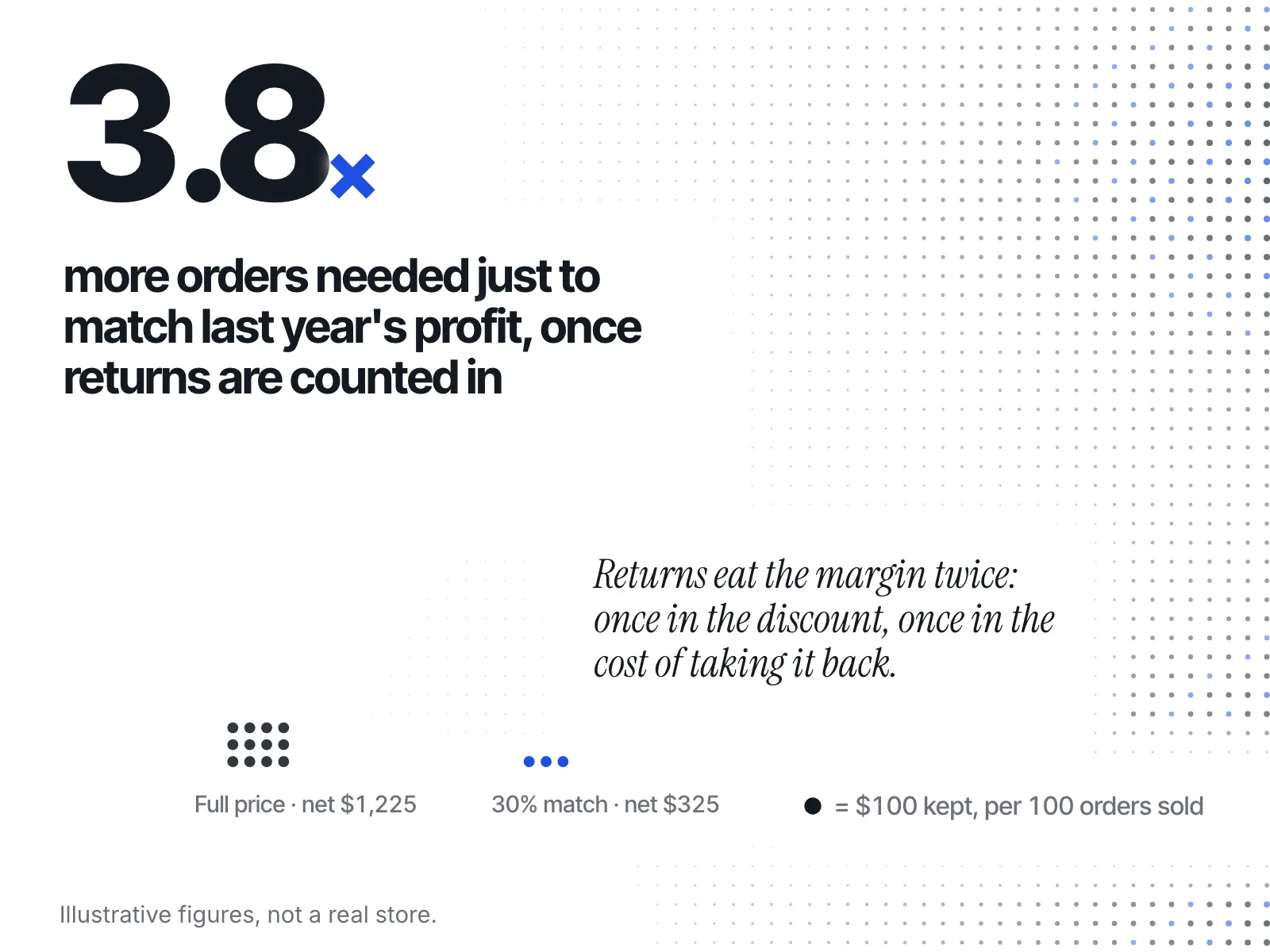
The steps carry over to any product: margin per kept order, minus the cost of returns, then the orders you'd need to get back to full-price profit. A brand with a lower return rate or a fatter margin gets a much lower bar from the same 30%, which is why one brand's sensible match is another brand's loss.
When should you hold your price?
Hold when the orders you'd need are more than a sale could plausibly bring in, or when the rival's discount is aimed at stock you don't compete with. While you hold, you can still give shoppers a reason to buy that costs less than a markdown.
Signs that holding is the better call:
- The rival's real price, from their history, has barely moved, and the "50% off" is mostly a raised compare-at price.
- Their discount sits on styles with broken size runs, which looks like end-of-line clearance.
- Your return rate on the styles in question is high, so the table above punishes you hardest.
- Your customers buy you for fit or fabric, and the overlap with the rival's sale items is small.
If you hold, decide what you offer instead before the week starts. A free-shipping threshold, a gift with purchase or early access for your email list each costs you something, but a known one. In the worked example above, free shipping costs $6 an order; a 20% markdown takes $8 from every kept order.
When should you beat a rival's discount?
Beat a rival's discount only on a product where the sums still work at the deeper price, and where winning that shopper is worth more than the margin you give up. That usually means a style with a low return rate and a high margin, used to bring in new customers.
Beating a rival across your whole catalogue rarely survives that maths in apparel. Beating them on one hero product can, if that style rarely comes back and you expect those buyers to order again at full price later. Pick it deliberately, cap the stock you put behind it, and know your break-even order count before it goes live.
When is matching simply the right call?
Matching is the right call when your margin and your return rate already clear the bar. If you run the table with your own numbers and the orders needed look achievable for a Black Friday weekend, match the price on the overlapping styles and move on.
It's also sensible when you were going to run a sale anyway. If you had 25% off planned and a close rival goes to 30% on similar items, matching on those items may cost you little extra. The table tells you how much. Plain matching is often right, as long as you've checked the sums rather than assumed them.
How do you watch a rival's price without checking by hand?
Record each rival product's price and compare-at price every day, from a few weeks before the sale until after Cyber Monday. That shows the real cut and when it started. By hand, that's fine for three rivals and painful for ten.
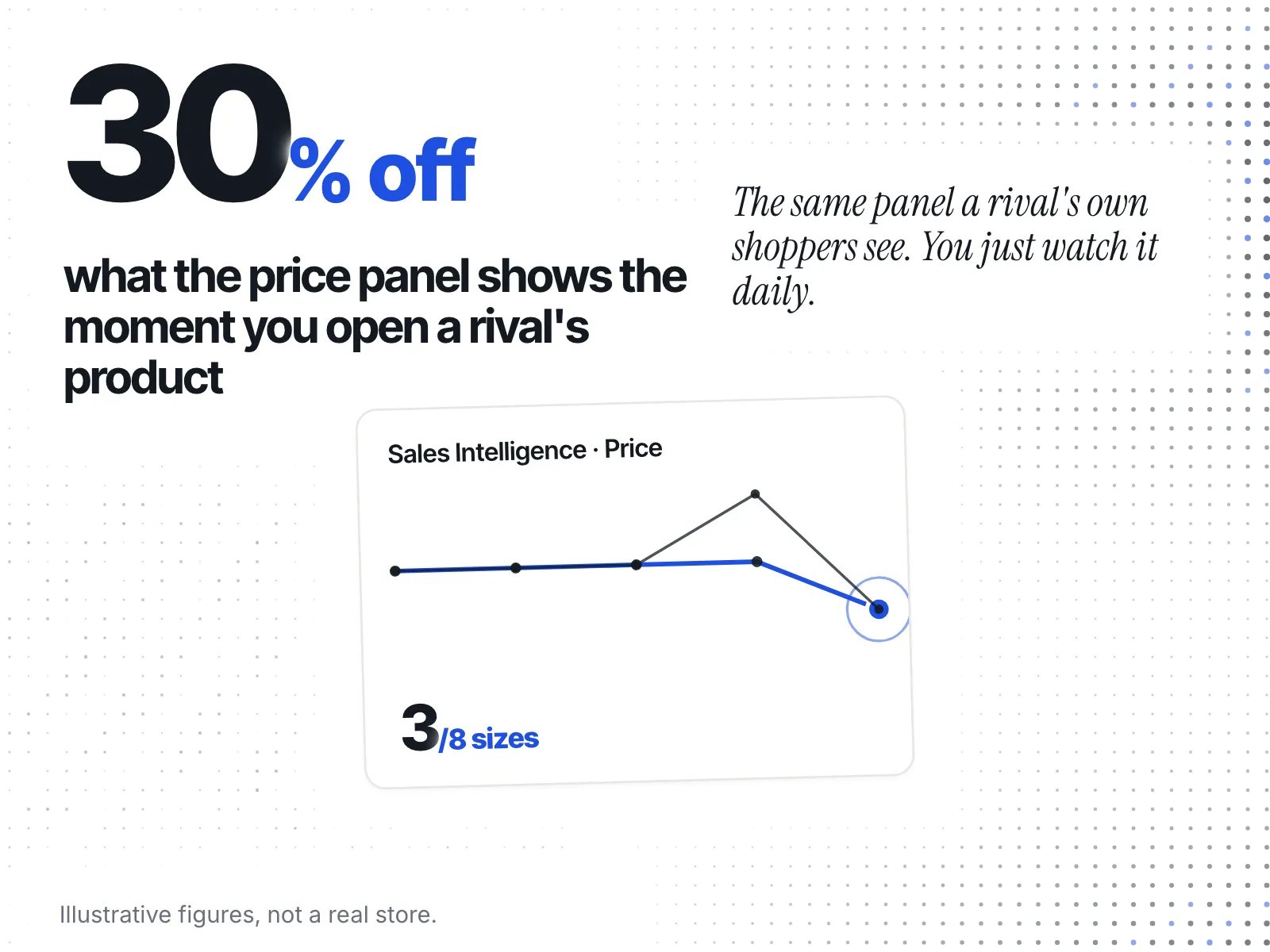
ecvision, a Shopify competitor-intelligence app, does this from the Products page. On its Sales Intelligence tab, open a rival's product. Its price panel, headed "Price ·" and the time window, draws two lines: Price and Compare-at. A badge in the panel's header shows the current percent off the compare-at when the product is marked down. That's the step-one question answered directly: did the price actually drop, or did the "was" price go up? The same product's sales card also shows a Sizes reading, sizes in stock out of sizes, so you can see whether a discount sits on a broken size run. Plans are on the pricing page.
What can't any of this tell you?
None of this shows you a rival's margin, their return rate or how many units their sale moved. A compare-at price is their claim, a sold-out badge is a hint, and a price history shows what they did, not whether it worked for them. Only your own costs and returns can tell you whether matching works for you.
A checklist for the weeks before Black Friday
- List the rival products that compete directly with yours, style by style.
- Record each one's price and compare-at price daily, starting now.
- When a rival's sale goes live, compare their sale price with their pre-sale price, not with the strike-through.
- Check which sizes are left on the discounted styles.
- Pull your own return rate, by style if you can, and your cost per return.
- Run the table: margin per kept order, cost of returns, orders needed to get back to full-price profit.
- Decide per product: match the price, hold with a cheaper offer, or beat it on one chosen style.
Sources
Read on 22 October 2026; the Shopify figure on 27 October 2026.
- Legal Information Institute, 5 U.S. Code § 6103, Holidays: the Thanksgiving date.
- Shopify, Record-breaking $14.6 billion in BFCM sales (2 December 2025): merchant sales over BFCM 2025.
- Legal Information Institute, 16 CFR § 233.1, Former price comparisons: the FTC rule on former prices.
- Coresight Research, The true cost of apparel returns: apparel return rates and reasons.