Beauty Black Friday gift sets: what to check on a rival
How beauty brands build Black Friday gift sets, how to check a rival's value claim against its own singles, and what a set page can't tell you.
Thomas Pham · · 8 min read

Is a rival's Black Friday gift set actually a good deal, and should you answer it? To check a rival beauty brand's Black Friday gift set, price each item as a single on the brand's own site, add up the regular and sale prices, and compare both totals with the set's price and stated "value". Do it before Black Friday on 27 November 2026.
Cyber Monday is 30 November. Black Friday falls the day after Thanksgiving, which US law fixes as "the fourth Thursday in November" (5 U.S.C. §6103). Rivals' holiday sets were already live on 10 November.
What gift-set mechanics do beauty brands use for Black Friday?
On 10 November 2026, the own pages of e.l.f., Tarte, Clinique and Rare Beauty showed five mechanics: a set with a stated "value", a set priced below its singles, a gift with purchase (GWP) above a spend threshold, a gift for buying more than one set, and a set marked as excluded from a sitewide promotion.
| Mechanic | Real example, read 10 Nov 2026 | What the page says |
|---|---|---|
| Value claim | e.l.f. 24-Day Advent Calendar | "O.M.G. value: $153 worth of beauty for $95." (e.l.f.) |
| Set vs singles | Tarte sculpt tape & blush tape duo | "Regular price $72 Sale price $36" (Tarte) |
| GWP at a threshold | Clinique | "Get a free 5-piece gift with eligible $95 purchase.*" (Clinique) |
| Gift for buying sets | Rare Beauty | "Buy 2+ Holiday Sets, Get A Free Clutch." (Rare Beauty) |
| Set excluded from a promo | Tarte maracuja juicy lip trio | "Excluded from promotions" (Tarte) |
Rare Beauty's threshold is a count of holiday sets, not a dollar amount. It is built to push a shopper towards a second set rather than towards any second product.
No dedicated mini or travel-size set is in the table: none could be confirmed live on a brand's own page on 10 November. Minis still turn up inside bigger sets. e.l.f.'s calendar lists "4 Mini Skincare items" and "2 Mini Primers" next to its full-size pieces, and sums itself up as "18 full-size products and 2 advent-only exclusives" (e.l.f.). When you log a rival's calendar, count the minis separately. A mini fills one of the 24 days, but it is not a full size.
How do you check a "$X value" claim on a rival's gift set?
Open each item in the set as a single product on the same site, note its current price and its regular price, and add them up. Compare both totals with the set's price and its stated value. If the value matches the singles' regular prices, the claim is consistent with the brand's own pricing. It still says nothing about sales.
Here is that check, done on Tarte's sculpt tape & blush tape duo on 10 November 2026.
- Read the set. The duo holds a "full-size blush tape™ liquid blush" and a "full-size sculpt tape™ contour". Its page shows "Regular price $72 Sale price $36". Elsewhere on the same page it shows "Regular price $36", with no $72 next to it (Tarte duo). One page, two different regular prices.
- Price the first single. Blush tape liquid blush: "Sale price $22", "Regular price $36" (Tarte).
- Price the second single. Sculpt tape contour: "Sale price $22", "Regular price $36" (Tarte).
- Add the regular prices. $36 + $36 = $72. That matches the duo's $72 exactly. So the $72 is the two full sizes at their own regular prices.
- Add today's sale prices. $22 + $22 = $44. The duo's sale price is $36. Bought as a set, the pair is $8 cheaper than the two singles at their own sale prices that day.
- Note the stock line. The duo showed "Out of stock" with a "join the waitlist" option.
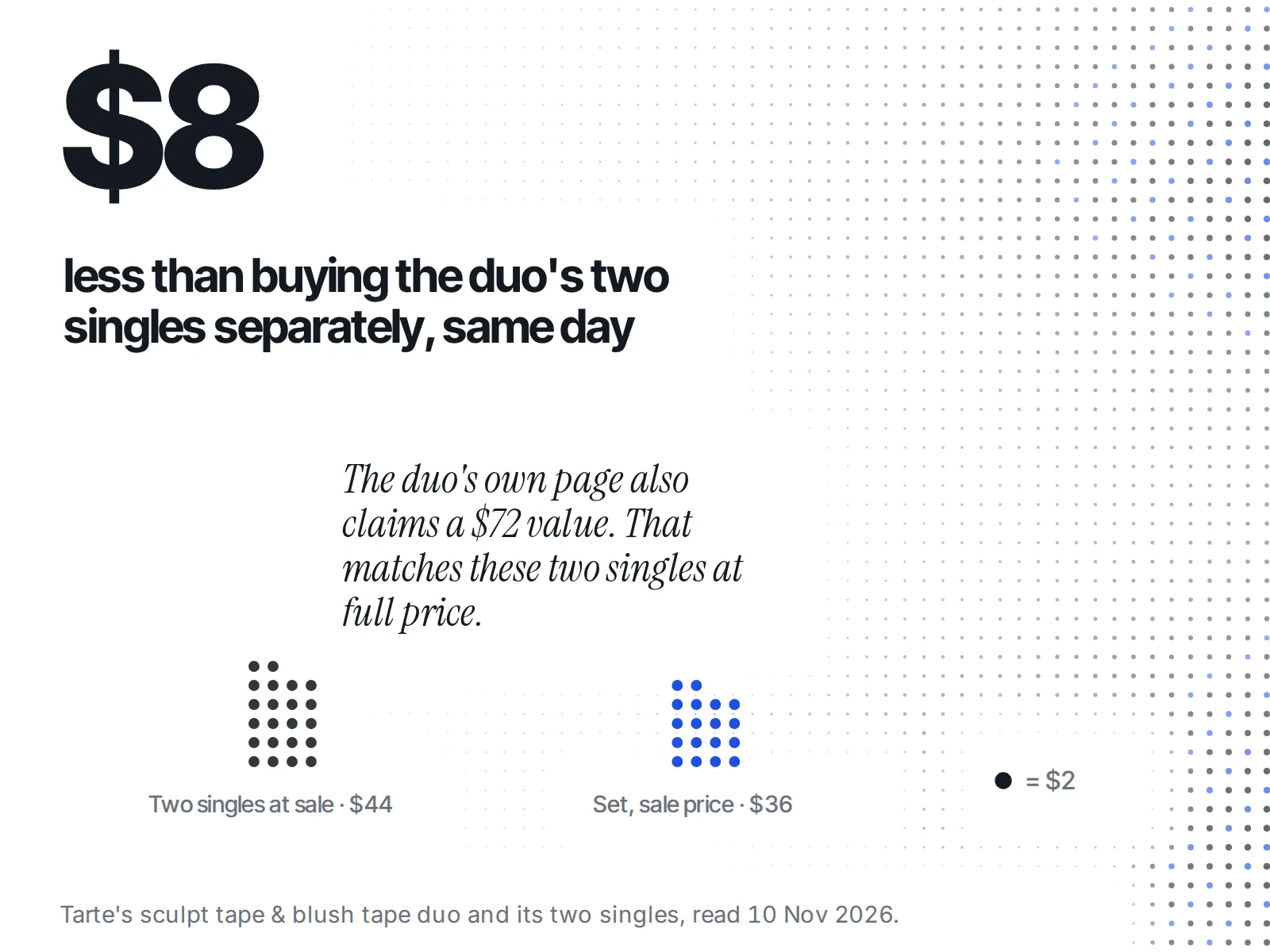
What this shows: the $72 checks out against the singles' regular prices, and the set is a real saving against the singles' sale prices. It does not explain the second "Regular price $36" on the duo's page. Treat a mismatch like that as a sign of a rushed promo page, not proof of bad faith.
The same check works on Tarte's lip trio. Its page shows "Regular price $30" and "You'll Save $51!" (Tarte lip trio). The page doesn't say what the $51 is measured against, so the only way to test it is to price the three lip products as singles.
If a rival's set also shows a struck-through price, our post on whether a competitor's Black Friday was-price is real goes deeper on compare-at prices.
What do the FTC pricing guides say about "value" claims?
The FTC's Guides Against Deceptive Pricing cover "comparable value comparisons" in 16 CFR §233.2. Their example is a "Retail Value $15.00, My Price $7.50" pen ad, which "would be deceptive" when only a few small outlets charge $15 (text via Cornell LII). Pricing the singles is how you see what a value figure rests on, for a rival's set and for your own.
When does a gift with purchase kick in, and what does the threshold tell you?
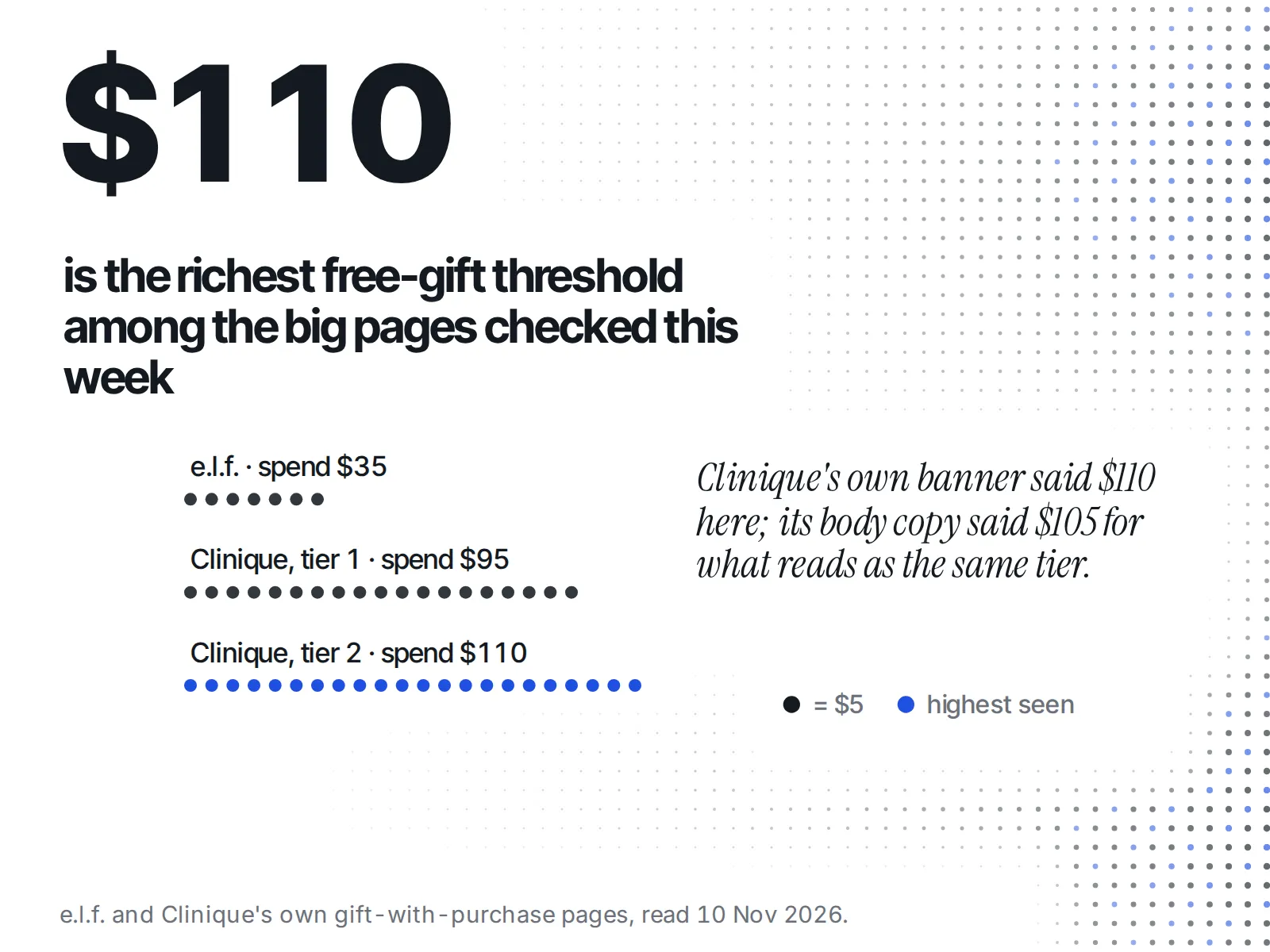
A gift with purchase (GWP) kicks in at the spend the brand picks, and that number is the useful part. It tells you the basket size the rival is reaching for. On 10 November, e.l.f. asked for $35, and Clinique ran two tiers, one of which showed two different thresholds on the same page.
e.l.f.'s offer is simple: "up to a $9 value! Just spend $35+ and add to cart—no promo code needed!" (e.l.f.).
Clinique's gifts-with-purchase page is tiered. Tier one: "Get a free 5-piece gift with eligible $95 purchase." Tier two's banner reads "Free full-size gift. Spend $110, get a free Moisture Surge™ Face Spray." The body copy for what reads as the same tier says "Get yours with eligible $105 purchase.* Very limited quantities." That is $110 in one place and $105 in another. Log both numbers and the date.
Two things to take from a threshold:
- Where it sits. You don't know the rival's average order. You do know the number they chose, and whether it sits just above the price of their hero product or needs two items to reach.
- Whether it moved. A threshold that drops in Black Friday week is a change you can date.
The FTC guide on offers tied to a purchase, 16 CFR §233.4, says "all the terms and conditions of the offer should be made clear at the outset" (text via Cornell LII). It also warns against raising the regular price of the item the shopper must buy.
What should you log for each rival gift set?
Log seven things per set, with the date you read them: set price, stated value, each single's current and regular price, full-size or mini per item, any GWP threshold, when the set went up, and any exclusion line.
| Field | Where to find it | Why it matters |
|---|---|---|
| Set price | The set's product page | Your baseline |
| Stated value | Same page, "value" or "worth" line | The claim you'll test |
| Singles' current and regular prices | Each item's own product page | The only way to test the value claim |
| Full-size or mini, per item | The set's contents list | Minis inflate item count cheaply |
| GWP threshold and tiers | The brand's offers or GWP page | The basket size they're reaching for |
| Date the set went up | Collection or product page, or your own first sighting | Their launch timing |
| Exclusions | The set's page and the offer terms | Whether sets stack with the sitewide deal |
For when rivals tend to put sets up in the first place, see our holiday gift-set launch calendar. For the gift-guide page above a set, see what a competitor's holiday gift guide tells you.
What can't a rival's gift-set page tell you?
A set page can't tell you how many sets sold, what margin the bundle carries, or how many units were made. Stock lines are the only hint of demand, and they are weak. "Out of stock" can mean a set sold well or that the brand made very few on purpose.
On 10 November, both Tarte sets above showed "Out of stock". Clinique's second tier said "Very limited quantities". Read them as facts about the page, not about demand.
What a page does tell you is which products the brand wants to move. The items a rival puts in its biggest-value set are often the ones it most wants to sell.
Should you build a gift set, run a GWP, or hold?
Build a set if you have two or three products whose singles prices a shopper can check and add up. Run a GWP if you want a bigger basket without discounting your bestsellers. Hold if you have the stock or margin for neither, and don't copy a rival's mechanic just because it is on their page.
Say you sell skincare, and a rival puts up a three-piece holiday set with a large "value" line. You price its three singles and the value matches their regular prices, but the set barely beats their current sale prices. The saving is mostly on paper. You don't need a bigger set to answer it. A GWP on your own cleanser, with a clear threshold set just above a typical two-item order, answers it without cutting your hero product's price.
If you do build a set on Shopify, its Help Center defines a bundle as "a set of two or more related products, commonly offered at a discount", and notes "you must have a bundles app installed on your Shopify store" (Shopify Help Center). Price your own singles first, so your value line passes the same check you just ran on a rival.
How ecvision keeps the gift-set record for you
ecvision, a competitor-intelligence tool for Shopify stores, keeps a dated record of a rival's collections, so a new holiday set shows up as a dated row instead of something you happen to spot. On the Products screen, the Collections tab shows two dates per collection: "Published (per the shop)" and "First seen by us".
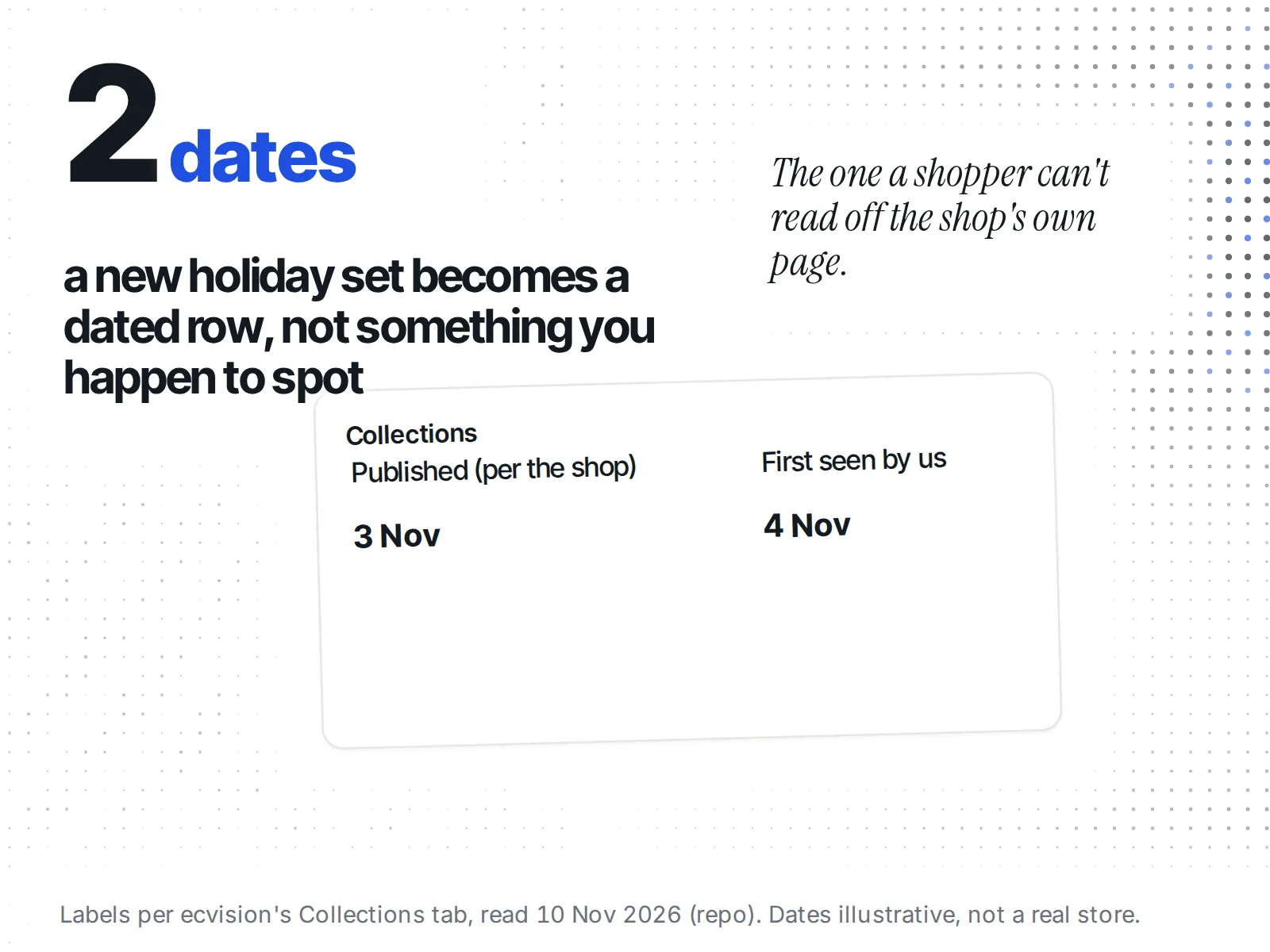
The Products screen has three tabs: "Sales Intelligence", "Collections" and "Catalogue". On the Sales Intelligence tab, ecvision also works out the percent off the compare-at, where a product is marked down, so a price cut on one of the singles inside a set is something you can see.
"Value" lines and GWP banners you still check on the page yourself. What the record saves you is the noticing: a new set collection arrives with its dates attached. See ecvision's plans.
Your gift-set checklist before Black Friday week
- List the rivals whose sets your customers would compare with yours.
- For each set, log the seven fields above, with the date.
- Price every single and add up both the regular and the sale prices.
- Note any page that shows two different prices or thresholds for the same thing.
- Log GWP thresholds and re-check them once Black Friday week starts.
- Decide: set, GWP or hold, from your own stock and margin.
- Run the same value check on your own set before it goes live.
This is one item on the wider Black Friday competitor research checklist.