Shopify Competitor Analysis Tool: Pick by the Job You Need
A Shopify competitor analysis tool covers up to five jobs. Compare free checks, trackers and full suites by price and coverage, then pick yours.
Thomas Pham · · 8 min read
A rival cuts prices, launches a new range or starts a fresh run of ads, and you hear about it a week late. A Shopify competitor analysis tool reads a rival store's public pages and channels for you. Each covers up to five jobs, and the right one for you is the cheapest that covers the jobs you actually need.
What does a Shopify competitor analysis tool actually do?
A Shopify competitor analysis tool reads a rival store's public pages and channels so you don't have to check them by hand. The work splits into five jobs: prices, catalogue and launches, ads, social posts, and traffic. Each tool covers a different slice of them.
- Prices: what a rival charges today, and when that changed.
- Catalogue and launches: which products are new, which sold out, which they push as best-sellers.
- Ads: which ads a rival is running right now, and what they say.
- Social: what they post on their public accounts.
- Traffic: an estimate of how many people visit the store.
Revenue is not on the list: a store's orders and takings are not on its public pages, so a tool that reads only what a shopper sees can't hand you a revenue figure. An app reads orders through Shopify's read_orders access scope, and per Shopify's developer docs, "Merchants approve the scopes when they install it." The signals around it are in how to tell if a Shopify store is actually making money.
How much does each kind of tool cost?
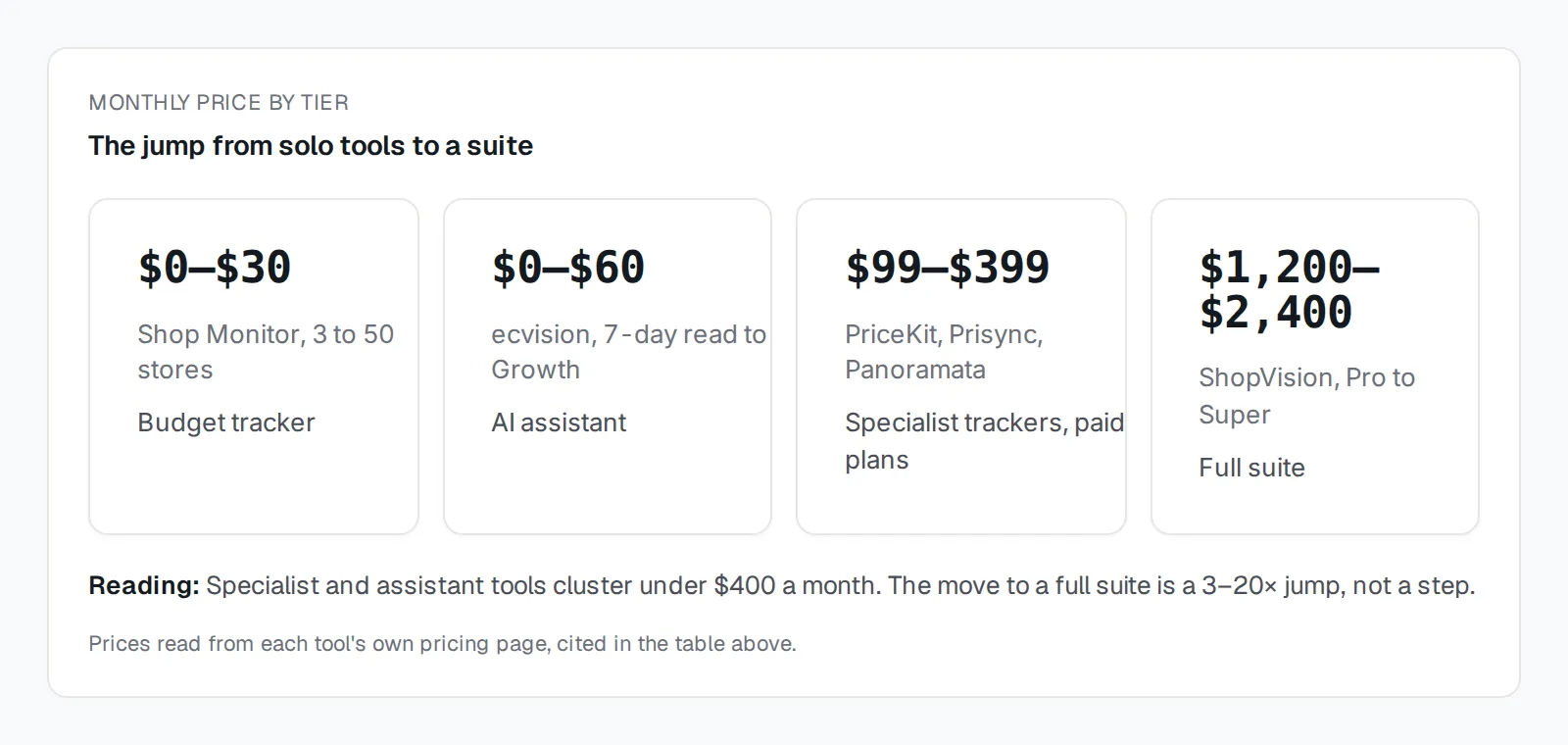
Shopify competitor analysis tools run from $0 to $2,400 a month, as of November 2026, across the seven rows below. Every price comes from the tool's own pricing page or App Store listing, read on the date in the last column. Start from the jobs you need, then find the row that covers them.
| Tier | Example | Price per month | Jobs it reads | Read on |
|---|---|---|---|---|
| Free, by hand | Meta Ad Library, Wayback Machine, Koala Inspector free plan | $0 | One job at a time, nothing tracked for you | 10 Nov 2026 |
| Budget Shopify tracker | Shop Monitor | $0 (3 stores) to $29.90 (50 stores) | New products, price changes, Instagram posts | 8 Nov 2026 |
| Price-only tracker | PriceKit | $0 (5 products) to $249 (1,000 products) | Prices | 8 Nov 2026 |
| Price-only tracker | Prisync | $99 to $399 | Prices, plus MAP (minimum advertised price) monitoring on the top plan | 8 Nov 2026 |
| Marketing library | Panoramata | $99 to $399 | Ads and emails; SMS, landing pages and a SKU tracker on higher plans | 6 Nov 2026 |
| Full suite | ShopVision | $1,200 to $2,400 | Prices matched to your products, launches, ads, email, social, and site traffic on the top plan | 6 Nov 2026 |
| AI assistant, no dashboard | ecvision | $0 (7-day read) to $60 | Catalogue, prices, social accounts and every Meta ad, read through your AI assistant (from $20) | 10 Nov 2026 |
How this was built: "Jobs it reads" is limited to what each vendor's own page names. A job the page doesn't mention is left out, not guessed.
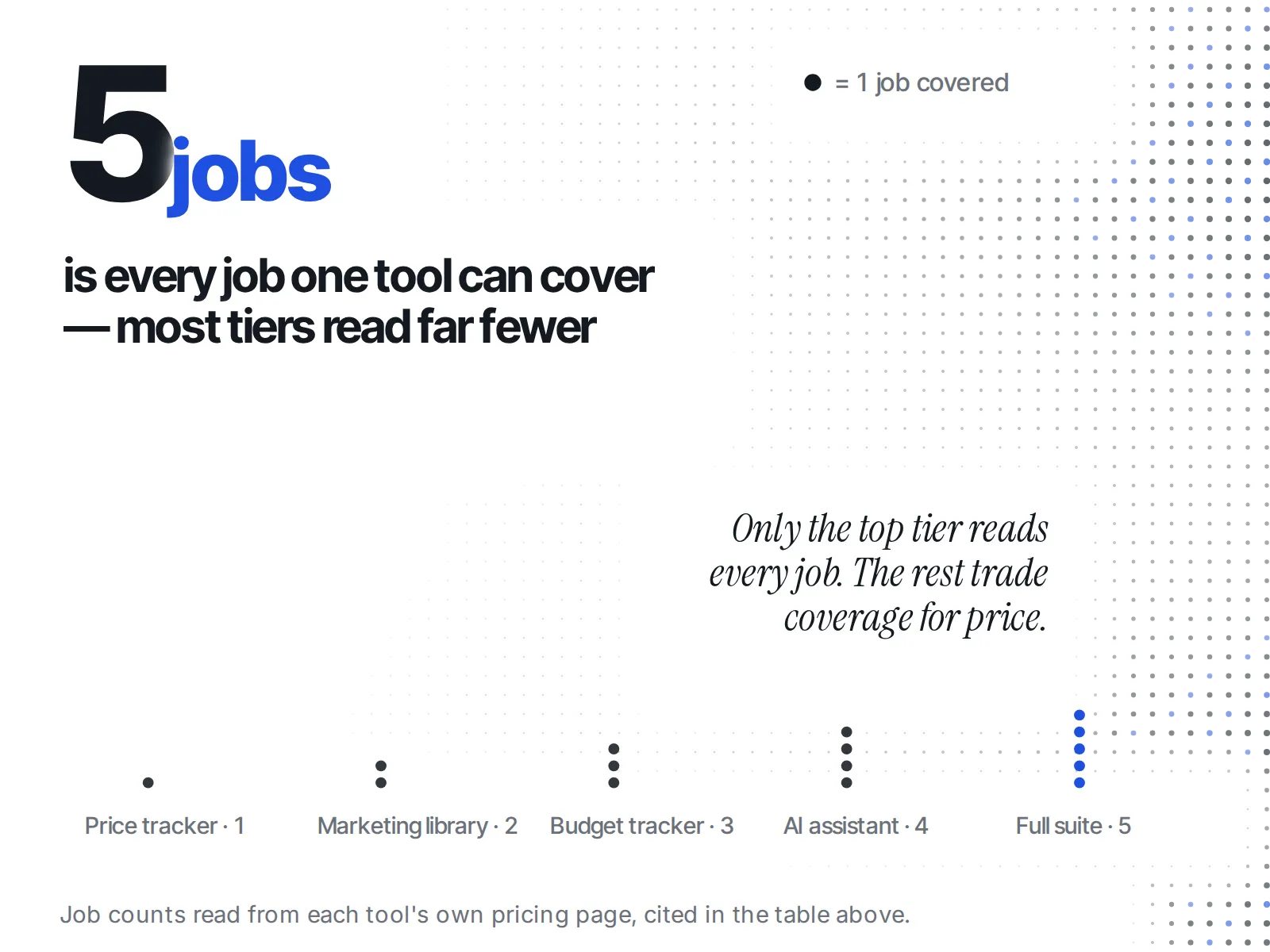
Counted from that table: a price-only tracker reads 1 of the five jobs, a marketing library 2, a budget tracker 3, an AI assistant like ecvision 4, and a full suite 5. Only the top price tier covers every job.
Do most small businesses watch competitors at all?
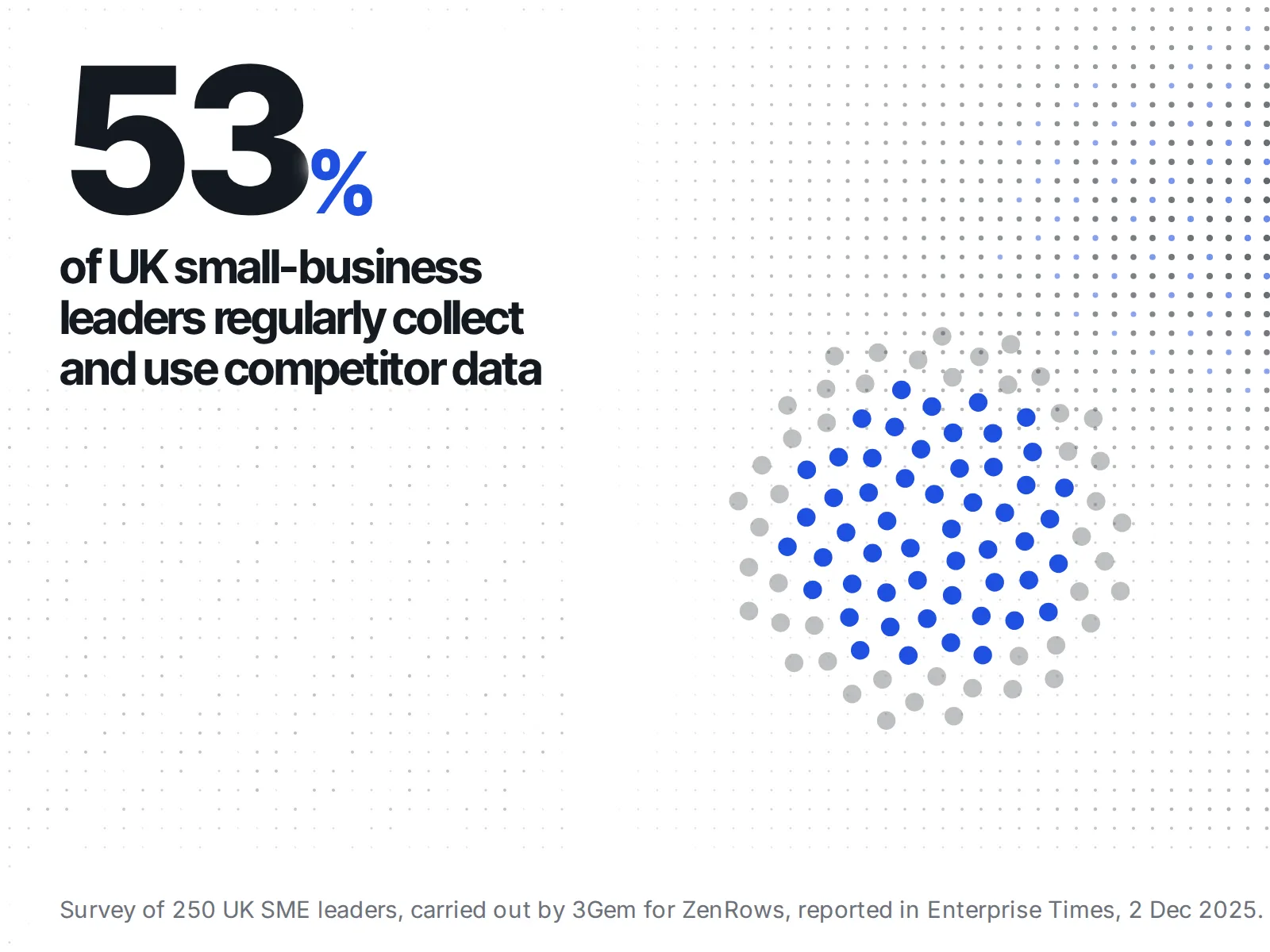
Only about half of UK small businesses watch rivals regularly. In a survey of 250 UK small-business leaders, carried out by 3Gem for ZenRows and reported in Enterprise Times in December 2025, "only 53% regularly collect and use competitive data." Just under half do not, so any method you pick, even a free one, puts you ahead of them.
Two caveats: the survey covered UK knowledge-based businesses with fewer than 250 employees, not Shopify stores, and ZenRows sells a scraping tool, so the gap it found is the gap its product fills.
What can you check for free right now?
Ads, past versions of a site, and a rival's best-sellers can all be checked at no cost, one store at a time. The catch is that nothing keeps a record for you: you see today, and you remember the rest yourself.
- Ads: the Meta Ad Library is where, in Meta's words, "people can search for all active ads running across products from Meta."
- Past prices and pages: the Wayback Machine shows saved copies of a page. Replace the date code in the address with an asterisk (*) to list every date it was captured.
- Best-sellers: sort a rival's collection by best-selling; the method is in how to find a competitor's best-selling products on Shopify.
- A one-click look: Koala Inspector is a Chrome extension with "a free plan that never expires." Its $22-a-month paid plan adds sales estimates and traffic data.
What does a budget Shopify tracker add?
A budget tracker does the weekly checking for you and keeps the record. Shop Monitor is built for Shopify stores and says it tracks "competitors' new products, price changes, and Instagram posts." Its Free plan covers 3 stores, and as of 8 Nov 2026 Plus is $9.90 a month for 10 and Pro is $29.90 for 50.
That's three of the five jobs for under $30; ads are not on its list. Our Shop Monitor alternatives page compares six tools that overlap with it.
What if you only care about prices, or only about marketing?
Buy a price tracker such as PriceKit or Prisync if prices are the whole problem, or a marketing library such as Panoramata if ads and email are what you study. You get depth on that one job and gaps everywhere else, so check which of the five jobs each plan leaves out.
Prices. PriceKit starts free for 5 products with daily checks, and as of 8 Nov 2026 its Business plan at $249 a month covers 1,000 products with "2× daily price checks." Prisync starts at $99 a month for up to 100 products with "Price Updates 3 Times a Day," and its $399 Platinum plan adds MAP monitoring. More in competitor price monitoring apps for Shopify stores.
Marketing. Panoramata (read 6 Nov 2026) starts at $99 a month to "Track 20 competitors" with "Emails & Ads marketing library searches." Its $179 Professional plan adds SMS, landing pages and flows. A "Catalogs SKU Tracker" appears only on the $399 Advanced plan, and no plan names a price tracker.
What does the top of the market buy you?
A full suite covers all five jobs (prices, catalogue and launches, ads, social and traffic), matched to your own catalogue, for a team. ShopVision offers "competitor prices matched to your products, daily," launch and restock tracking, and "competitor ads, email, and social as they go live." Its plans start at $1,200 a month.
As of 6 Nov 2026, Pro at $1,200 gives 5 seats and 20 sites; Super, at $2,400, covers 10 seats, 50 sites, paid ads and daily site traffic. The price pays for matching: ShopVision lines a rival's products up against yours, which matters most to a brand with a pricing team and a big overlapping range. Every other tool in the table sits under $400 a month. Our list of ShopVision alternatives covers six tools that each do part of that job for less, and ecvision vs ShopVision puts the two side by side.
Can you ask an AI assistant instead of opening a dashboard?
Some tools now collect rivals' data and let you read it by asking the AI assistant you already use, with no dashboard to open. ShopVision's Pro plan lists a "Claude Connector". ecvision is built around the idea; its assistant connection starts on the Starter plan at $20 a month.
I'm the founder of ecvision, so weigh this section with that in mind. Its pitch: "Ask your Claude or ChatGPT; every figure comes back dated." It needs "Nothing to install, no Shopify Admin API, no orders, customers or revenue. ecvision reads only the pages any shopper sees."
The plans, as of 10 Nov 2026, from ecvision's pricing page:
| Plan | Price per month | Rivals | History | Ads | Catalogue, prices, social | Assistant |
|---|---|---|---|---|---|---|
| Free | $0 | Your store plus 5 rivals, read for 7 days from setup | No history | Ads page, eight newest creatives withheld | No new catalogue, price or social reads | No AI chat or assistant connection |
| Starter | $20 | Your store plus 5 rivals | 3 months of history | Every ad they run on Meta | Catalogue, prices and social accounts | 1 AI assistant connection |
| Growth | $60 | Your store plus 10 rivals | 6 months of history | Every ad they run on Meta | Catalogue, prices and social accounts | 4 AI assistant connections |
Where it fits: a founder watching 5 to 10 rivals across prices, launches, ads and social. Where it doesn't: it doesn't match a rival's products to your own SKUs or do MAP or wholesale monitoring; for those, a price tracker or ShopVision is the better buy. There's no self-serve sign-up yet; the button says "Book a call," and on that call the workspace is set up on Free.
Which tool fits a small store watching two rivals?
For launches, prices and ads on two rivals, Shop Monitor's Free plan plus a weekly Meta Ad Library check by hand costs nothing. That plan watches up to 3 stores for new products and price changes, and the Ad Library check covers ads.
Say you sell swimwear online and two rivals keep beating you to the season: you don't know when they put new styles up, and you only notice their discounts when a customer mentions them. Launches come first, then prices, then ads; social and traffic can wait. A price-only tracker would miss launches, and a marketing library would miss prices.
If that weekly ad check keeps slipping, or you want to ask "what did they launch this month, and are they advertising it?" in one question, that is when a tool covering all three, ads included, earns its fee.
Which tool should you pick?
Pick the cheapest tool that covers the jobs you need. Start with the free methods, move to a budget tracker when the weekly checks start slipping, and pay for a full suite only when a team needs rivals' products matched to its own.
- Write down the jobs you need: prices, catalogue and launches, ads, social, traffic.
- One quick look, no history needed? The free methods above.
- Launches and prices for a few rivals, checked for you? A budget tracker like Shop Monitor.
- Prices are the whole fight? A price tracker like PriceKit or Prisync.
- Ads and email are what you study? A marketing library like Panoramata.
- Catalogue, prices, social and Meta ads together, asked in plain words? An assistant-based tool like ecvision.
- A team that needs every job matched to your own products? A full suite like ShopVision.
Before you pay, check the vendor's own pricing page; these pages change.