How Long to Watch a Competitor's Ad Before Copying It
The rule that 30 days means profitable has almost no evidence behind it. What a long-running rival ad proves, and what to check before you copy it.
Thomas Pham · · 9 min read
A rival's ad has been live for weeks. Every time you open the Meta Ad Library it is still there, and the advice you keep reading says that means it works, so you should brief your own version. Before you do, it helps to know how little that run length can tell you.
No number of days tells you an ad is working. A long run proves the brand kept the ad switched on. The one study that checked run length against real spend found almost no link between them. So watch for what the brand does to the ad over time, then copy the idea under it, never the ad itself.
Updated 17 October 2026. Meta's Ad Library documentation, the study and the other sources quoted here were rechecked that day.
What does a long-running competitor ad actually prove?
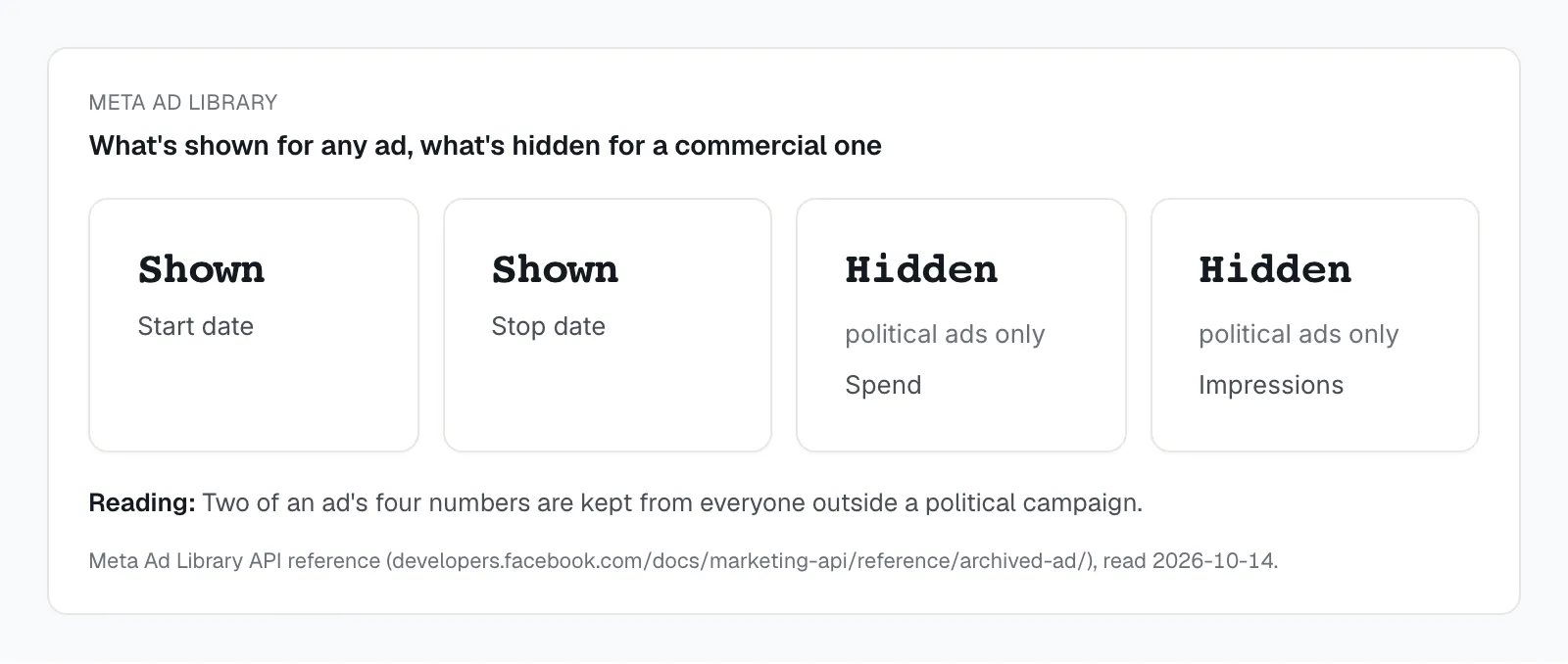
It proves the advertiser has not switched it off. That is all. Meta does not publish spend or impressions for ordinary commercial ads, so nobody outside the account can see whether the ad is paid for heavily, lightly, or barely at all. A long run is a fact about the brand's decision, not about the ad's results.
Meta's own documentation is plain about this. In the Ad Library API, the spend and impressions fields are marked "Available only for POLITICAL_AND_ISSUE_ADS" (Meta, archived ad reference). For a swimwear brand, a skincare brand or a pet food brand, those fields do not exist.
The dates you can see are not what they look like either. The start date is the "Date and time when an advertiser wants to start delivering an ad." If the stop date is blank, the same reference says "the ad will run until the advertiser stops it or they spend their entire campaign budget." Both are plans the advertiser set. Neither is a measure of how much the ad was shown.
Where does the 30-day rule come from?
It comes from tool vendors and blogs that state a day count as a finding without showing a study behind it. The thresholds differ from page to page, and the most quoted statistic behind them has no author, no method and no date range that anyone can check.
On 14 October 2026, the top results for this question set their lines at tiers like 30 days and 60 days, each stated as settled fact with no source. TrendTrack's guide to competitor ad spend puts it this way: "campaigns running 30 or more days are likely profitable, not random experiments." The same post says "10+ duplicates suggest high-budget scaling" and that you can estimate spend "within 20-30% accuracy" (TrendTrack). The post does not show a test behind either number.
The statistic that travels furthest is this one, from Hawky's guide to the Meta Ad Library: "An analysis of 47,392 ads from 1,247 brands found that only 11.3% of ads survive beyond 60 days" (Hawky). There is no link, no author and no method next to it. Treat it as unknown. It may be true, but there is no way to check it, and it does not say anything about profit anyway. Surviving 60 days and making money are two different claims.
Is there any real evidence linking run length to results?
Yes, one study, and it found almost nothing. Researchers took 47,503 political ads from Australia's 2022 federal election, where Meta does publish spend next to run dates. Run length explained less than 1% of the variance in spend. Commercial ads may behave differently, but this is the closest test anyone has published.
Here is the method. The study of political advertising on Facebook during the 2022 Australian federal election took 47,503 ads and compared how long each ran with how much was spent on it and how often it was shown. The correlation between run length and spend was R = 0.10. Between run length and impressions it was R = 0.17. The authors put it as "duration explaining less than 3% of the variance in impressions and less than 1% of the variance in expenses."
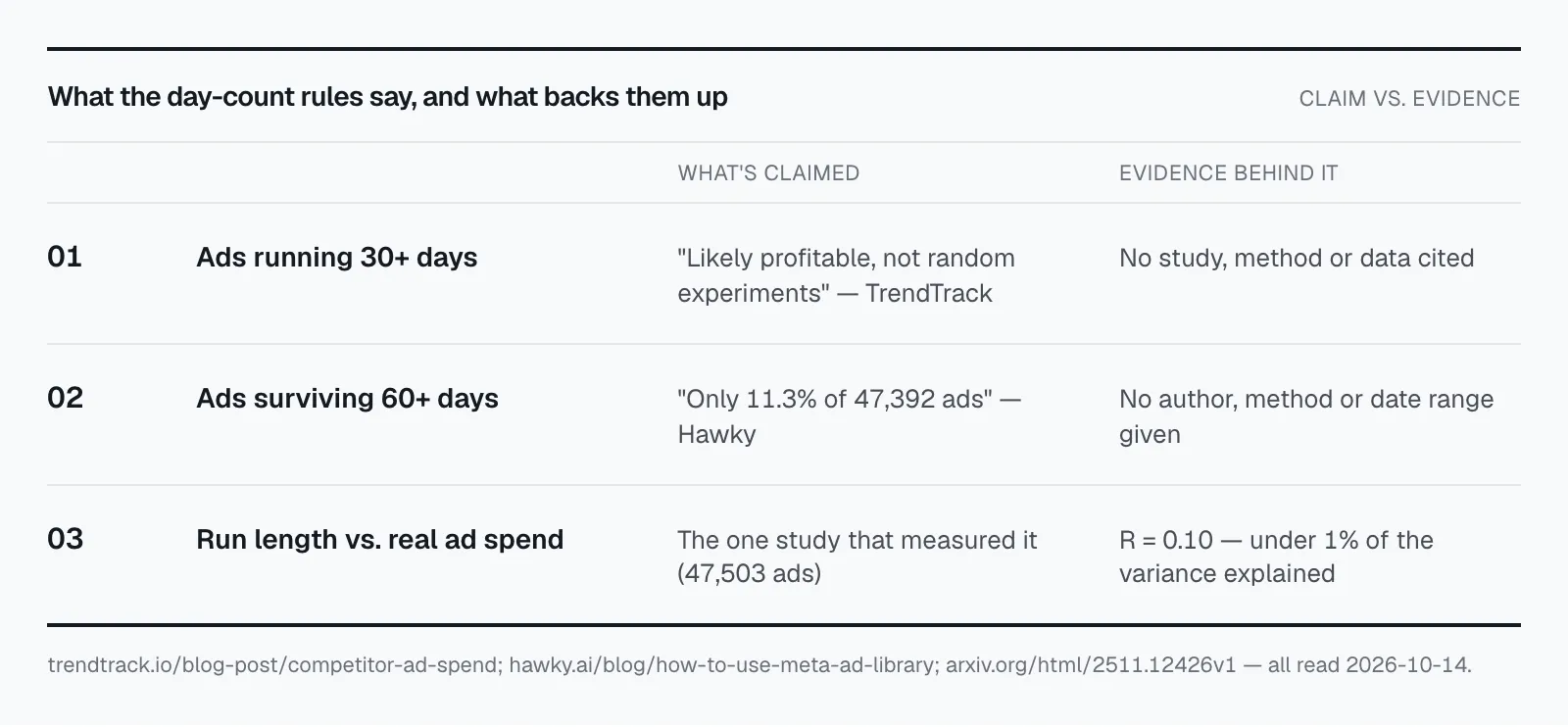
In plain words: knowing how long an ad ran tells you almost nothing about how much money went behind it. The caveat matters. These are political ads, not ads for a Shopify store. The same test cannot be run on commercial ads from the Ad Library, because Meta does not publish their spend. So read it as the best evidence available, not a perfect match. It is still more than the 30-day rule has.
Why can a long run mean nothing at all?
Because an ad stays live for reasons that usually have nothing to do with how well it works. The advertiser may have set no end date. The budget may be tiny. The ad may be a brand ad built to run all year. From outside, all of these look the same as an ad that pays for itself.
Three common cases:
- No end date. Meta's reference says a blank stop date means the ad runs until the advertiser stops it or the campaign budget runs out. An ad nobody has looked at in months can sit there, live.
- Little spend behind it. Because spend is hidden for commercial ads, an ad that gets almost none of its campaign's budget looks exactly like one that gets most of it.
- Always-on brand ads. Some ads are meant to run indefinitely: a founder story, a brand film, an evergreen catalogue ad. They were never a test, so their long life proves nothing about a test.
Say you sell swimwear, and a rival's ad for a ribbed one-piece has been live since March. It could be their best seller's main ad. It could also be an ad set up in spring with no end date, getting a sliver of budget, while all their real spend goes to newer ads you have scrolled past. The Ad Library page looks identical in both cases. If you copy it, you might be copying the ad they forgot about.
What should you do when you spot a long-running competitor ad?
Treat it as a reason to study the brand, not to copy the ad. Look at what sits underneath it: the offer, the price, the landing page, who the copy speaks to. Then keep watching what the brand does next, because new versions and new copies say more than elapsed days.
What to look at, in order:
- The offer. Is it a discount, a bundle, free shipping, a quiz? The offer is part of what the shopper is answering. If you copy the creative and keep your own weaker offer, you have copied the wrong half.
- The landing page. Click through. Note the product, the price and what the page asks the shopper to do. An ad is the front of a funnel you cannot see the rest of from the Ad Library.
- Who the copy talks to. Read who the words address: new mums, runners, people with sensitive skin. That hints at which audience the brand is spending on.
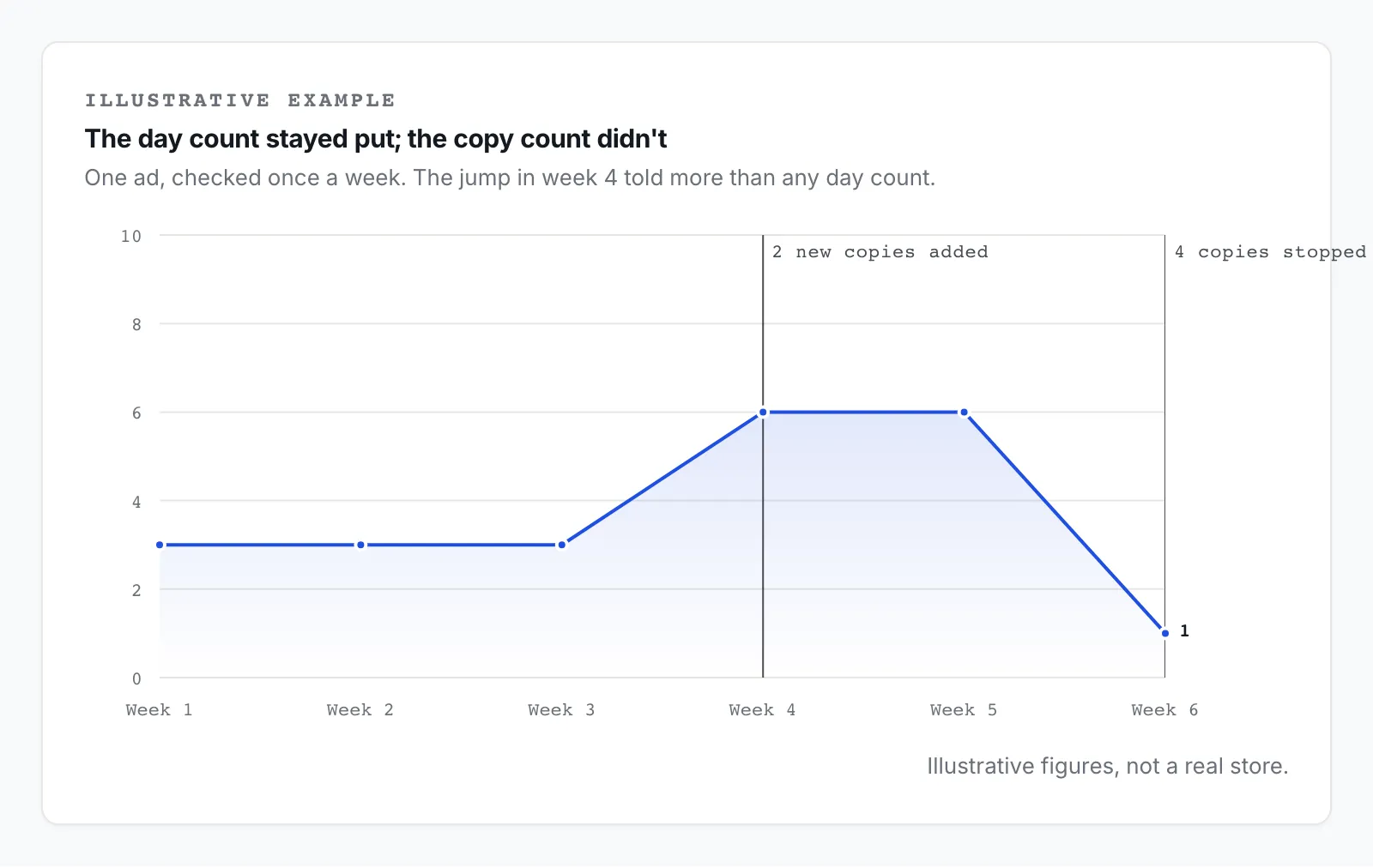
- Whether they are adding to it. A brand that keeps launching new copies and versions of one idea is putting more behind it. That is still commitment, not proof, but it is a stronger signal than a single ad left running.
- Whether they stopped it. An ad a rival ran for months and then killed is a decision too. It is easy to miss if you only ever look at live ads.
If a rival's move is about price rather than creative, the questions change; here is what to do when a competitor cuts prices on Shopify.
How long should you actually watch before you act?
Long enough to see the brand change something. One visit gives you a snapshot. Watching across a few weeks shows you whether they added copies, made new versions, or switched ads off. Those changes are things the brand did, which you can see, rather than results, which you cannot.
There is no magic number of days, and anyone selling you one is guessing. What you can do is replace "how long has it run" with "what have they done to it since I first saw it". That needs more than one look. If you only check a rival's ads when one catches your eye, you will see the ads that happen to be live that day and miss what was added or dropped in between. The same is true for prices, which is why watching more than one rival's prices works best as a habit rather than a one-off check.
How does ecvision show this without calling any ad a winner?
ecvision's Ads screen sorts a rival's creatives by what the brand did, never by how well an ad did. Its four reads are "Newest", "Running longest", "Most versions" and "Stopped". Each creative also carries a state, and the 30-day state is labelled "Kept running", with the rule saying a long run is commitment, not results.
The blurbs under the reads say what each one does and does not support. "Running longest" reads "What they keep paying to run." "Most versions" reads "One idea, many near-duplicates. Commitment, not proof it worked." "Stopped" reads "Bets they ran long, then abandoned." "Newest" reads "Each rival's newest, two at a time." No read is called "best", "top" or "winning".
The states follow the same rule. There are seven, each with the rule behind it:
| State | Rule, as the app shows it |
|---|---|
| Scaling | A creative at least 14 days old that gained 2+ new copies in 14 days, or 3+ more versions. |
| Testing | First ran less than 14 days ago and still live. |
| Kept running | A copy has been live at least 30 days. Kept, not proven: a long run is commitment, not results. |
| Steady | Live, and none of the above. |
| Winding down | A long-running creative whose copies are being retired. |
| Cut early | Every copy was switched off within 7 days. |
| Ended | Every copy has ended. |
Notice the bar for "Scaling". Time alone never earns it. A brand has to be visibly adding to a creative, with new copies or more versions, before ecvision calls it out. That is a stricter test than the 30-day rule. If you want it done for you across several rivals, see the plans.
A quick checklist before you copy a rival's ad
- Remember that run length shows the ad is still on, not that it works.
- Ignore day-count rules and statistics with no method behind them.
- Read the offer, the landing page and the audience before the creative.
- Watch for what the brand adds, copies or stops over a few weeks.
- Borrow the idea underneath, in your own words, with your own offer.
Sources
Read on 14 October 2026, rechecked on 17 October 2026.
- Meta, Ad Library tools: what the Ad Library shows, and that spend and reach are given only for ads about social issues, elections or politics.
- Meta for Developers, Archived Ad reference and Ads Archive reference: spend and impressions only for political and issue ads, and what the start and stop dates mean.
- Political advertising on Facebook during the 2022 Australian federal election (arXiv): 47,503 ads, run length compared with real spend and impressions.
- TrendTrack, Competitor ad spend: the 30-day longevity rule as it is usually stated.
- Hawky, How to use the Meta Ad Library: the "47,392 ads" statistic, quoted without a method.
- ecvision, the Ads screen: its four reads and seven creative states, as they appear in the app today.