Meta vs Google vs TikTok Ad Libraries: What Each Shows
Meta, Google and TikTok all run public ad libraries, but none shows spend for an ordinary ad. What each one publishes, and the EU law behind the gaps.
Thomas Pham ·

A client asks what their rival is spending on ads. You open the Meta Ad Library, then Google's Ads Transparency Center, then TikTok's library, and each one hands you a different set of fields. One shows targeting, one shows a payer, one shows how many people saw the ad. None of them shows a budget for the ad you care about.
That is not a gap you can search your way around. The three tools publish different things because the rules behind them ask for different things, and the main rule, the EU's Digital Services Act, asks who paid for an ad, not how much. Once you know that, you stop hunting for a number that was never published and start reading what is there.
This is about ordinary commercial ads: a brand selling a product. Political and social-issue ads run under stricter rules, and they come up once below, where they explain where Meta's spend figures come from.
Updated 15 October 2026. Facts checked against the linked sources on 15 October 2026.
What is each library, in one line?
Each platform keeps a public, searchable record of the ads it serves, and each covers a different slice. Google's names who paid, Meta's adds detail for ads shown in the EU, and TikTok's was built for Europe first.
- Meta Ad Library is Meta's public record of ads. Meta describes it as "bringing in all active ads any Page is running — not just ads related to politics or issues."
- Google Ads Transparency Center shows, in Google's words, "the advertiser name, location, the entity that pays for the ads, and the ads they have served over a certain time period."
- TikTok Commercial Content Library shows paid ads and "content that's commercial in nature and tagged with either a paid partnership label or promotional label." When TikTok announced it, the company said "only data from Europe is available."
What does each one show for an ordinary ad?
For an ordinary commercial ad, all three show you the ad itself. Beyond that they split: who was reached and how it was targeted depends on the platform and on where the ad ran, and none of the three publishes a spend figure for a commercial ad.
| Meta Ad Library | Google Ads Transparency Center | TikTok Commercial Content Library | |
|---|---|---|---|
| The ad itself | Yes, active ads | Yes, ads served over a time period | Yes, the advertising creative |
| Who paid | Funding entity named for political and issue ads | Yes, "the entity that pays for the ads" | Not listed in its launch post |
| Dates the ad ran | Yes, for ads shown in the EU | Ads "served over a certain time period" | Yes |
| Targeting | Age, gender, location, for ads shown in the EU | In some countries | Age, gender |
| People reached | "Who was served the ad", for ads shown in the EU | Total recipients per ad, in some countries | Number of people served |
| Spend | Political and social-issue ads only | Not in any field Google lists | Not in any field TikTok lists |
| How long ads stay | EU ads: one year after the last impression. Political and issue ads: 7 years | Not stated on Google's help pages | Not stated in TikTok's launch post |
| Where data covers | All active ads; extra fields for ads shown in the EU | Some fields only in some countries | Europe only, at launch |
Two cells say "not stated", and that is what they mean. Retention figures for Google circulate on third-party blogs, but Google's own help pages don't give one, so it is not in this table.
Why doesn't any of them show ad spend?
Because the law that shaped these libraries never asked for it. The Digital Services Act's Article 39 lists what a large platform's ad repository must hold, and the money line is who paid: "the natural or legal person who paid for the advertisement". There is no line for the amount.
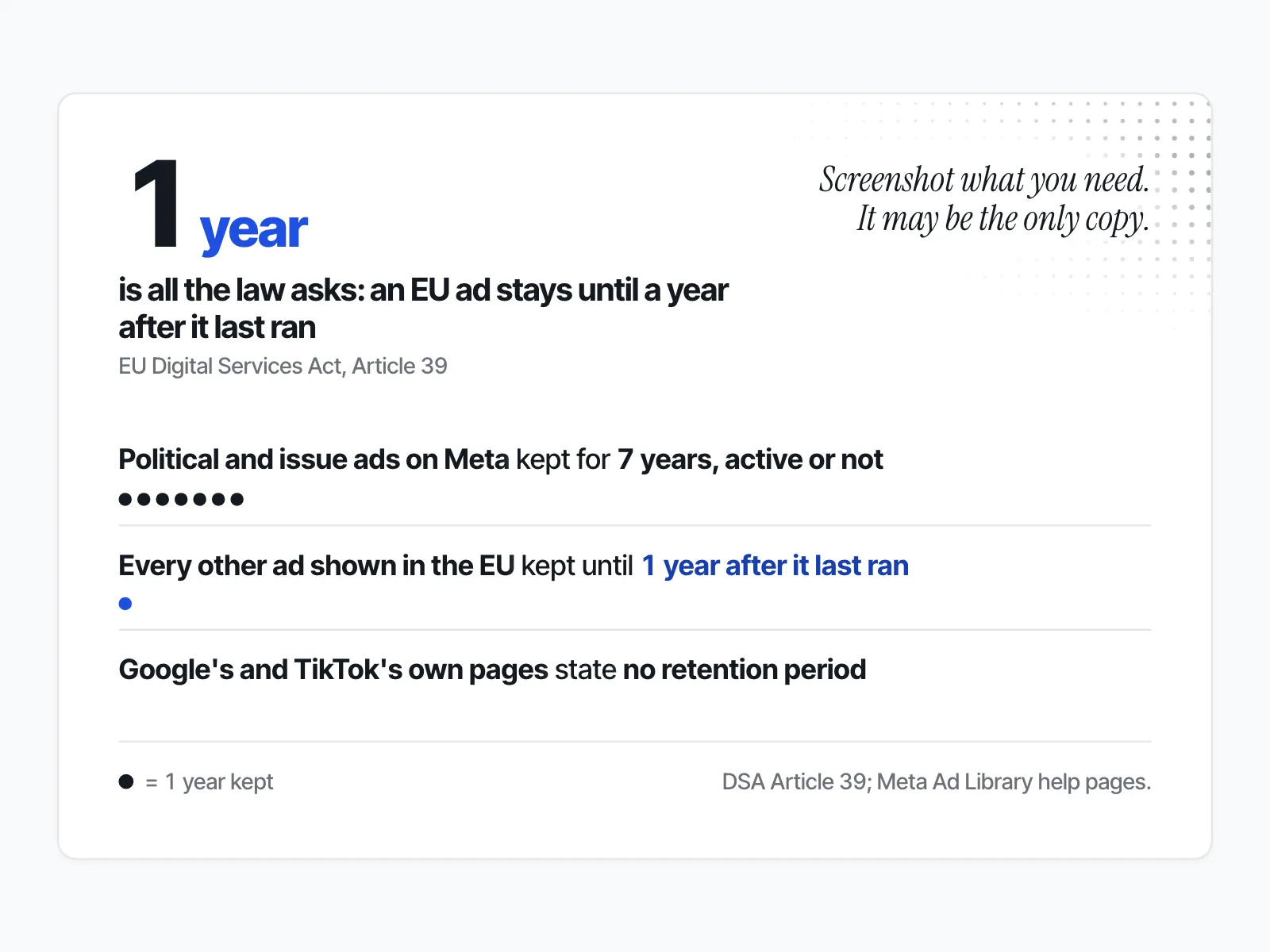
Here is the list Article 39 gives, in order: the ad's content, the "natural or legal person on whose behalf the advertisement is presented", the person who paid, if different, "the period during which the advertisement was presented", the main targeting parameters and any used to exclude groups, whether it is a commercial communication, and "the total number of recipients of the service reached", broken down by member state where that applies. The law also says each ad stays in the repository "until one year after the advertisement was presented for the last time."
Read that list against the table and most of the pattern falls out. Who paid, when, targeting, people reached: that is roughly what Meta and TikTok publish for ads shown in Europe, and what Google publishes in some countries. Spend is not on the list, so a platform that publishes it is going past the minimum.
Meta does go past it, but only for one kind of ad. For social-issue, election and political ads, Meta says it provides "spend, reach and funding entities," and keeps those ads for 7 years whether they are active or not. That is where the spend figures people remember come from. For a skincare brand or a swimwear store, Meta's pages don't name those fields at all.
Article 39 binds the platforms the European Commission designates as very large. Its list names Facebook, Instagram, TikTok, YouTube and Google Shopping as very large online platforms, and Google Search as a very large online search engine. All three companies are on it.
What can you learn about a competitor's ad, and what can't you?
You can learn what a competitor ran, roughly when, and, for ads shown in Europe, who it was aimed at and how many people it reached. You can't learn what they spent. Set that expectation with the client before you start, not after.
Say a client sells swimwear, and a rival has been everywhere on their feed this spring. The client wants to know what the rival is spending. Here is what each tool can honestly answer.
In the Meta Ad Library you can see every ad the rival's Page has active. If those ads were shown in the EU, you also get the dates they ran, the age, gender and location targeting, and who was served. If the rival only advertises outside the EU, you mostly get the creative.
In Google's Ads Transparency Center you can see the ads the rival has served and the entity that paid for them, which can be someone other than the brand itself. In some countries you also get targeting and a recipient count per ad.
In TikTok's library you can see the rival's paid ads and any posts tagged as paid partnerships, with dates, age and gender targeting and the number of people served, as long as the ads ran in Europe.
So the honest answer to the client is: here is what they are running, where, since when and at whom. Not what it cost. If someone shows the client a spend figure for that rival, ask where it came from, because none of these three libraries published it.
What does that mean for how you research a rival?
Treat the libraries as a record of what a brand did, not of how its ads did. Use them to see which products a rival is pushing, which offers they repeat, which ads they keep running and which they drop. Don't read a long run as a sign an ad made money; it only tells you the ad stayed on.
A few habits keep the research honest:
- Check where the ad ran before you read the fields. On Meta and TikTok, the richest fields depend on whether the ad was shown in Europe.
- Write "not published" where a number is missing. A blank spend cell is unknown, not zero.
- Keep the payer. Google names who pays for an ordinary ad; Meta names a funding entity only for political and issue ads.
- Save what you find. Google's help pages and TikTok's launch post don't state how long an ad is kept, so a screenshot you take today may be the only copy you can count on.
Where ecvision fits
The ads screen in ecvision has no spend, impressions, click-through or engagement control anywhere on it, on purpose: the Meta Ad Library publishes none of those for commercial ads, so a sort by spend would be a sort by a number the product had to invent. The money stays unknown, because it is. Plans are on the pricing page.
A checklist before you open the three libraries
- Agree with the client that you are reporting what a rival ran, not what it spent.
- Search the rival on all three: Meta Ad Library, Google Ads Transparency Center, TikTok Commercial Content Library.
- For each ad, note where it ran; European ads carry the most fields on Meta and TikTok.
- Record the payer from Google.
- Mark every missing figure as "not published", never as zero.
- Screenshot what you need to keep, with the date you saw it.