Should you match a rival's Black Friday price on a sofa?
A rival home brand cut its hero sofa for Black Friday. Before you match, run the landed cost: freight doesn't shrink with the price, and returns pay it twice.
Thomas Pham · · 8 min read

A rival has cut 20% off the sofa that competes with yours, and you're deciding whether to match their Black Friday price. On a big-ticket home item, match the delivered price a shopper compares, not the percentage on the banner. Delivery on a sofa costs about the same at $2,000 as at $1,600, and a return pays it twice. So the same 20% that's harmless on a cushion can halve your margin on a sofa.
Black Friday 2026 is Friday 27 November, the day after US Thanksgiving, which federal law fixes as "the fourth Thursday in November". Cyber Monday is 30 November. There's time to do the sums before the rival's banner goes up.
Updated 25 October 2026.
The general match-or-hold framework covers any category, and the clothing version covers apparel. This is the part only bulky pieces have: freight that doesn't discount and returns that cost a second delivery.
What does a rival's Black Friday price on a hero piece tell you?
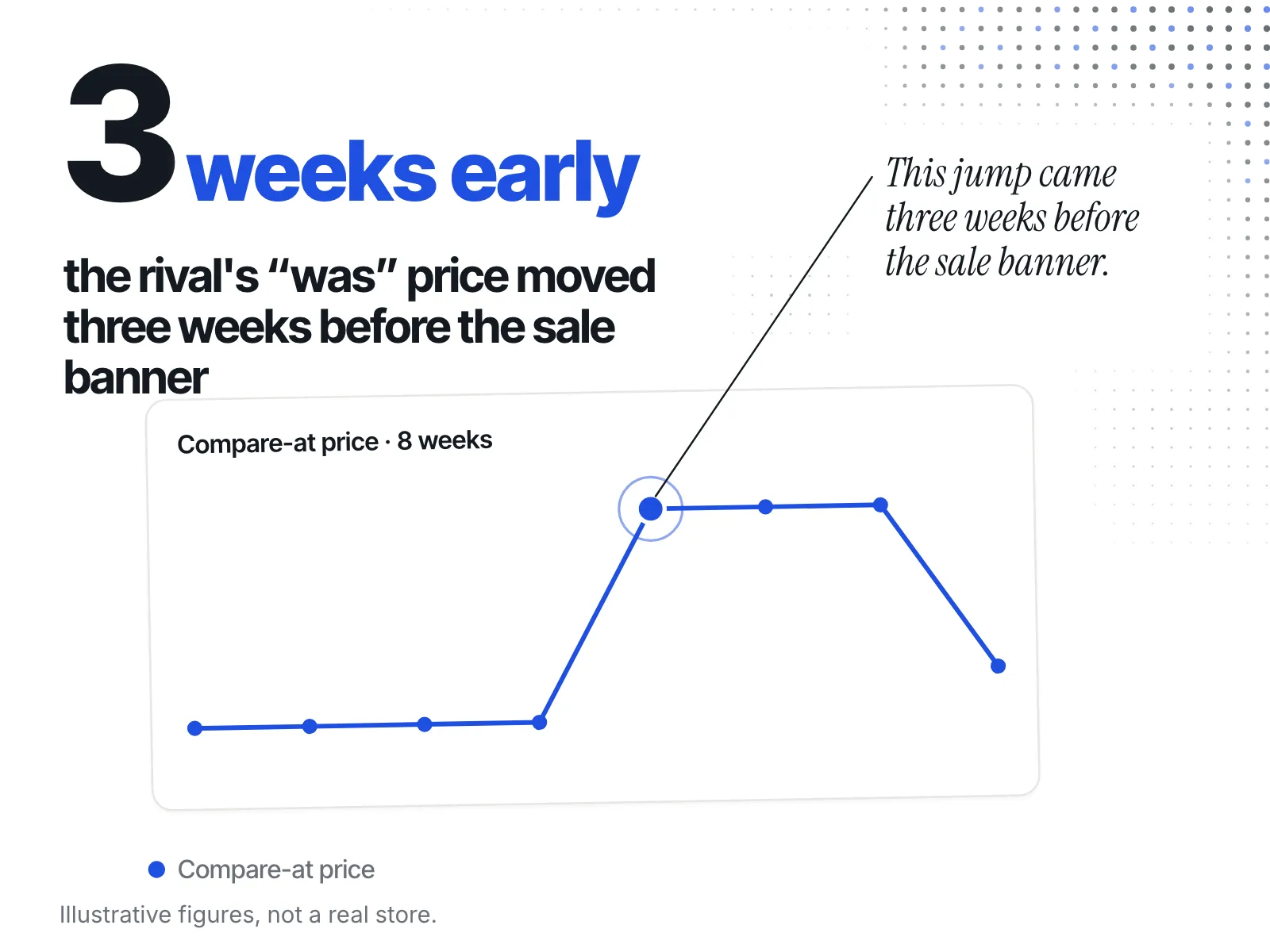
A rival's sale page tells you the price they're asking now and the "was" price they chose to show beside it, not their freight cost, their margin, or whether that "was" price was ever charged. The number worth having is their sale price compared with what the same piece sold for in the weeks before.
The strike-through price is the rival's own claim. The US Federal Trade Commission's guide on former-price comparisons says a "was" price should be "the actual, bona fide price at which the article was offered to the public on a regular basis for a reasonably substantial period of time". A "30% off" banner might be measured from a price that held all year, or from one raised a fortnight before the sale. Only the piece's price history tells you which.
Then read the rest of the offer, because on a sofa the price is only part of it:
- The delivery charge. Included, a flat fee, or quoted at checkout? A rival who cuts the price but charges for delivery has made a smaller cut than the banner says.
- The lead time. Dispatch from stock, or a build after the order? A sale piece that arrives in the new year is a different offer from yours if yours ships this week.
- Pre-order or deposit wording. The rival is taking money for pieces they haven't made yet.
Should you match the percentage or the delivered price?
Match the delivered price, meaning item plus delivery, on the pieces where you really compete. That is the number a shopper puts side by side when comparing two sofas, and a rival's 20% off can leave a much smaller gap once delivery is added to both sides.
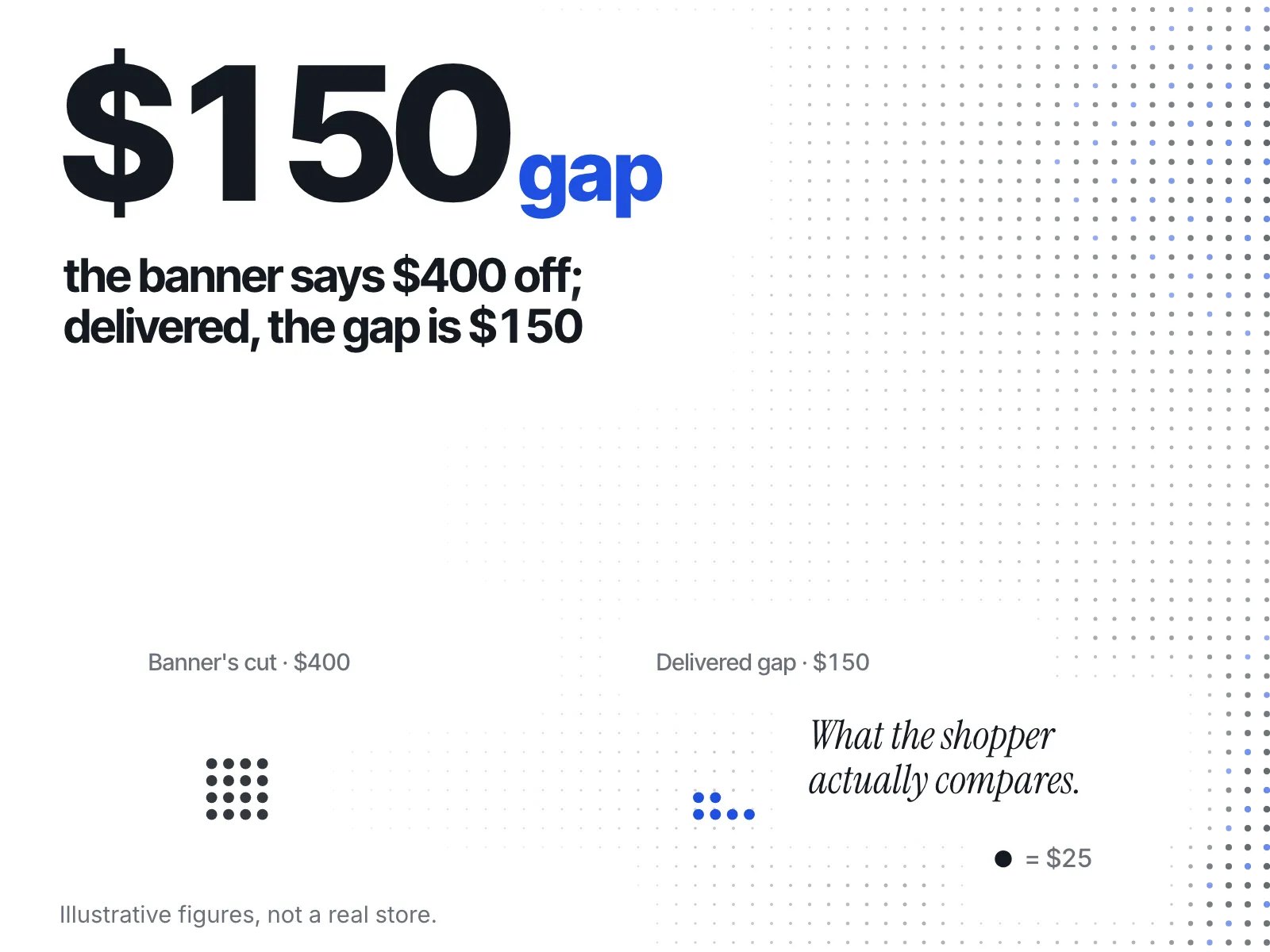
Say a rival's sofa normally sells at $2,000 plus $250 delivery, and yours sells at $2,000 with delivery included. Every price and cost figure in this worked example is made up to show the method. For Black Friday the rival goes 20% off: $1,600 plus $250, so $1,850 delivered. Your sofa, delivered, is $2,000. The gap the shopper sees is $150, not $400. Matching the banner would give away $250 more than the shopper needed.
How does freight change the cost of matching?
A discount comes off the price, but the delivery cost stays put, so the whole cut comes out of what's left after freight. And when an order comes back, you pay delivery out and collection back on a sale that earned nothing.
Eightx, a CFO-advisory firm, estimates that "Reverse logistics on bulky items can run 100-150% of the original outbound delivery charge." That's a vendor estimate, not a measured standard, but plan for a return to cost at least a second delivery, and use your own carrier quote.
A worked example (hypothetical numbers)
Take the same $2,000 sofa, with delivery included in the price.
- It costs you $900 to make and land in your warehouse.
- Delivery to the customer costs you $300.
- One order in ten comes back.
- A return costs the $300 you already paid to deliver it, $300 to collect it, and $50 to inspect and restock it. The sofa goes back into stock.
At full price, out of 100 orders, 90 are kept at $800 margin each ($2,000 − $900 − $300), which makes $72,000. The 10 returns cost $650 each, so $6,500. You net $65,500 per 100 orders, or $655 per order placed.
Now run the same 100 orders at each price:
| Offer | Price | Margin per kept order | Net on 100 orders | Orders needed to net $65,500 |
|---|---|---|---|---|
| Full price | $2,000 | $800 | $65,500 | 100 |
| Match the delivered price | $1,850 | $650 | $52,000 | 126 |
| 10% off | $1,800 | $600 | $47,500 | 138 |
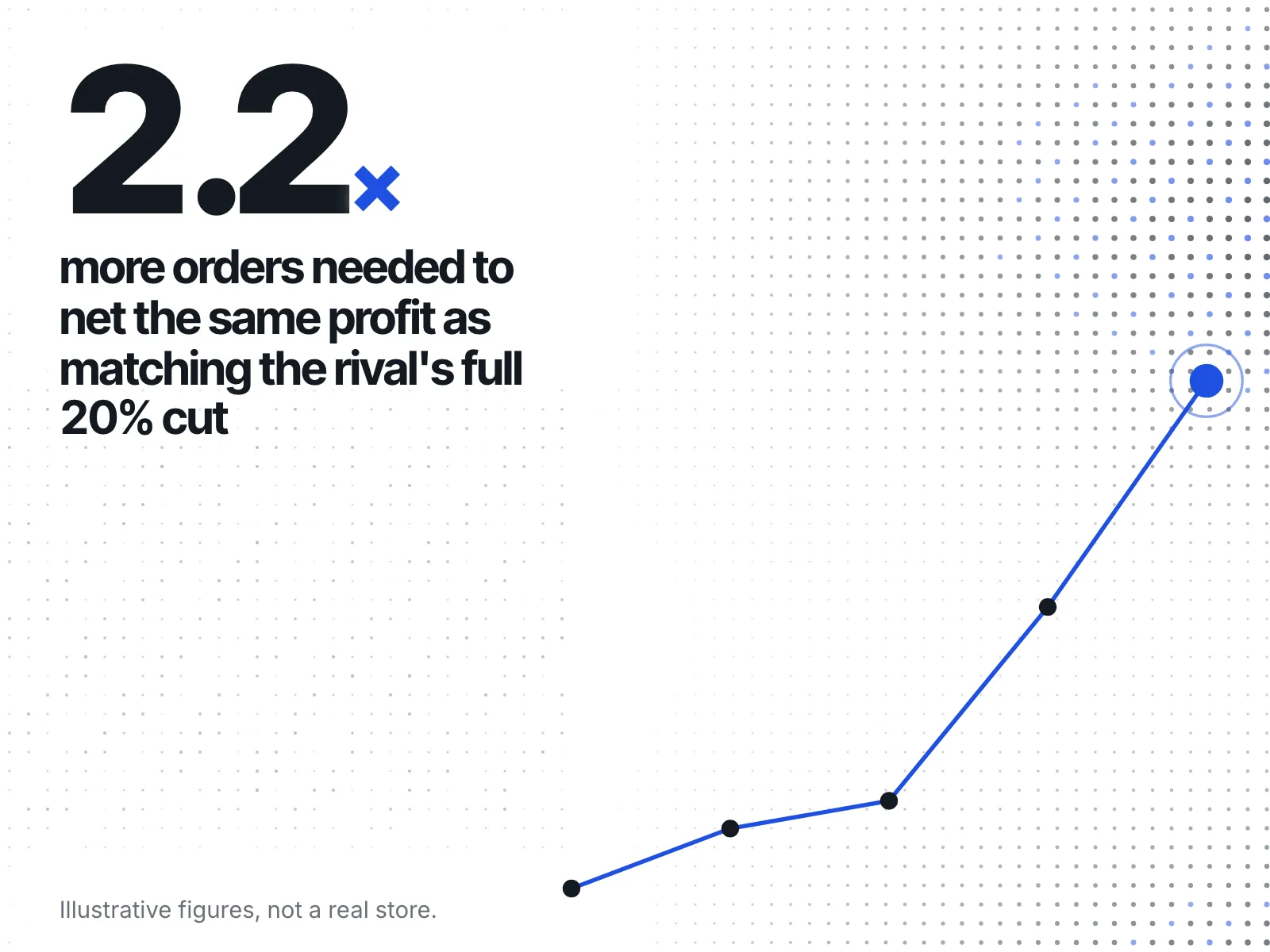
| Match the 20% | $1,600 | $400 | $29,500 | 222 |
| Beat it at 25% | $1,500 | $300 | $20,500 | 320 |
Matching the banner's 20% means you need 2.2 times your usual orders just to stand still. Looking only at price and product cost, it would seem like 1.6 times ($1,100 margin falling to $700). Freight raises the bar to 2 times, because the $400 cut comes out of an $800 margin. Returns push it the rest of the way, at $650 each whatever you charged.
Matching the delivered price instead, at $1,850, needs 126 orders. That's the gap between a sale you can survive and one you can't, and it came from reading the rival's delivery charge. On a cushion the sums barely move; on a sofa, rug or large lamp, delivery is the slice that decides.
Does it matter if the piece is made-to-order?
Made-to-order changes the decision on both sides. A rival's made-to-order sale is a price for a sofa the shopper will wait for, so your in-stock sofa delivered before the holidays may justify a higher price. If you make to order yourself, a match commits you to building every order that week at the lower price.
If their sale piece ships weeks after yours, the price gap may be the price of waiting, so put a clear dispatch date on your own page. If you make to order, check your workshop can build the extra orders on time, or the discount turns into late deliveries.
When should you hold your price?
Hold when the orders you'd need to earn back full-price profit, after freight and returns, are more than Black Friday could bring in, or when the rival's real cut is smaller than their banner. Holding isn't doing nothing: offer something that costs less than a markdown.
Signs that holding is the better call:
- Their real price barely moved; most of the "20% off" comes from a raised compare-at price.
- Their delivery charge closes most of the gap.
- Their sale piece is made-to-order with a long lead time, and yours ships from stock.
- Your returns on that piece are high, so the table punishes you hardest.
If you hold, decide the alternative before the week starts. In the example your price includes delivery while the rival charges $250 for it. Say that plainly on your product page; it costs nothing new. A free swatch kit or a longer trial costs a known amount you can price against the $400 a 20% markdown takes from every kept order.
When should you beat a rival's price?
Beat a rival only where you can still sell enough orders at the deeper price to earn back full-price profit after freight and returns, and winning that buyer is worth the margin. In home goods that means a piece with low delivery cost for its price, few returns, and buyers likely to come back for the matching chair or rug.
In the example, beating the rival at 25% needs 320 orders, more than three times normal. Across a range of bulky pieces, tripling orders on every one isn't realistic; on one hero piece already in the warehouse, it can. Cap the units and know your break-even first.
When is matching simply the right call?
Matching is right when, after freight and returns, you'd need only a few more orders than usual to earn back full-price profit. If the piece ships from stock, delivery is cheap for its size, and the rival's cut is small next to your margin, match on the overlapping pieces and move on.
It's also sensible if you had a 15% sale planned and a close rival goes to 20%: the extra step may cost little, and the table tells you how much.
How do you watch a rival's price on hero pieces without checking by hand?
Record each rival piece's price and compare-at price every day, from a few weeks before Black Friday until after Cyber Monday. By hand, that's fine for three sofas and tiring for twenty. A daily log of both prices shows whether a sale is a real cut or a raised "was" price.
ecvision, competitor intelligence for ecommerce brands, does this on the Products page. Open the Sales Intelligence tab and pick a rival's product. Its price panel, headed "Price ·" and the time window, draws two lines, Price and Compare-at, and marks each change on the chart as the old price → the new price. When the piece is marked down, a badge shows the current percent off the compare-at. Under the price, a line counts the changes and gives the low and the high. Plans are on the pricing page.
It shows the product's price, not the rival's delivery charge or lead time; check those on their shipping pages.
What can't a rival's price history tell you?
A rival's price and compare-at history doesn't show their freight contract, margin, return rate or how many sofas their sale sold. A price history shows what they did, not whether it worked, so make the decision with your own costs and quotes.
Don't borrow a return rate either. The National Retail Federation's 2025 returns estimate puts online returns at "19.3% of online sales" without a furniture or home-goods figure. Eightx also notes that "If you search for a furniture return rate, you will find numbers from 8% to 23%, which is wide enough to be useless." Use your own returns and carrier quotes.
A checklist for the weeks before Black Friday
- List the rival pieces that compete directly with yours, piece by piece.
- Record each one's price and compare-at price daily, starting now.
- Note each rival piece's delivery charge and promised lead time.
- When a rival's Black Friday sale goes live, compare their delivered sale price with their delivered pre-sale price and with yours.
- Pull your own product cost, delivery cost, return rate and cost per return for each piece.
- Run the table: margin per kept order, cost of returns, orders needed to get back to full-price profit.
- Decide per piece: match the delivered price, hold with a cheaper offer, or beat it on one chosen piece.
Sources
Read on 25 October 2026.
- Legal Information Institute, 5 U.S. Code § 6103, Holidays: the Thanksgiving date.
- Legal Information Institute, 16 CFR § 233.1, Former price comparisons: the FTC guide on former prices.
- National Retail Federation, 2025 returns estimate press release: the online return estimate.
- Eightx, Average furniture and home return rate benchmarks: reverse-logistics cost and the spread of published furniture return rates (vendor estimates).