What to do when a competitor cuts prices on Shopify
A rival dropped their price. Before you match it, run three checks: what's your floor, is it the same offer, and is the cut lasting? Then decide.
Thomas Pham ·

A rival has just dropped the price on the product that competes with your best seller, and your first instinct is to match it by tonight. Don't, yet. Whether you should match a competitor's price cut on Shopify comes down to three checks: what is the lowest price your margin can take, is it really the same offer, and is the cut lasting or just a sale?
Updated 13 October 2026. Shopify's sale-pricing rules, Google's and Meta's sale-price display, and the ecvision screens described here were re-checked that day.
Should you match a competitor's price cut?
Not by default. Matching is one of three answers, alongside holding your price and repositioning the offer. Matching on reflex hands the rival control of your pricing.
| Check | The question | If the answer is no |
|---|---|---|
| 1. Your floor | Is the new price above the lowest price your margin allows? | Don't match. Hold or reposition. |
| 2. Same offer | Is their product the one a shopper would pick instead of yours, on the same terms? | Nothing to match. Hold, and say what makes yours different. |
| 3. Lasting cut | Is this a new price, or a sale that will end? | Wait. A sale that ends is not a price you have to live with. |
Only when all three come back yes is matching on the table.
What's your price floor, before the event?
Work out your price floor before you look at theirs again. Your floor is the lowest price at which the product still earns the margin you need. It comes from your landed cost and your minimum margin, and only you know both. If the rival's new price sits below your floor, matching it is off the table.
Landed cost is everything it takes to get one unit to a customer: the product, freight in, duties, packaging, payment fees, and any shipping you absorb. Your minimum margin is the share of the price you need to keep to cover ads, staff and rent and still make the product worth stocking.
The floor is then:
price floor = landed cost ÷ (1 − minimum margin)A rival below your floor is usually either running on a cheaper cost base than yours or choosing to lose money on the product. You can't win the first by cutting. You shouldn't copy the second.
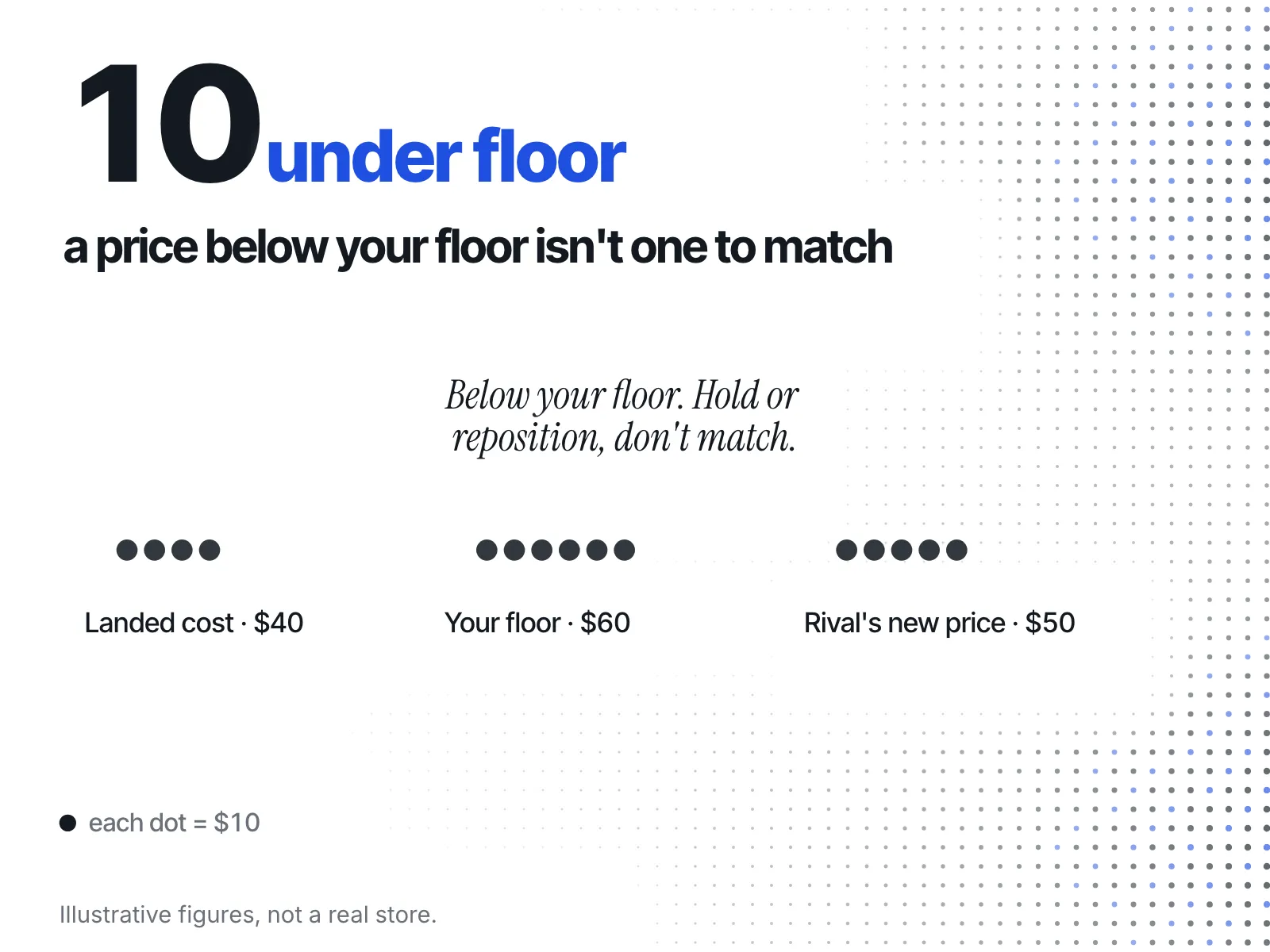
Do this before Black Friday, not during it. This year Black Friday falls on 27 November and Cyber Monday on 30 November, and that weekend is when rivals' cuts come fastest and you have the least time to think. Write the floor down now for every product a rival could undercut.
Decide how you'd discount, too, because shoppers see the two kinds differently. A discount code run as a Google promotion shows in Search and the Shopping tab as a "special offer" link while your listed price, the one Google keeps a history of, stays where it was. A product-level sale price shows as a strikethrough: in Google Shopping, and in Meta catalogue ads with the strikethrough overlay turned on.
Is it really the same offer?
Compare the whole offer, not the number on the page. A lower price on a product with a different material, a smaller pack size, slower shipping or a weaker returns policy is a different offer. If a shopper wouldn't swap one for the other, there is nothing to match.
Look at what the shopper gets for the money:
- The product itself. Same material, size, pack count, variant?
- What comes with it. Shipping cost and speed, returns window, warranty, any free gift.
- Who it's for. A budget line from a rival can sit next to your premium one without taking your buyer.
Is the cut a sale or a new price?
Look at how the price is shown, then watch it over time. On Shopify, a store marks a product down by setting a compare-at price: the old price shown above the new one. A lower price with no compare-at is more likely a new base price. A sale ends. A new price is the one you'll be competing with.
Shopify's help page on sale pricing describes the mechanics: "To set a sale price, set the value of the Compare-at price field in your Shopify admin to the original price of the product," and the compare-at has to be higher than the price "to display the sale price."
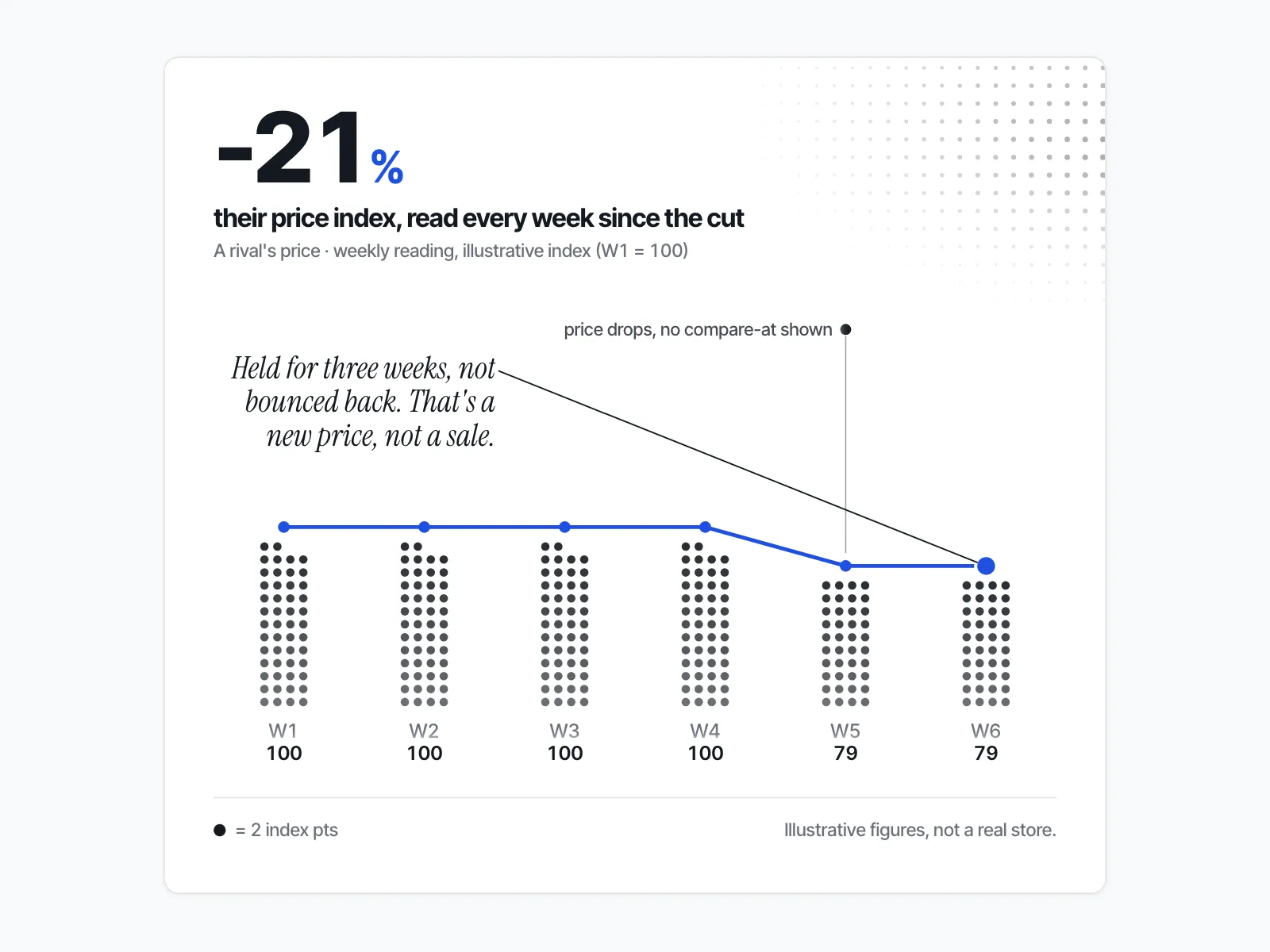
One visit can't tell you which it is. The answer is in the pattern: how long the lower price has held, and whether this rival cuts on a rhythm. That's the method in logging a competitor's prices and sale dates over a few weeks. Keep in mind its blind spot. Shopify says savings from automatic discounts or discount codes "are always displayed with a crossed-out price at checkout," which means the product page you're watching won't show them.
Also ask what kind of product they cut. A cut on their hero product is usually a play for volume. A cut on an old colour or an odd size is often stock being cleared.
If you'd rather not keep that log by hand, this is what ecvision's Sales Intelligence tab is for. It is the first of three tabs on Products, before Collections and Catalogue. Open a product and the Price over time panel charts its price, and its compare-at where there is one. Every change is marked on the chart with its old and new price, and an arrow for up or down. One line sums it up: "N changes · low X · high Y" when the price moved, or "flat across N readings" followed by "on sale" or "no discount" when it never did. A single change that has held is your lasting cut. Several changes swinging between the same low and high looks like a rival that runs sales.
When should you match, hold or reposition?
Match when all three checks say yes and you can see sales going to that rival on that product. Hold when the cut breaks your floor, the offers differ, or the cut looks temporary. Reposition when the cut is real and lasting but you can't or won't follow it down.
| Decision | When it's the right call |
|---|---|
| Match | The new price clears your floor, it's the same offer, the cut is lasting, and that product's sales have dropped since the cut. |
| Hold | The new price is under your floor, the offers differ, or the cut has a compare-at and the rival runs sales on a rhythm. |
| Reposition | The cut is lasting and on the same offer, but you can't follow it down or don't want to. |
Repositioning means changing what the shopper gets instead of what they pay:
- Bundle. Pair the product with something cheap to you and useful to them, so the comparison is no longer one price against another.
- Change the terms. Free or faster shipping, a longer returns window, a guarantee the rival doesn't offer.
- Say why yours costs more. If your material or making is better, put that on the product page, where the shopper compares.
- Lead with a different product. Move your ad spend and email to a product the rival doesn't compete with, and let this one sell at its price.
A worked example
Say you sell linen duvet covers and a rival sells a close match. The numbers are invented, not any real store's.
Your double cover sells at 120. Theirs was 120 too, and three weeks ago it dropped to 95.
Check 1: your floor? Your landed cost is 58 per cover. You need to keep at least 35% of the price. The floor is 58 ÷ 0.65, about 89. Their 95 clears it. Yes, though with only 6 of room.
Check 2: same offer? Same fabric weight, same sizes, both ship free, both take returns for a month. A shopper would happily take either. Yes.
Check 3: lasting cut? Their product page shows 95 with no compare-at above it, and your log has had 95 at every reading for three weeks. The rival hasn't run a sale on this product in the months you've watched. Yes.
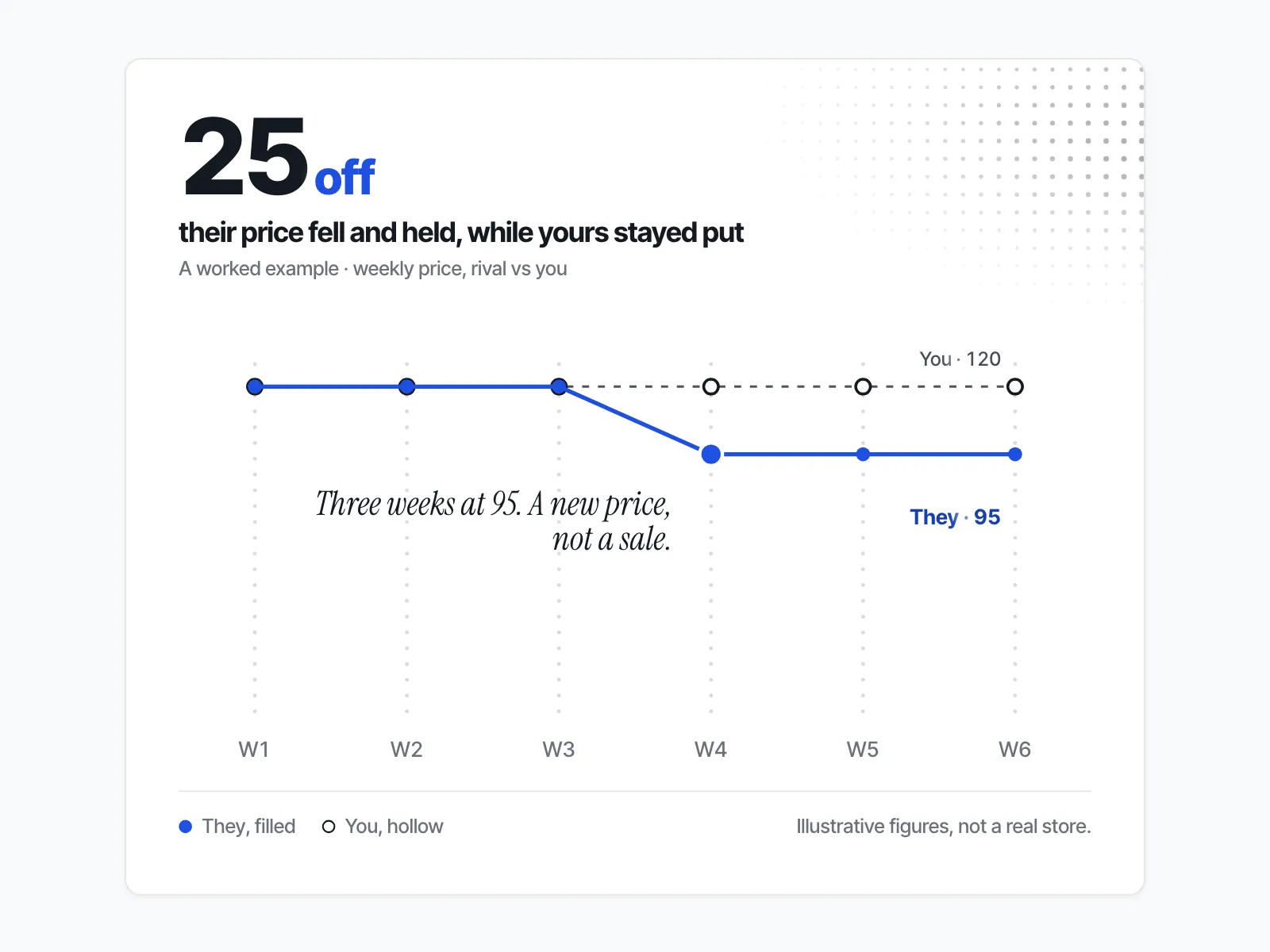
All three say yes, and your own sales of the double cover have dropped since the cut. That is a match, at 95. Or, if 6 of room feels too thin, reposition: hold at 120 and bundle a pair of pillowcases that cost you little.
Now change one fact. Suppose their page showed 95 with 120 struck through above it, and your log showed the same cut every few weeks for a week at a time. Check 3 fails. That's a rival with a sale calendar, and the right call is to hold and let the sale end.
What does holding cost you?
Holding isn't free. If the rival's cut is lasting, on the same offer, and shoppers are choosing them, holding means losing those sales while you wait. Set a review date when you decide to hold. If the price hasn't come back and your sales haven't either, run the checks again.
Merchants have asked this exact question on Shopify's community forum, and the advice there is the same as here: find out whether the lower price is costing you sales before you react. That cuts both ways. If it is, and the numbers allow, matching is the right call. A framework that never says "match" isn't a framework. It's a way of putting the decision off.
To see what ecvision tracks and what it costs, the pricing page has the plans, and the ecvision homepage shows the rest of the product.
Your checklist
- Before Black Friday (27 November), work out your floor: landed cost ÷ (1 − minimum margin).
- Check it's the same offer: product, terms and buyer.
- Check whether it's a sale (compare-at, a rhythm) or a new price that has held.
- Match only if all three pass and that product's sales have dropped.
- Otherwise hold with a review date, or reposition with a bundle, better terms, or a different lead product.
Sources
Read on 12 and 13 October 2026.
- Shopify Help Center, Sale pricing: how compare-at prices show a sale, and why code and automatic discounts appear only at checkout.
- Google Merchant Center Help, Get started with Promotions and How to sync sale price and promotions from Shopify to Google: where promotions show, and why promo codes stay separate from the product's price.
- Google Merchant Center Help, About sale price annotations: the struck-through original price, and the price history Google checks before showing it.
- Meta for Developers, catalog fields, and Social Media Today, Meta updates dynamic labels for Advantage+ catalog ads: the sale_price field and the strikethrough price overlay.
- Shopify Community, How do you handle it when a competitor undercuts your price?: merchants on checking whether a lower price is costing sales before reacting.
- ecvision, the Sales Intelligence tab under Products: the Price over time panel described above, as it appears in the app today.