Shopify BFCM Statistics for 2026 Planning
Shopify's BFCM 2025 numbers and Adobe's 2026 forecast, each tied to its source, plus how to tell whether your category beat the average or fell behind it.
Thomas Pham · · Updated · 8 min read
The Shopify BFCM statistics to plan 2026 around are Shopify merchants' record $14.6 billion over Black Friday Cyber Monday (BFCM) 2025, up 27% (Shopify's own release), and Adobe's forecast of $15.1 billion in US online sales on Cyber Monday, 30 November 2026. Neither says anything about your category or your store.
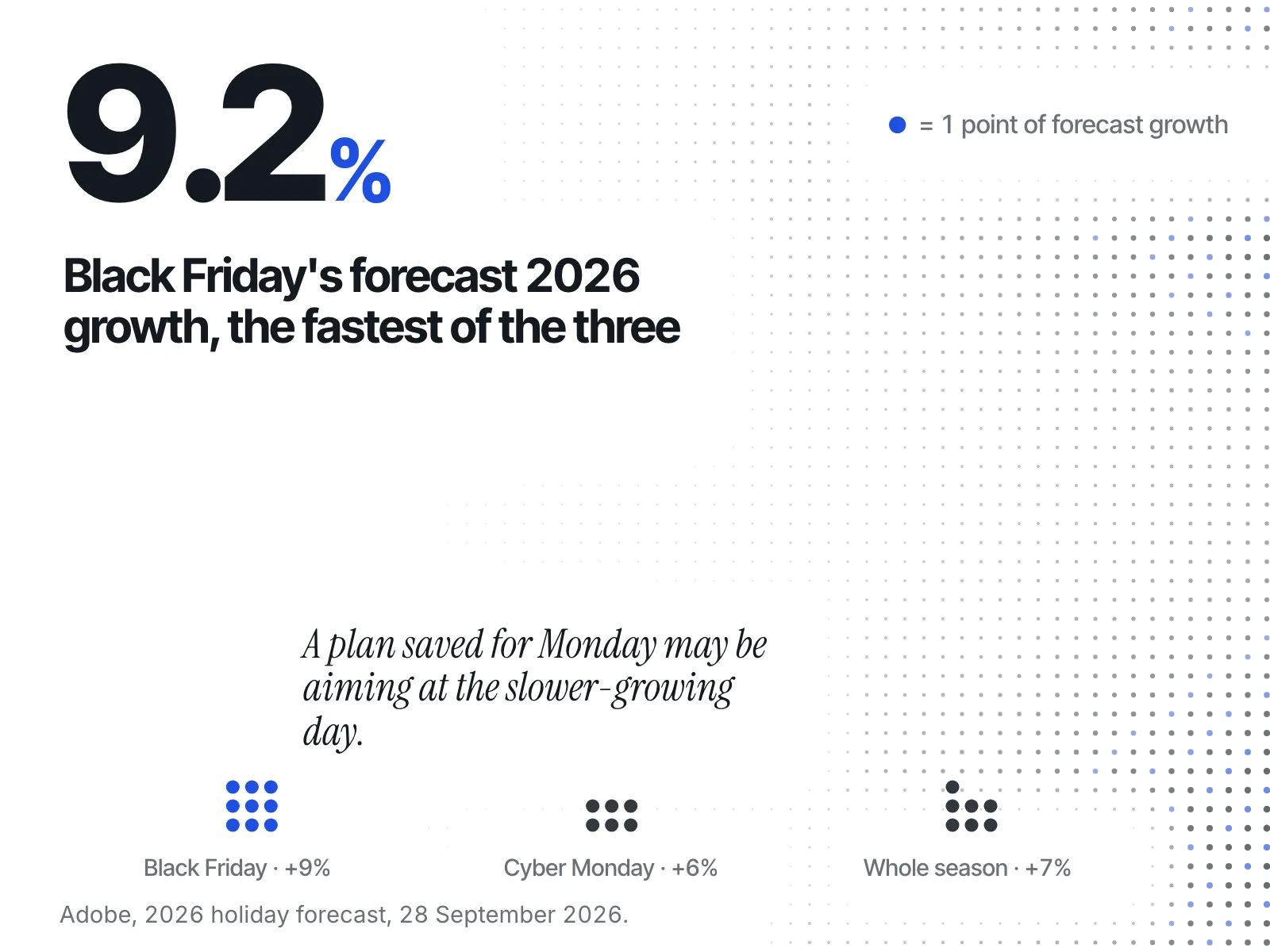
Updated 6 November 2026: Adobe forecasts $275.1 billion for the season, with Cyber Week at $47.5 billion (up 7.4%), Black Friday $12.9 billion (up 9.2%), Cyber Monday $15.1 billion (up 6.2%) and discounts up to 30% off listed price in Cyber Week (Adobe).
BFCM key facts (as of 6 November 2026):
- Shopify merchants sold a record $14.6 billion worldwide over Black Friday Cyber Monday 2025, up 27% on 2024 (Shopify, 2 December 2025).
- Shopify's BFCM 2025 sales peaked at 12:01 p.m. EST on Black Friday, at $5.1 million per minute (Shopify).
- Adobe forecasts US online holiday sales of $275.1 billion for 1 November to 31 December 2026, up 6.7% (Adobe, 28 September 2026).
- Adobe expects AI traffic to US retail sites this holiday season, counted as shoppers clicking a link from an AI tool, to rise 130% on the year.
How much did Shopify merchants sell over BFCM 2025?
Shopify merchants made $14.6 billion in sales over the BFCM 2025 weekend, according to Shopify's release of 2 December 2025. That was up 27% on 2024, or 24% once currency swings are taken out. It is the platform-wide total across every Shopify store, every category and every country.
The 27% is the number to hold on to. If your own BFCM revenue grew less than that last year, you still grew, but Shopify's merchants as a whole grew faster. If your weekend was flat, buyers did not stop spending over BFCM. They spent somewhere else, and some of that is your category rivals.
Shopify also gives one caveat that most roundups drop: its release says the data "is unaudited and is subject to adjustment", and that all figures are approximate and "based on various assumptions." Treat the $14.6 billion as a strong signal, not an audited result.
When did Shopify's BFCM 2025 sales peak?
Sales across Shopify peaked at 12:01 p.m. EST on Black Friday, when merchants together were selling $5.1 million per minute, per Shopify's BFCM 2025 data. The busiest minute of the whole weekend fell at midday on the Friday, not on the Monday.
That matters for when you look at your rivals. A rival's offer you only notice at Friday lunchtime has already had the run-up to the busiest minute of the weekend. To answer it, see it by Thursday evening or Friday morning. In 2026, Thanksgiving is 26 November and Black Friday is 27 November, under the federal holiday rule that sets Thanksgiving as "the fourth Thursday in November". Our post on how to see when competitors start their Black Friday sale covers the signals to watch on those days.
What did shoppers buy, and from where?
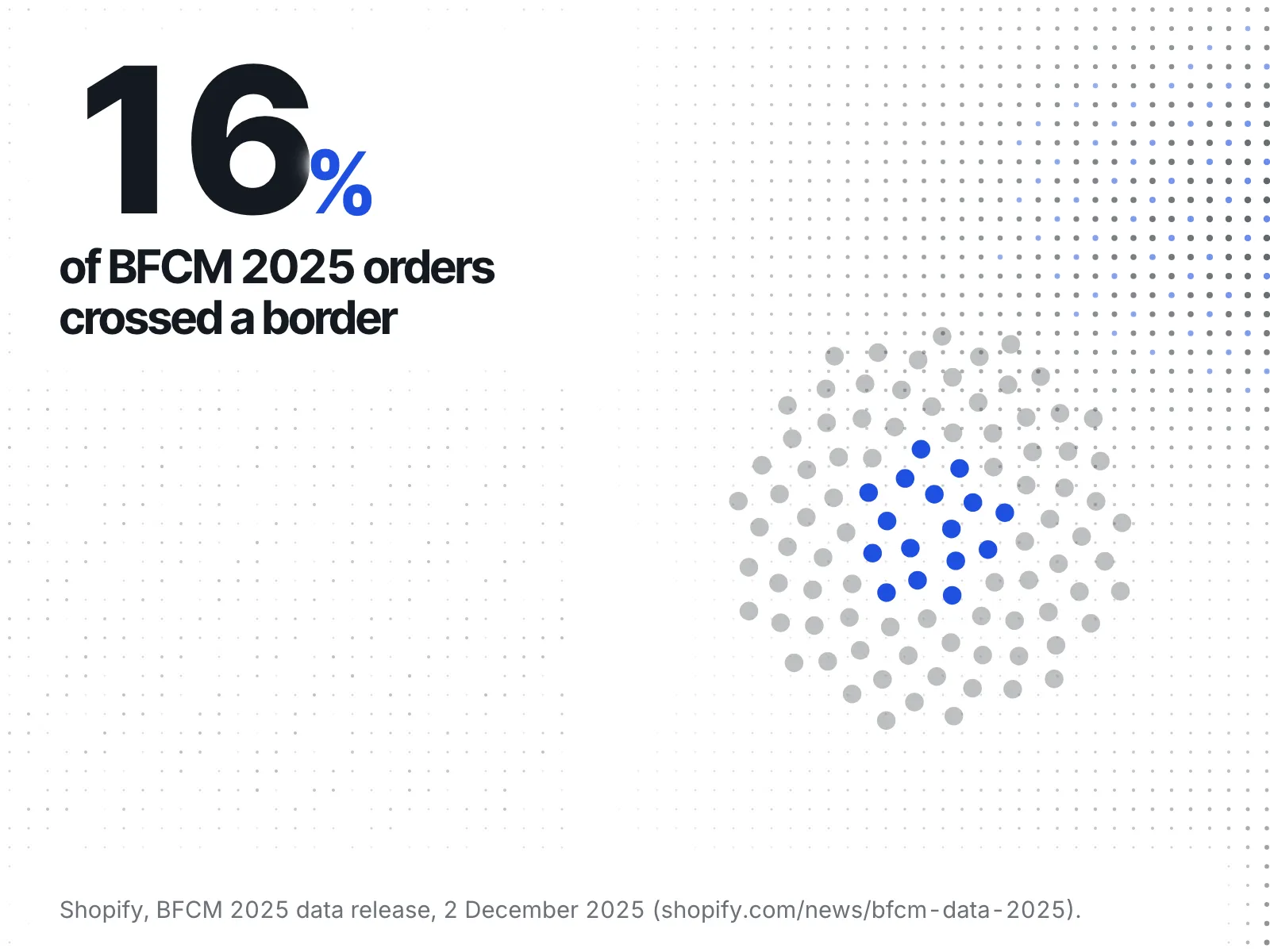
Shopify named four hottest product categories for BFCM 2025: "Cosmetics, clothing tops & pants, activewear, fitness & nutrition." The average cart was $114.70, cross-border orders were 16% of all orders, and the top-selling countries were the US, UK, Australia, Germany and Canada, all per Shopify's release.
Each of these changes a different decision:
- The category list tells you whether you sell in what Shopify called its hottest categories. If you sell cosmetics, activewear or clothing tops and pants, you were in one of them, so falling short of the platform's 27% is a clearer warning, with one caveat: the 27% is a total across every Shopify merchant, stores new to the platform included, so it is not a same-store growth rate and falling short of it does not prove a rival took your sales. If you sell something else, Shopify's release does not say how your category did, and you should not assume it matched the headline.
- The $114.70 average cart is a platform-wide figure. Compare it with your own BFCM order value as a sense check, not a target.
- The 16% cross-border share is the one to act on if you have never sold abroad. If one order in six on the platform crossed a border, check that your shipping rates, duties and currency display work for international buyers before November, not during it. Shopify's release does not say which countries those cross-border orders came from.
Are BFCM 2026 US online sales forecast to grow?
Adobe forecasts US online sales will grow 6.7% on the year, to $275.1 billion for 1 November to 31 December 2026, according to its 2026 holiday forecast released 28 September 2026. This is a forecast across all US online retail, not Shopify's actuals.
Keep these two sources apart. Shopify reports what happened on its platform worldwide. Adobe forecasts US online spending across every retailer. They cannot be added together.
| Day or period | Adobe's 2025 actual (US online) | Adobe's 2026 forecast (US online) |
|---|---|---|
| Black Friday | $11.8B, up 9.1% | $12.9B, up 9.2% |
| Cyber Monday | $14.25B, up 7.1% | $15.1B, up 6.2% |
| Cyber Week (Thanksgiving to Cyber Monday) | $44.2B, up 7.7% | $47.5B, up 7.4% |
2025 actuals from Adobe's Cyber Monday 2025 release; 2026 figures are Adobe's forecast of 28 September 2026.
Three things in Adobe's forecast change how you plan. First, Cyber Monday (30 November 2026) is still forecast to be the biggest single day, at $15.1 billion, but Black Friday is forecast to grow faster, at 9.2% against 6.2%. A plan that saves its best offer for Monday may be aiming at the slower-growing day. Second, Adobe expects "deals will be on par with the 2025 season", which means last year's discount depths are a fair guide to this year's. Third, AI traffic to US retail sites rose 670% on Cyber Monday 2025, per Adobe, from a small base, and Adobe expects another 130% rise this season, most of all on Thanksgiving (up 159%).
How deep did US online retailers discount on Cyber Monday 2025?
According to Adobe's Cyber Monday 2025 data, discounts peaked at 31% off listed price in electronics, 28% in toys and 25% in apparel. The shallowest of the categories Adobe listed was sporting goods, at 17%. With Adobe forecasting 2026 deals on par with 2025, they are a reasonable public guide to how deep this year may go.
| Category | Peak Cyber Monday 2025 discount (off listed price) |
|---|---|
| Electronics | 31% |
| Toys | 28% |
| Apparel | 25% |
| Computers | 23% |
| Television | 22% |
| Furniture | 19% |
| Appliances | 19% |
| Sporting goods | 17% |
These are Adobe's peaks across US online retail, not what your three closest rivals did. A rival in apparel may have gone well past 25% or stayed at 15%, and the table cannot tell you which. Before you set a discount from it, read whether to match a competitor's Black Friday discount, which works through the match-or-hold decision for clothing stores.
Why can't the industry average plan your BFCM for you?
Because Shopify's $14.6 billion and 27% growth, and Adobe's 6.7% forecast, are totals or averages across a whole platform or market, and your weekend is decided by a handful of stores. Those numbers tell you the pie grew. They do not tell you whether the stores your customers compare you with took a bigger slice of it.
Say you sell activewear on Shopify, and your BFCM 2025 revenue came in about level with 2024. Activewear was on Shopify's list of hottest categories, and the platform grew 27%. That 27% is a platform-wide total, though, and includes stores new to Shopify as well as existing ones growing, so it cannot on its own prove a rival took your sales. With that caveat, the likely story is that shoppers still bought activewear, from someone else. Maybe a rival opened its sale on the Wednesday while yours started Friday. Maybe a rival launched a new range that week and you did not. Those are the questions that decide your 2026 plan, and no industry statistic answers them.
A store that beat 27% last year should not assume it will again. Adobe's 2026 forecast growth is smaller than 2025's on both Cyber Monday and the whole Cyber Week, and a strong year can come from one rival having a weak one.
How do you check your own category against the 2025 numbers?
Watch what your closest rivals actually did, week by week, and set it next to Shopify's 27% growth and Adobe's category discount peaks. Start now, while the weeks are normal, so the BFCM weeks have something to be compared with.
- Pick the rivals your customers compare you with, not the biggest names in your category. Our Black Friday competitor research checklist has a method for choosing them.
- Record a normal week. For each rival, note how many new products went up, how many new ads started, and whether any sale collection appeared. This is your baseline.
- Watch the same three things through November. A rival that opens a sale collection early, or launches a run of new products the week before Black Friday, is telling you its plan.
- Compare the shape, not just the size. If your rivals launched and discounted earlier than you did last year, that may explain more of a gap with the 27% than the discount depth does.
- Set your own discount from what your rivals did, using Adobe's category table as the outer guide, not the target.
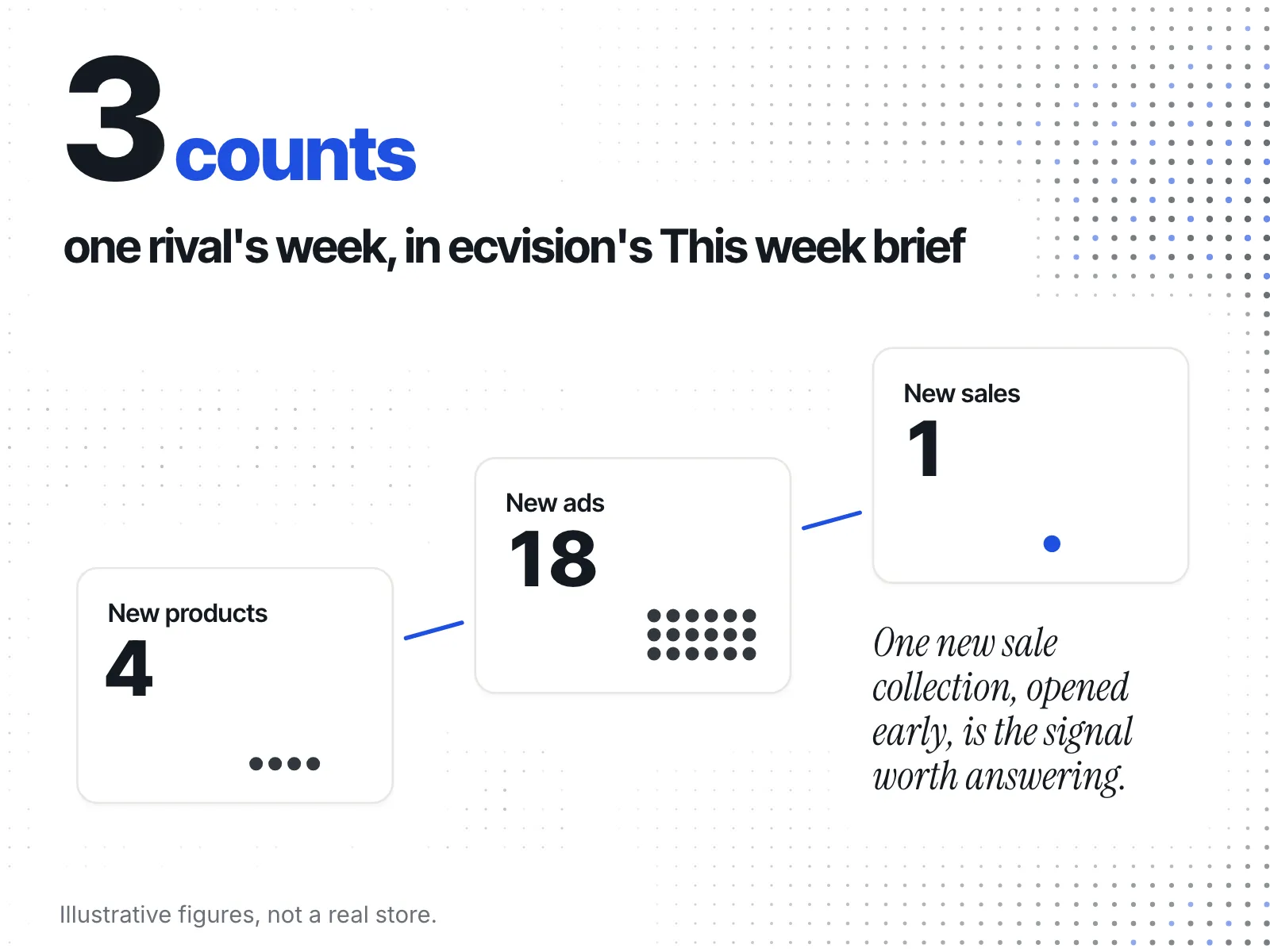
ecvision, a competitor-tracking app for Shopify stores, does this job. On ecvision's Dashboard, the "This week" tab shows each store you track with three counts, "New products", "New ads" and "New sales", each beside its earlier count. A "New sales" count is new sale collections appearing on the rival's store, not a price cut on a product that was already there. The Collections tab then labels each of a rival's collections by kind, "Sale" among them, and shows a kind only where the model "was at least 70% sure." That turns "Shopify did $14.6 billion" into "two of my three rivals opened sale collections a week before I did." You can see what ecvision tracks or check the plans.
Once the weekend starts, the questions change from planning to reacting. Our post on how a competitor changes its offer between Black Friday and Cyber Monday covers that stretch.
The numbers to plan with, in one place
- $14.6 billion in Shopify merchant sales over BFCM 2025, up 27% (24% at constant currency). Shopify, 2 December 2025, unaudited.
- Peak: 12:01 p.m. EST on Black Friday 2025, at $5.1 million per minute. Shopify.
- Hottest categories: cosmetics, clothing tops and pants, activewear, fitness and nutrition. Shopify.
- Cross-border: 16% of orders; top countries US, UK, Australia, Germany, Canada. Shopify.
- 2026 forecast: $275.1 billion US online holiday sales (up 6.7%), Black Friday $12.9 billion (up 9.2%), Cyber Monday $15.1 billion (up 6.2%), deals on par with 2025, AI traffic to US retail sites up 130%. Adobe, 28 September 2026.
- Cyber Monday 2025 peak discounts: 17% (sporting goods) to 31% (electronics). Adobe.
- Dates: Black Friday 27 November 2026, Cyber Monday 30 November 2026 ($15.1 billion forecast, Adobe).
None of these says how your rivals will play November. That part you have to watch.