Black Friday Competitor Research Checklist for Shopify
Compare what your rivals did last Black Friday with what they sell now, then pick your own offer per product line before the price war starts.
Thomas Pham ·
Black Friday 2026 is Friday, November 27. Cyber Monday is November 30. If you plan to look at your competitors' offers once their Black Friday banners go up, you are already late: by then your opening move is already decided, and you are choosing between matching in a panic or staying quiet and hoping.
Do it in the other order. Pick three to five direct rivals. Find out what they did last November: which products they discounted, how deep, when they started, and what they bundled. Compare that with what they sell today. Then decide your own offer, product line by product line, while you still have weeks to do it.
Updated 14 October 2026. Facts checked against the linked sources on 8 October 2026.
Why do this in October and not during Cyber Week?
Because the decision window closes before the sale starts. Adobe's 2026 US holiday forecast says "Black Friday will see stronger growth due to earlier discounts": US online sales of $12.9 billion on Black Friday, up 9.2% year over year, against $15.1 billion and 6.2% growth for Cyber Monday. The deep offers are moving earlier.
If rivals open their best offer on Friday or before, watching them on Monday means reacting. Researching now leaves time to set prices, build bundles and check stock against a plan you chose.
For scale, Shopify reports that its merchants sold $14.6 billion worldwide over BFCM 2025, a 27% increase on 2024. A pricing mistake on that weekend repeats on every order you take.
What actually changes in a rival's catalogue for Black Friday?
Usually one of three things: the same products at a lower price, new bundles or gift sets built for the season, or a new collection page that groups existing products under a sale banner. Each tells you something different, so tag what you find with one of the three before you judge it.
A lower price on the same SKU is the plain discount. It is easy to compare and it is the one you will feel most in your own margin if you match it.
A bundle is a way to lower the price a shopper sees per item while keeping the order value up. The bundle section further down covers how to read one.
A sale collection is often packaging. If a rival's "Black Friday edit" turns out to be last month's prices under a new banner, you do not need to respond to it at all.
The way to tell them apart is to have a "before" picture. Write down each rival's product count, typical price and price range now, in October, so that when the sale pages go up you can compare them with a baseline rather than a memory.
How do you find out what a rival did last Black Friday?
Use the Wayback Machine. Enter the address of a rival's homepage, a collection page or a best-selling product page and press "Browse History". It lists the dates that address was captured. Open the snapshots from late November 2025 and record what you see.
For each rival, write down:
- The headline offer. The banner text on the homepage: a percentage, a fixed amount, a gift with purchase, or free shipping.
- What the offer covered. Sitewide, one collection, or a handful of products.
- The prices on the pages you opened. Note the product, the sale price and the regular price if both were shown.
- Any bundles or sets. Their names, what was inside and their price.
- The dates. The first snapshot showing the offer, and the last.
Be honest about the limits. The list only holds the dates a page was captured, so a missing snapshot means you do not know, not that nothing happened. Record gaps as "unknown" instead of guessing. It is also slow work, so budget a sitting per rival rather than trying to do all of them at once.
A worked example, one rival end to end
The store here is made up, to show how the notes turn into a decision; the steps and the Adobe figure are real. Say you sell everyday apparel and your closest rival sells the same basics.
- Pull last November. In the late-November 2025 snapshots of their homepage, suppose the first one with a sale banner is from the week before Thanksgiving, the banner reads as a sitewide percentage off, and the last one with the banner is dated after Cyber Monday.
- Open the product you both sell. Suppose their best-selling tee shows a sale price and a regular price, and the gap is deeper than the 23% peak discount Adobe forecasts for apparel this Cyber Week.
- Look for bundles. Suppose a multi-pack of the tee appears in the 2025 snapshots and is still on their site today.
- Tag and map it. Same product cheaper, sitewide; plus a repeated bundle. Timing: started before Thanksgiving, extended past Cyber Monday.
- Make the call. If your margin on that tee cannot carry a discount deeper than the category's forecast peak, the call is Hold and differentiate: keep the tee's price, build your own multi-pack, and go live in the same pre-Thanksgiving week they did.
When did they start discounting, and when will they start this year?
Assume they start at least as early as last year, and check the first and last dated snapshot that showed a sale to see when that was. A useful frame is three phases: an early-access teaser to their email list or a "deals start now" banner before Thanksgiving, the main offer on Black Friday, and an extension or a final "last chance" push through Cyber Monday. Adobe's forecast puts the stronger growth on Black Friday because discounts are arriving earlier, and Adobe treats Cyber Week as the five days from Thanksgiving through Cyber Monday, forecast at $47.5 billion in US online sales, up 7.4%. If a rival opened their sale on Black Friday last year, plan for the possibility that they open earlier this time, and decide now whether you want to be live before them, with them, or after them.
How deep did they go, and should you match it?
Match only when the line is price-compared and your margin can carry the rival's depth; otherwise hold. To see the depth, write down the deepest discount each rival showed on a product you also sell, then compare it with your category's range. Adobe's Cyber Week 2026 forecast for US online shopping puts peak discounts at 30% off listed price for electronics, 29% for toys, 23% for TVs, computers and apparel, 19% for sporting goods, and 18% for appliances and furniture.
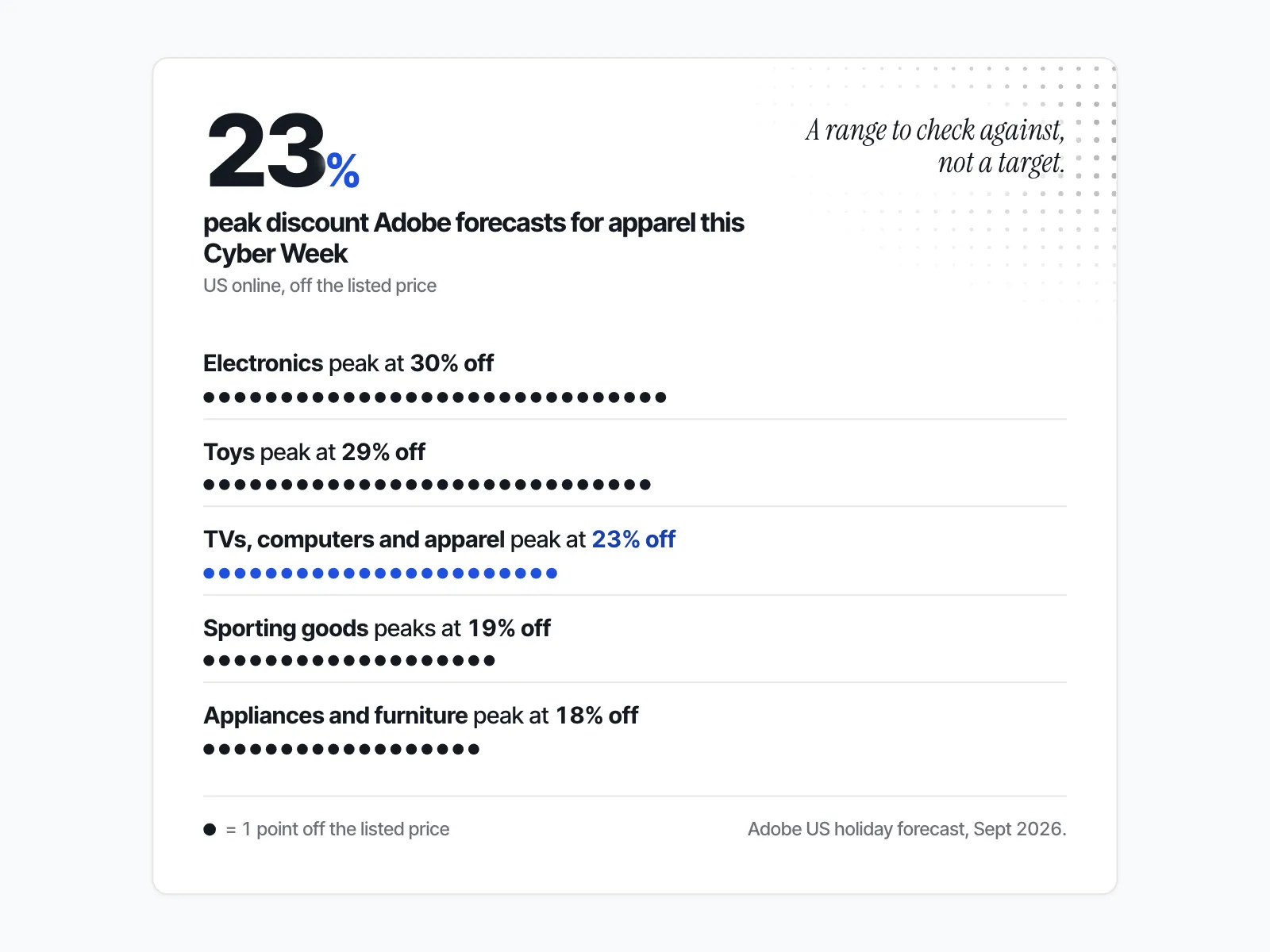
These figures tell you whether a rival is going unusually deep for the category, not what you should charge.
Matching a rival's discount is the wrong move when:
- Your margin cannot carry it. Every extra order then costs you money.
- Your customers are not buying on price. If they come for fit, quality, service or a product nobody else has, a deeper discount gives away margin to people who would have bought anyway.
- Your edge is somewhere else. A bundle, a gift, faster shipping or a limited edition can compete without touching the price of your core product.
So make the decision per product line, not per competitor. For each line, write one of three words:
| Decision | When it fits |
|---|---|
| Match | The line is price-compared, your margin can absorb the rival's depth, and losing the order costs more than the discount |
| Beat | You want this line to bring in new customers and you have priced the margin hit on purpose |
| Hold and differentiate | Margin is thin, buyers are not price-driven, or you have a bundle or exclusive the rival cannot copy |
Holding on most lines and matching on one or two is a normal result.
What did they bundle, and what does that tell you?
A bundle lets a store show a lower price per item without cutting the price of any single product. When a rival leans on bundles instead of sitewide percentages, they may be protecting the price of their hero products while still giving shoppers a reason to buy now.
For each bundle you found, note what was inside, its price, and the separate prices of the items if the pages showed them. Then look for patterns:
- A hero product paired with slower sellers suggests the rival wanted to clear stock.
- Sets in gift packaging suggest they were selling to gift buyers, not their regular customers.
- The same bundle in both years suggests it worked well enough for them to repeat it. You cannot see their sales, so treat this as a hint, not proof.
If every rival cuts the same products, a bundle of your own lets you compete without cutting your core line.
What should you watch once Cyber Week starts?
Keep a short watchlist and check it every day of Cyber Week, not once. Look at each rival's homepage banner, their sale collection, and the prices of the few products you compete with directly. Note any price change, any product marked sold out, and any offer extended past Monday.
Some categories move very fast in that week. Adobe expects US online sales of personal hygiene products to jump 150% during Cyber Week compared with September averages, clothing basics 210%, baby products 113% and pet products 93%. If you sell in one of those, a rival running out of stock on Saturday can change what you should do on Sunday.
How does ecvision help with this?
ecvision is competitor intelligence for Shopify, and it keeps the "before" picture for the stores you track. On the Products page, the catalogue summary lists each tracked store with its number of products, median price and price range, and a line above the table says when those catalogues were last read in full ("Last full read …"). That is the October baseline of product count, typical price and price range, kept for you instead of in a spreadsheet.
Once you track two or more rivals, the Agent page opens with suggested questions such as "Which rivals launched new products this week?" and "What is [rival] advertising right now?", and you can type your own question in plain words. See the plans on the pricing page, or start from the ecvision homepage.
Your Black Friday competitor research checklist
Run this over the next few weeks, a little at a time:
- Pick three to five direct rivals. Stores your customers actually compare you with.
- Record today's baseline. Product count, typical price and price range for each.
- Pull last November from the Wayback Machine. Headline offer, coverage, prices, bundles, first and last dates. Write "unknown" where there is no snapshot.
- Tag each change. Same product cheaper, new bundle, or new sale page.
- Map their timing. Before Thanksgiving, Black Friday, or extended past Cyber Monday.
- Compare their depth with your category range. Use Adobe's figures as a sanity check.
- Decide per product line. Match, beat, or hold and differentiate, and write down why.
- Plan your own dates. Decide whether you go live before, with or after your rivals.
- Set a Cyber Week watchlist. Banners, sale pages and a few key prices, checked daily.
Spread the research over a few sittings, and have your offer for November 27 written down before October ends.