How to see a competitor's holiday shipping cut-off
Find each rival's "order by" date for Christmas, check it against the 2026 USPS, UPS and FedEx deadlines, and know what to do the day theirs passes.
Thomas Pham · · Updated · 8 min read

To see a competitor's holiday shipping cut-off, find their "order by" date in the five places they publish it, then hold it up against the carrier's own 2026 deadline.
Updated 3 November 2026.
Before Christmas, a shopper who hasn't ordered yet is choosing on one thing: will it arrive in time. The gap between a rival's date and the carrier's tells you what they're promising, and the day theirs passes is your opening.
Early deals now start in the first week of November: Target's run 5–7 November (Target, 21 October 2026) and Best Buy's from 6 November (9to5Toys, 27 October 2026). Those sale-start signals are covered in how to see when competitors start their Black Friday sale. This post picks up after Cyber Monday, when the race is about the calendar, not the price.
Where does a competitor post its holiday shipping cut-off?
A rival can publish its last day to order in five places you can read from outside: the announcement bar across the top of the site, the shipping or FAQ page, a delivery estimate on the product page or at checkout, their ad copy, and their holiday emails. Check all five, because they don't always agree.
- Announcement bar. The thin strip above the header.
- Shipping or FAQ page. Usually the most complete version: one date per shipping method, sometimes a separate line for express.
- Product page and checkout. If the store shows a delivery estimate, note the date it gives today. Shopify's Shop Promise feature lets a merchant "Display estimated delivery dates to customers during checkout and throughout their order journey", so the estimate can sit later in the funnel than the product page.
- Ads. Meta describes its Ad Library as showing "all active ads running across products from Meta". Search the brand and read the copy for a date. How the libraries compare across Meta, Google and TikTok is in Meta Ad Library vs Google Ads Transparency vs TikTok.
- Emails. Sign up to each rival's list before December, so their deadline email reaches you.
Write down what each place says and the day you read it. A shipping page left over from last year, or a bar that says "order soon!" with no date, is a finding too.
What are the carriers' own 2026 holiday deadlines?
USPS published its 2026 dates on 22 September. For delivery before 25 December in the contiguous US, its recommended send-by dates are 17 December for Ground Advantage and First-Class Mail, 18 December for Priority Mail and 19 December for Priority Mail Express. FedEx's dates run from 15 to 24 December by service, UPS's from 21 to 23 December.
| Carrier and service | Last recommended day to send (2026) |
|---|---|
| USPS Ground Advantage, First-Class Mail | Thursday 17 December |
| USPS Priority Mail | Friday 18 December |
| USPS Priority Mail Express | Saturday 19 December |
| FedEx Ground Economy | 15 December |
| FedEx Ground / Home Delivery | 17 December (5-day transit) to 23 December (1-day transit) |
| FedEx Express Saver | 21 December |
| FedEx 2Day, 2Day AM | 22 December |
| FedEx First, Priority and Standard Overnight | 23 December |
| FedEx SameDay | 24 December |
| UPS 3 Day Select | Monday 21 December |
| UPS 2nd Day Air | Tuesday 22 December |
| UPS Next Day Air | Wednesday 23 December |
The USPS dates are from USPS's holiday shipping page, read on 27 October 2026. For Alaska, Hawaii, Puerto Rico and US territories, USPS doesn't give Ground Advantage a fixed date there — its table marks that row "see below" and footnotes a 10-day-or-more service expectation that varies by location. First-Class, Priority Mail and Priority Mail Express keep the same 17/18/19 December dates for that region. The FedEx dates are FedEx's own 2026 chart for arrival by 24 December. Its PDF blocked our direct fetch, so the figures come from ValueAddedResource's 2026 deadline roundup, which quotes the chart. The same roundup gives the USPS publish date.
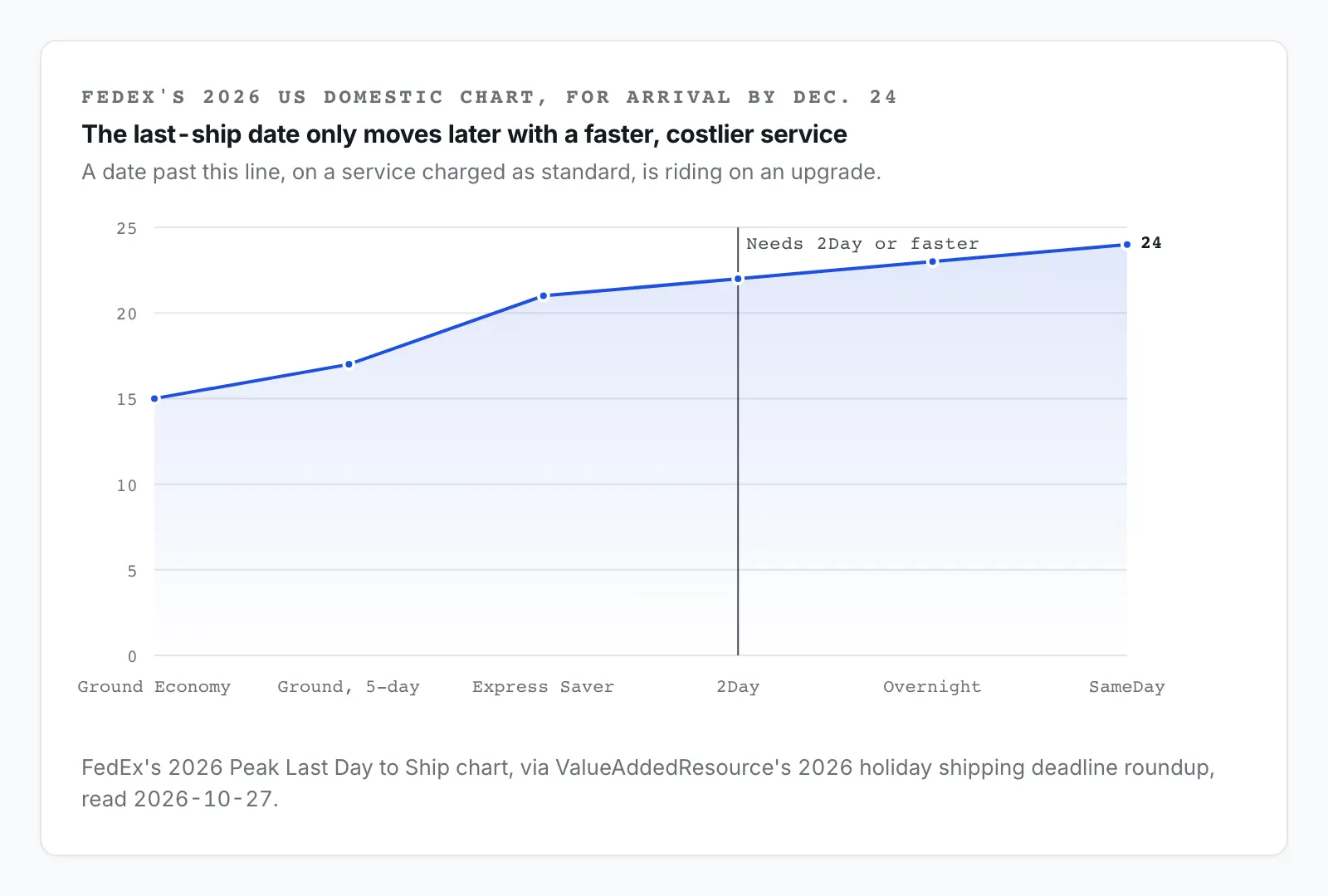
The line only moves right when the service gets faster. A rival's "order by" date that sits past where a service tier lands is not a standard-shipping promise — it's riding on a tier further right on this line.
None of these is a guarantee. USPS says "Actual delivery date may vary and is based on origin, destination, Post Office™ acceptance time, and other conditions." FedEx Ground's range exists because, per the roundup, "Ground and Home Delivery transit times vary by origin and destination ZIP code, so FedEx recommends checking specific transit times before shipping."
What are UPS's 2026 last days to ship?
For delivery on Thursday 24 December, UPS recommends shipping by 21 December for 3 Day Select, 22 December for 2nd Day Air and 23 December for Next Day Air. UPS Ground has no single date: UPS says to check transit time at ups.com/ctc.
The dates are from UPS's 2026 year-end holiday schedule, read on 30 October 2026.
How do you read a rival's date against the carrier's?
Work out which service their stated date has to ride on, then compare it with that carrier's last day. A rival's date usually falls into one of three buckets: inside the carrier's window, past it on the method they're charging for, or comfortably early.
Say you sell scented candles, and a rival's announcement bar reads "Order by 22 December for Christmas delivery" next to their free standard shipping. If standard means a ground service, USPS Ground Advantage's last recommended day is 17 December. FedEx Ground covers 22 December only for 2-day transit, so their promise holds only where FedEx Ground transit is two days or less. A 22 December date on free shipping is most often one of two things. Either they quietly upgrade late orders to something faster at their own cost, or the promise is ahead of what the carrier supports. Check their shipping page. If it lists an earlier date for standard and a paid express option for the 22nd, the bar is an upsell. If it doesn't, the bar is a promise they may not keep.
Now flip it. If their bar says 14 December for standard, they've left days of slack before USPS's 17 December. They're protecting themselves, which leaves you a few more days to sell to their customers.
| Their stated date vs the carrier's last day | What it most likely means | What it means for you |
|---|---|---|
| Inside the carrier's window for the method they charge for | A realistic promise | Match or beat it only if your carrier allows |
| Later than the carrier allows for that method | A paid upgrade, a quiet upgrade, or a promise at risk | Their late buyers may be disappointed; be the dependable option |
| Well before the carrier's last day | A safety buffer | You have days to sell after theirs passes |
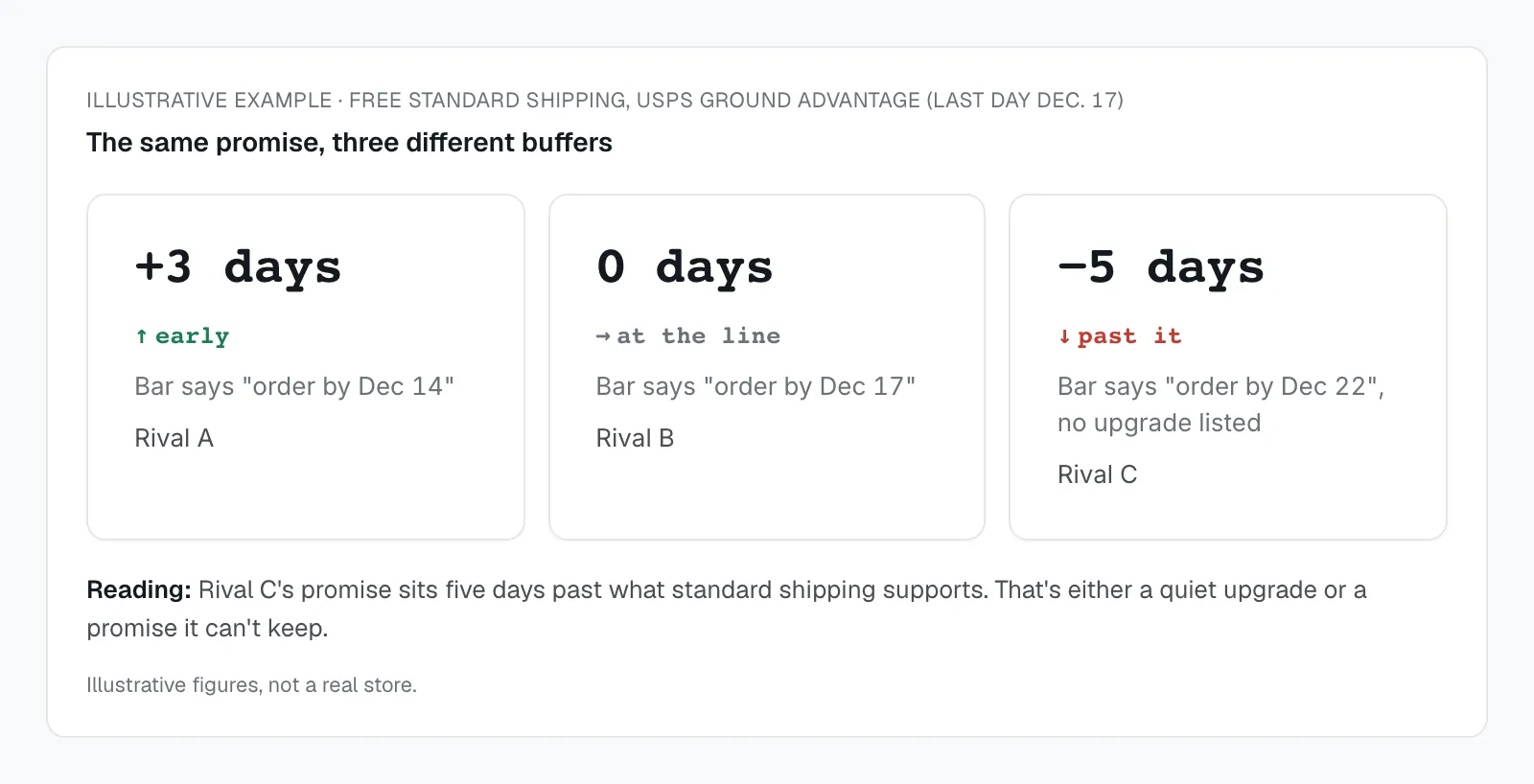
Read the date against the method, not against the words around it.
What should you do when your cut-off is later than theirs?
Say so, on the day theirs passes. A shopper who misses a rival's deadline is looking for someone who can still deliver. Put your own date in the announcement bar, on the product pages that compete with theirs, and in the ads and email you have running that day.
Be exact. "Order by 18 December for Christmas delivery on Priority" is a promise a shopper can act on. "Fast shipping!" is not. Then make sure it's true: your date should sit inside your carrier's window for the method you name, using the table above.
What if your cut-off is earlier than theirs?
Then you either buy time or sell something that doesn't need shipping. Add an express option with its own, later date, so a late shopper still has a way to order from you. Or move your last week of holiday ads to e-gift cards, which don't depend on a carrier at all.
Make the dates real in your own store first. Shopify's shipping setup lets you "Set business days, holidays, and cutoff times for order processing", and per-product and per-location processing times feed its delivery estimates. Set those before you announce a date, so your checkout and your banner say the same thing.
If a rival's best seller is also running low as their deadline nears, the stock side is in how to spot a competitor stock-out during BFCM.
How do their ads change once a cut-off passes?
The copy moves from a delivery date to something that doesn't need one. Watch for ads naming an "order by" date to stop running, and for new ads about gift cards, e-gift cards or in-store pickup to start. That switch tells you, in public, that they've stopped promising Christmas delivery.
Read it in the Ad Library around their stated date. If ads still name a delivery date after the carrier's last day for the method they sell, note it. Either they've upgraded shipping, or the ad was never updated.
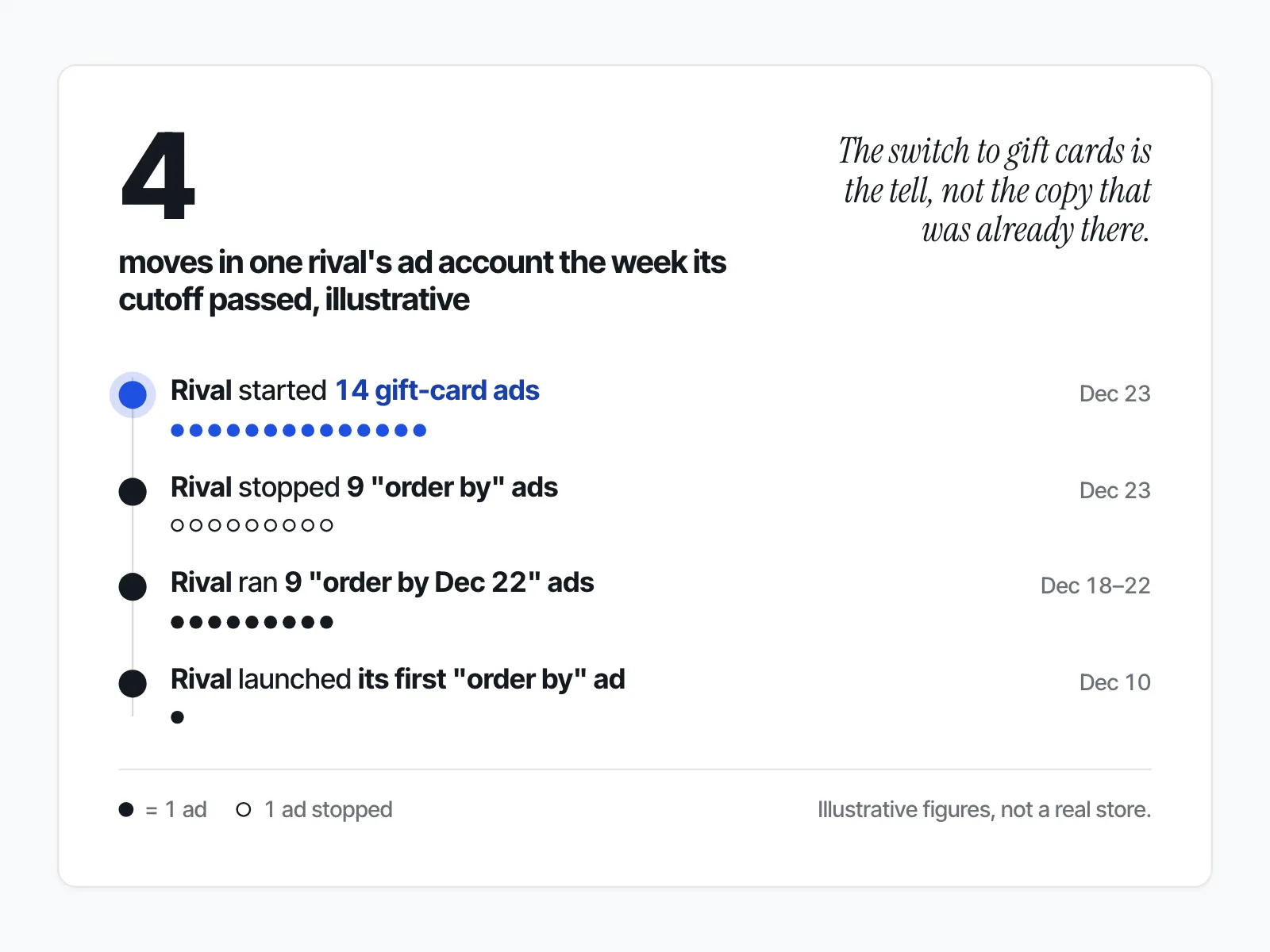
The stop and the start land on the same day. That pairing, not either move alone, tells you their cut-off just passed.
How do you watch several rivals' cut-offs without checking every day?
Pick three to five direct rivals and read all five places on a fixed schedule: once when their first holiday date goes up, then on your carrier's last days, and on each rival's own stated date. Log the date you read it, the place, their stated date, the shipping method and whether it fits the carrier's calendar.
This is the same habit as the weekend log in what changes between a competitor's Black Friday and Cyber Monday, run into December.
ecvision takes the ad side of that sweep off your hands. On the Ads screen, the Status filter has three options: All, Running and Ended, and each ad card shows how long it has been Running for. Set Status to Running to see a rival's live ads, then to Ended after their date to see which delivery-date ads came down. On the Dashboard, the weekly brief shows Ads started this week with its date range, a New ads count, and Products published this week with a New products count. So a rival's last-minute campaign or newly published products show up in your weekly read without opening their site. ecvision shows you the ads and products; it doesn't read the copy for a date. That read is yours. Plans are on the pricing page.
The holiday cut-off checklist
- Before December: sign up to each rival's emails and note their shipping-page URL.
- When their dates go up: log every date from all five places, with the shipping method.
- Against the carriers: check each date against the carrier rows for that method.
- Their date later than the carrier allows: look for a paid upgrade on their shipping page, and position yourself as the dependable option.
- Their date passes and yours hasn't: say your exact date in the bar, on competing product pages, and in that day's ads and email.
- Yours passes first: offer express with its own date, or switch to gift cards.
- After their date: check whether their delivery-date ads have ended and gift-card ads have started.