Why Meta CPMs Rise on Black Friday, and What to Do
Meta ads cost more on Black Friday because more brands bid for the same people. Last year's numbers, why cutting spend didn't help, and how to check rivals.
Thomas Pham · · 8 min read
Your Meta ads cost more on Black Friday because almost every ecommerce brand raises its budget in the same few weeks, and Meta sells impressions through an auction. More bidders for the same people push the price up. Nothing is broken in your account, and cutting your own spend won't make it go away.
Black Friday 2026 falls on Friday 27 November and Cyber Monday on Monday 30 November, per the US rule that fixes Thanksgiving as "the fourth Thursday in November". So the useful questions now are how big the jump was last year, why it happens, and whether your own rivals are adding ads into the same window.
How much do Meta CPMs rise around Black Friday?
In 2025, the median brand in the analysis by Lebesgue, a marketing analytics platform for ecommerce brands, of its biggest Meta spenders paid 59% more per 1,000 impressions in Black Friday week than in September. On Black Friday itself, 28 November 2025, the gap reached 84%. This year's figure is unknown until the week happens.
CPM means cost per 1,000 impressions: what you pay for your ad to be shown a thousand times. Here is how last year's rise built, day by day, as the median change against September:
| Day in 2025 | What it was | Median CPM vs September |
|---|---|---|
| 10 November | First clear daily rise | +13% |
| 20 November | One week before Thanksgiving | +27% |
| 27 November | Thanksgiving | +53% |
| 28 November | Black Friday | +84% |
| 1 December | Cyber Monday | +71% |
| 3 December | Wednesday after Cyber Monday | +20% |
Source: Lebesgue, read 13 November 2026.
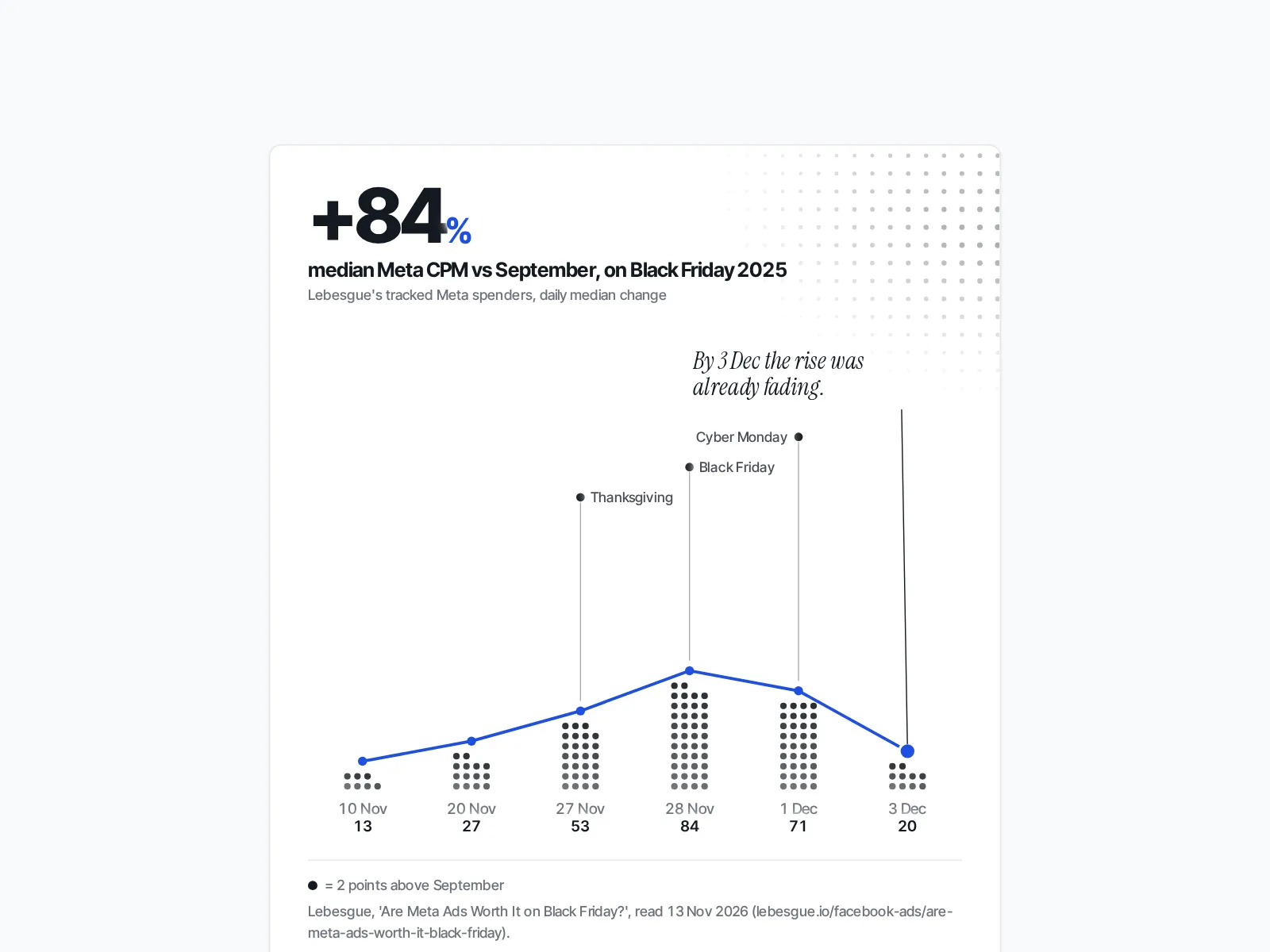
These are a vendor's numbers from its own customers. Lebesgue says it "analyzed $22.6 million in Meta spend from September through November 2025", drawn from the biggest Meta spenders on its platform. That is a real sample, but it is not a census of every advertiser on Meta. The direction matters more than the exact percentage.
Why does Meta charge more per impression in November?
Meta CPMs climb in November because more advertisers want the same audiences at the same time. Lebesgue puts it simply: "Meta sells impressions through an auction, so more bidders push prices up." In November, it adds, "almost every ecommerce brand raises budgets at the same time."
How one ad wins. Meta's own page on the ad auction describes how it picks which ad to show. It sets its system apart from those "traditional auctions that pick the winner based on the highest bid", and says "the estimated action rate and ad quality are combined to measure how relevant the ad is." Ad quality is judged from several signals, including checks for clickbait language. So a more relevant ad can beat a bigger bid.
Why the overall price goes up. Meta's page does not talk about seasons, competition or cost at all. The November rise is plain auction economics, and Lebesgue frames it that way. More brands bid for the same audience, so the price that clears each auction rises for everyone, relevant ads included.
Does cutting your own budget avoid the rise?
A smaller budget does not avoid the rise: your CPM is set by how many other advertisers want the same people, not by your spend. Lebesgue reports that "one fashion brand spent 60% less than in September and still saw its CPM rise 78%." Cutting spend lowers your total bill, but each impression still costs the going rate.
Pulling budget can still be the right call for your cash. Just know it won't bring the price per impression back to September levels. The auction is crowded whether you are in it or not.
Does every category get hit the same?
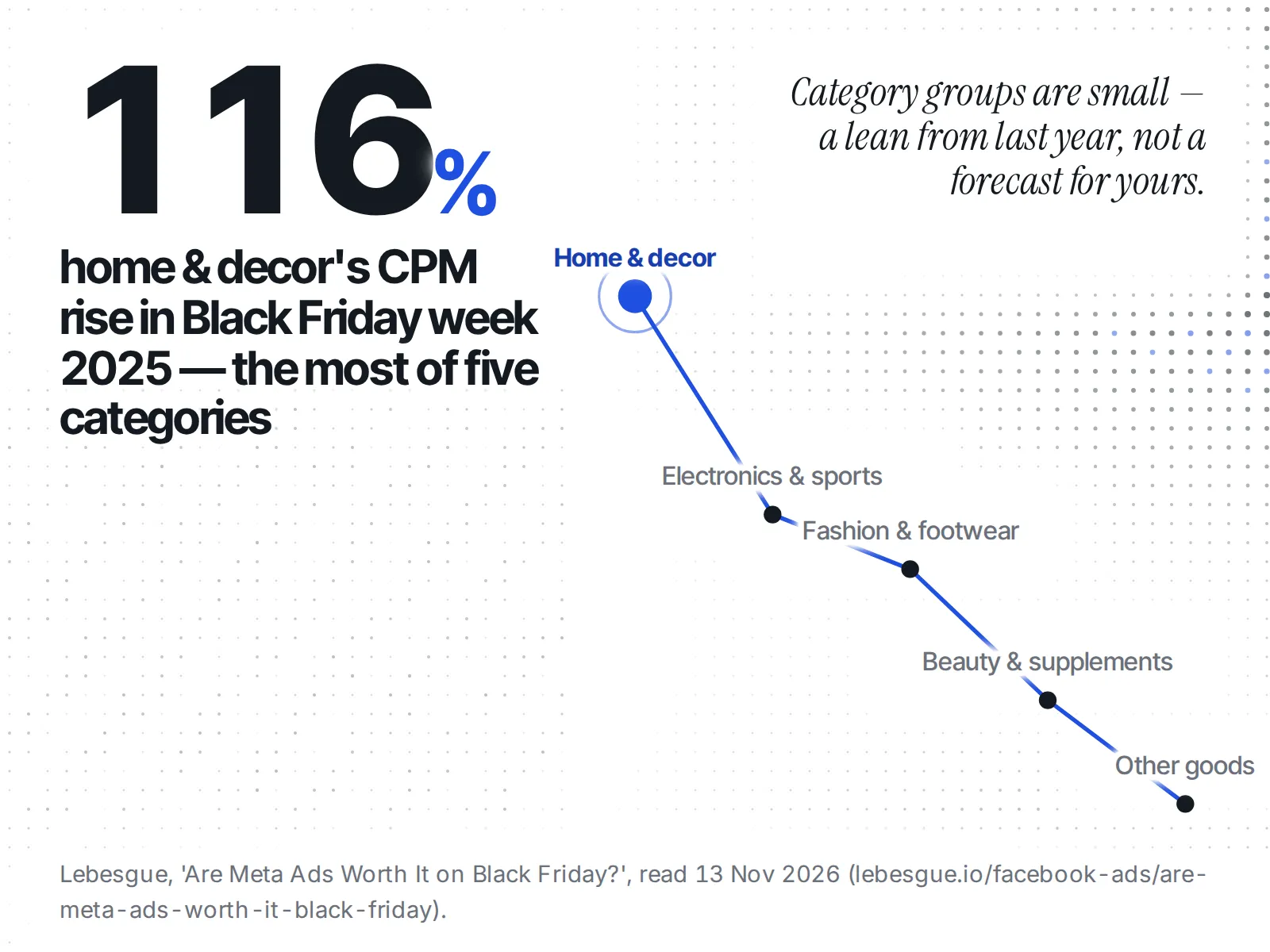
Categories were not hit the same: in 2025 the Black Friday CPM rise differed a lot by category. In Lebesgue's 2025 data, home and decor brands saw the median CPM in Black Friday week more than double against September, while the "other accessories & home goods" group rose by less than a quarter.
| Category (Lebesgue's grouping) | Median CPM change, Black Friday week 2025 vs September |
|---|---|
| Home & decor | +116% |
| Electronics & sporting goods | +76% |
| Fashion & footwear | +66% |
| Beauty, health & supplements | +42% |
| Other accessories & home goods | +23% |
"Home & decor" and "Other accessories & home goods" are separate groupings in Lebesgue's data, so their results don't contradict each other. Lebesgue flags that its category groups are small and not market-wide benchmarks. Treat the table as a rough guide to which way your category leaned last year, not a forecast for yours this year.
Is the Black Friday CPM spike getting worse every year?
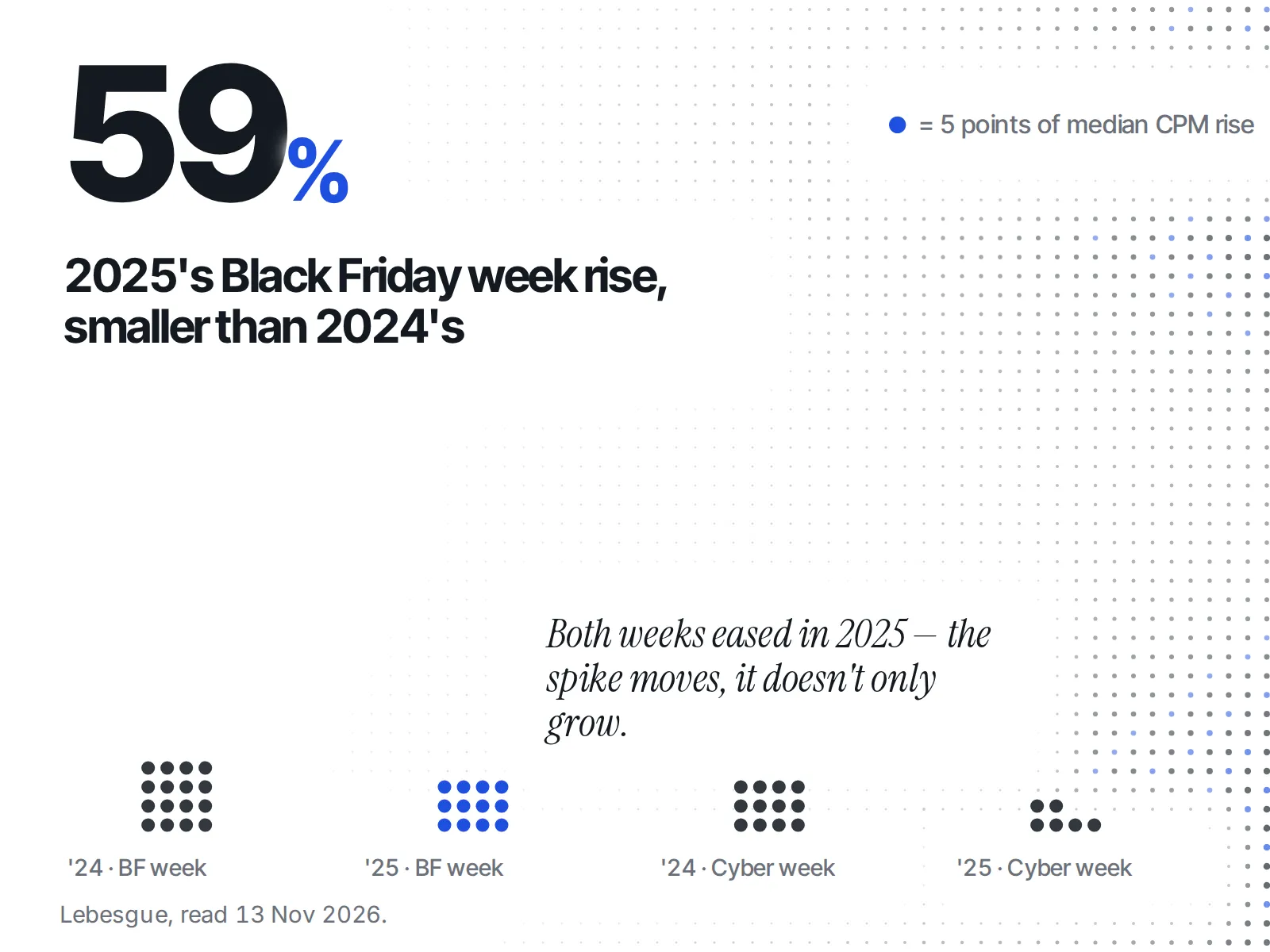
The Black Friday CPM spike was later and smaller in 2025 than in 2024, not worse. In Lebesgue's data, the first week at least 10% above September moved from 14 October to 10 November, and Black Friday week went from +80% to +59%. The spike is real, but it moves.
| Lebesgue measure | 2024 | 2025 |
|---|---|---|
| First week at least 10% above September | 14 October | 10 November |
| Black Friday week, median CPM change | +80% | +59% |
| Cyber week, median CPM change | +58% | +31% |
A second source points the same way on direction, with a different measure. The Cyber Five 2024 report from Tinuiti, a media agency, drawn from its own Meta advertisers, found CPM rose 12% year over year across Thanksgiving to Cyber Monday 2024, with the biggest daily jump on Thanksgiving at 16%. That was "far eclipsing the 3% CPM growth observed over the entirety of the Cyber Five" in 2023. Note this compares one year with the year before, not November with September, so its numbers are not comparable with Lebesgue's.
Lebesgue's data shows the full shape: prices climb into Thanksgiving, peak around Black Friday and ease after Cyber Monday. Tinuiti's report stops at Cyber Monday, so it confirms the rise but not the ease. How high they go, and when they start, changes from year to year.
Is Meta still worth it in Black Friday week?
For the median brand Lebesgue tracked in 2025, yes, because shoppers bought more readily. In that data, the median brand's cost per purchase fell 20% in Black Friday week and its Meta-reported ROAS (return on ad spend) rose 19%, even as CPM rose. Its conversion rate rose 48%, which more than offset the pricier impressions.
So a pricier impression is not automatically a worse deal. What matters is whether your offer converts well enough that week to absorb the higher price. That is a question about your offer, not about Meta.
If Meta still feels too expensive for your margins, other channels are worth a look. Before you move budget, see whether your rivals are already there: our guide to free ways to track a competitor's TikTok ads shows how to check.
How can you tell if your own rivals are adding ads?
Look at their live ad count and when their newest ads started, then compare it with a normal week. A vendor's median describes thousands of accounts. Your auction is decided by the handful of brands chasing your customers, and you can watch what they do.
Say, hypothetically, you sell scented candles, and you watch four rival candle and home-fragrance stores. If three of them launch a batch of new ads in mid-November, your corner of the auction is getting crowded on the same timetable as Lebesgue's curve. If none of them has added anything, the national average may overstate what you are up against, and the jump in your account may be coming from bigger brands outside your niche.
Here is the check, step by step, with what each step shows.
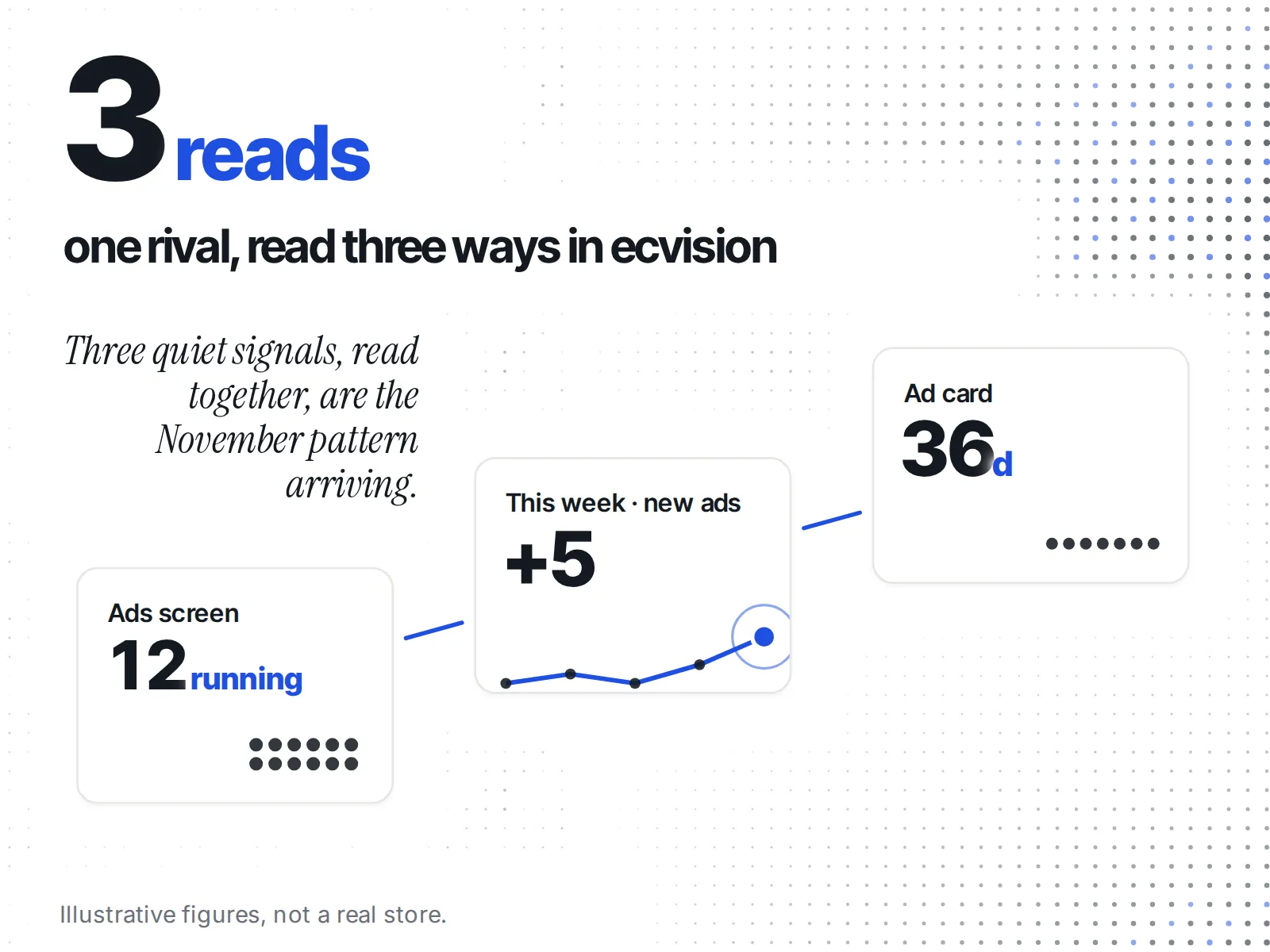
- Count what is live. In ecvision, the Ads screen for each watched store carries a summary line in the form "N ads · M running": every ad tracked for that store, and how many are active now. A running count that grows in November is a rival adding to the auction you're in.
- See what started this week. The Dashboard's weekly brief has a strip headed "Ads started this week", with the dates of that week. When nothing new has started, the strip shows "Newest ads" instead, which tells you the rival has been quiet.
- Compare with the week before. The same brief's "New ads" count shows this week's number next to the week before's, for each tracked store. One busy week means little. Two or three rising in a row, across several rivals, is the November pattern arriving in your niche.
- Check how long their ads have run. Each ad card shows "Running for" a number of days, and marks whether the ad is still live. For a live ad the figure is a floor, shown as "at least", because the ad hasn't stopped yet. A rival that keeps an ad live for weeks is choosing to keep it in the auction.
You can do the same by hand in Meta's Ad Library, one rival at a time. Our comparison of the Meta Ad Library, Google Ads Transparency and TikTok's library covers what each one shows and where it stops. ecvision runs the count across every store you watch and puts it in one weekly brief; plans are on the pricing page.
What should a small brand do before 27 November?
Get your Black Friday ads live before the steepest part of the rise, give Meta's auction your most relevant creative, and decide your budget from your rivals' activity and your offer, not from panic about your CPM. In 2025, the rise was already visible by 10 November.
- Launch before the peak. Last year the median CPM was 27% above September a week before Thanksgiving and 84% above it on Black Friday. Ads that start earlier spend their early days at a lower price. Our post on when to start Black Friday ads covers the timing in detail.
- Put relevance first. Meta says the estimated action rate and ad quality decide how relevant an ad is, and that clickbait language counts against quality. In a crowded auction, that is the part you control. Meta lists "five components: matching objective, targeting, enough budget, enough time, and compelling ad content."
- Budget for the price, not around it. Judge the week on cost per purchase, not CPM alone.
- Watch your own rivals. Check whether the brands you compete with are adding live ads and new ads week over week. That tells you whether the national curve is your curve.
- Keep this year an open question. 2025 was later and smaller than 2024. Nobody knows 2026's number until the week arrives, so plan for a rise without assuming last year's size.