How to Read a Rival's Black Friday Shipping and Returns
Read a rival's free-shipping threshold and holiday return window together with its final-sale rule, then decide what to match before Black Friday.
Thomas Pham · · 8 min read

To read a competitor's free returns and shipping policy, open their shipping and refund policy pages, write down the free-shipping threshold, the return window and any holiday extension, then read the final-sale rule next to that window. The exclusion often decides how generous the policy really is. Do it now: Black Friday 2026 is 27 November and Cyber Monday is 30 November.
If you sell clothes, returns are the cost you feel most and see least. A rival's shipping and returns terms are where they show how much of that cost they are willing to carry over BFCM. Those terms are public. It is easy to read the headline ("free returns!") and miss the line underneath that changes it.
Where does a rival publish its shipping and returns terms?
On a Shopify store, the terms sit on two fixed pages: /policies/shipping-policy and /policies/refund-policy. Shopify generates both from the store's admin, and links to them appear in the checkout footer by default. The shipping policy link also shows on product pages and in the cart.
That comes from Shopify's own Help Center page on store policies, which lists the generated URLs and says "A link to your shipping policy is listed on your product pages and your cart." So for most Shopify rivals you can type their domain plus /policies/refund-policy and land on the real text.
Check these places, in this order:
- The refund policy page (
/policies/refund-policy). The return window, what is excluded, refund or store credit. - The shipping policy page (
/policies/shipping-policy). Rates, the free-shipping threshold, delivery estimates. - The help or FAQ pages. Some brands keep their terms here instead: Gymshark's are on its support site.
- The banner across the top of the store, if the rival runs one.
- The cart. Some carts show a bar that fills as the basket nears free shipping. That bar is not a Shopify feature: Shopify's free shipping help page only covers offering "free shipping based on order value", and the bars on the App Store are sold as add-ons. Seeing one tells you the rival paid attention to the threshold, nothing more.
Take a screenshot of each page with the date in the file name. If a rival edits its terms before the sale, you will want to know what changed and roughly when.
What should go in a side-by-side comparison?
Seven levers decide a shipping and returns offer: the free-shipping threshold, the shipping cost below it, the delivery estimate, the return window, any holiday extension, who pays return postage, and what is excluded as final sale. Put each rival in a column and each lever in a row. Gaps are findings too.
Here are two public apparel brands, read from their own pages on 7 November 2026:
| Lever | Gymshark (US) | Everlane (US) |
|---|---|---|
| Free-shipping threshold | Orders over $75 | Orders over $75 |
| Standard shipping below it | $6, 3–6 working days | $8, 4–7 business days |
| Return window | 30 days from delivery | 30 days from ship date (US & Canada) |
| Holiday extension | Bought 1 Nov 2026 – 1 Jan 2027: returnable until 31 Jan 2027 | None found on the refund policy page |
| Return postage | Not stated | Free in store, at Return Bars or by mail |
| Refund or credit | Original payment method only | Refund, or store credit if you choose |
| Final sale | Items with a final discount of 60% or more | Items "marked as Final Sale", no discount level stated |
Sources: Gymshark delivery information, Gymshark returns policy, Gymshark US returns policy, Everlane shipping policy, Everlane refund policy.
Two things stand out. Both set free shipping at $75, so neither is undercutting the other on basket size. And the real differences sit lower down: time on one side, postage on the other.
How do you read a return window and a final-sale rule together?
Read the window first, then ask which BFCM items the exclusion removes from it. A long holiday window looks generous. If a separate final-sale rule takes the deepest markdowns out, the shoppers buying those markdowns never get that window. The two rules sit on the page apart, so most people read only one.
Gymshark shows this clearly. Its returns page says: "Purchases made between 1st November 2026 and 1st January 2027 can be returned up until 31st January 2027." An order placed on 1 November therefore gets about three months instead of the usual 30 days. Its US returns page separately says that "items with a final discount of 60% or more are 'Final Sale'" and are "not eligible for returns, exchanges, refunds, or store credit." The holiday extension text says nothing about final sale.
The pattern is wider than Gymshark. Saucony's US returns page says orders placed "between October 1 and December 31, 2026 can be returned through January 31, 2027." Altitude Sports' help centre says orders placed "between November 2 and December 7, 2026 are eligible for returns until January 8, 2027."
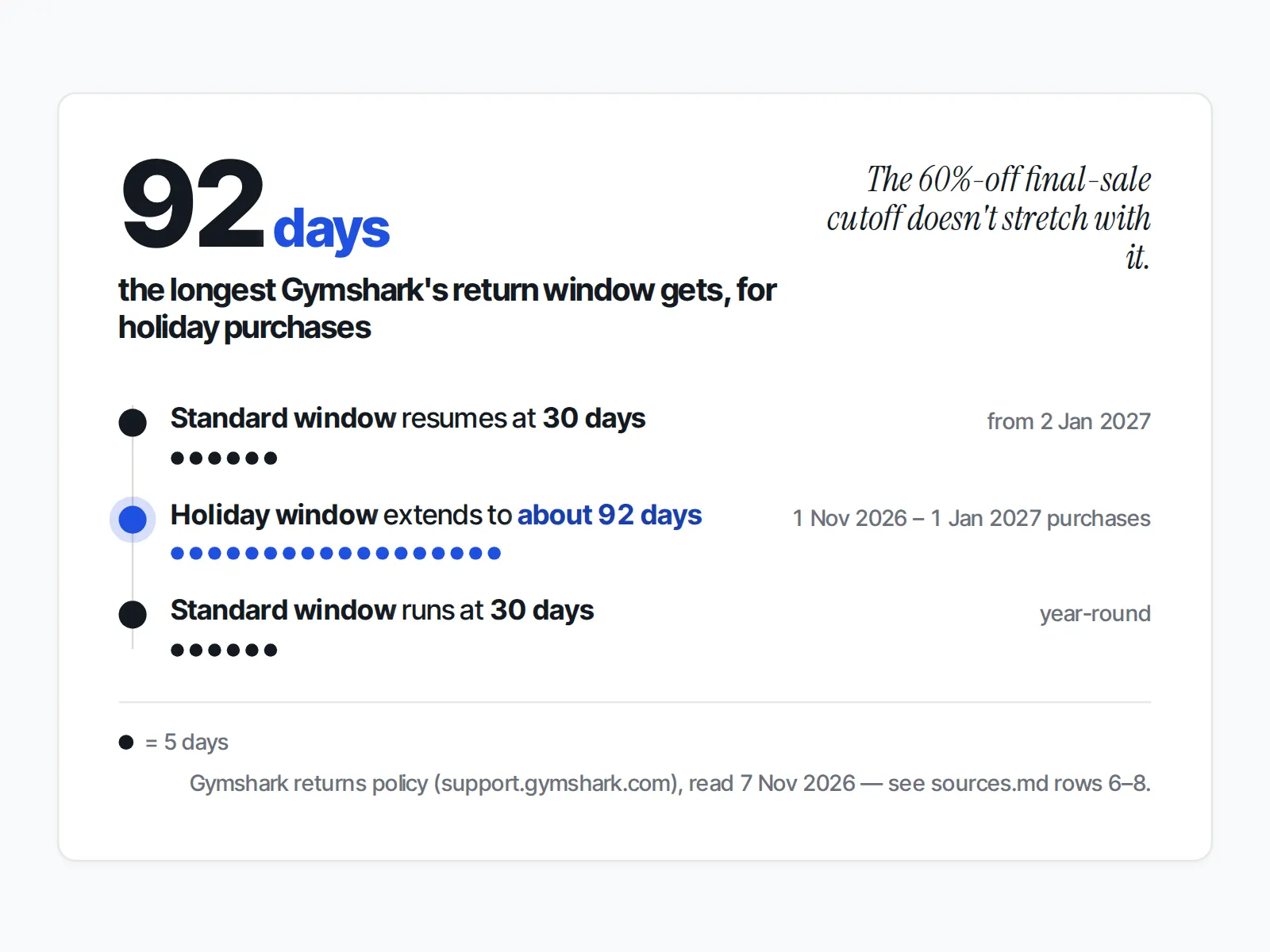
Put as a shape, the asymmetry is obvious: the window triples, the exclusion doesn't move.
So the method is three steps:
- Note the window and the holiday extension, with exact dates.
- Find the final-sale or exclusion rule, and note whether it is tied to a discount level.
- Compare that level with the rival's BFCM discount depth. If their sale goes past the cut-off, the extended window covers less of the sale than it seems to.
Everlane is the contrast. Its exclusion has no stated discount level: "items marked as Final Sale cannot be returned or exchanged." The refund page does not say which items carry that label. In exchange, every return is free, which removes the postage question that Gymshark's page leaves open.
What does a generous holiday policy tell you about a rival?
A generous holiday policy shows how much return risk a rival carries, and where they drew the line. A longer window on full-price items paired with a hard cut-off on deep discounts says: we will take returns on margin we can afford, not on clearance. Free return postage says the rival would rather pay the shipping than lose the sale.
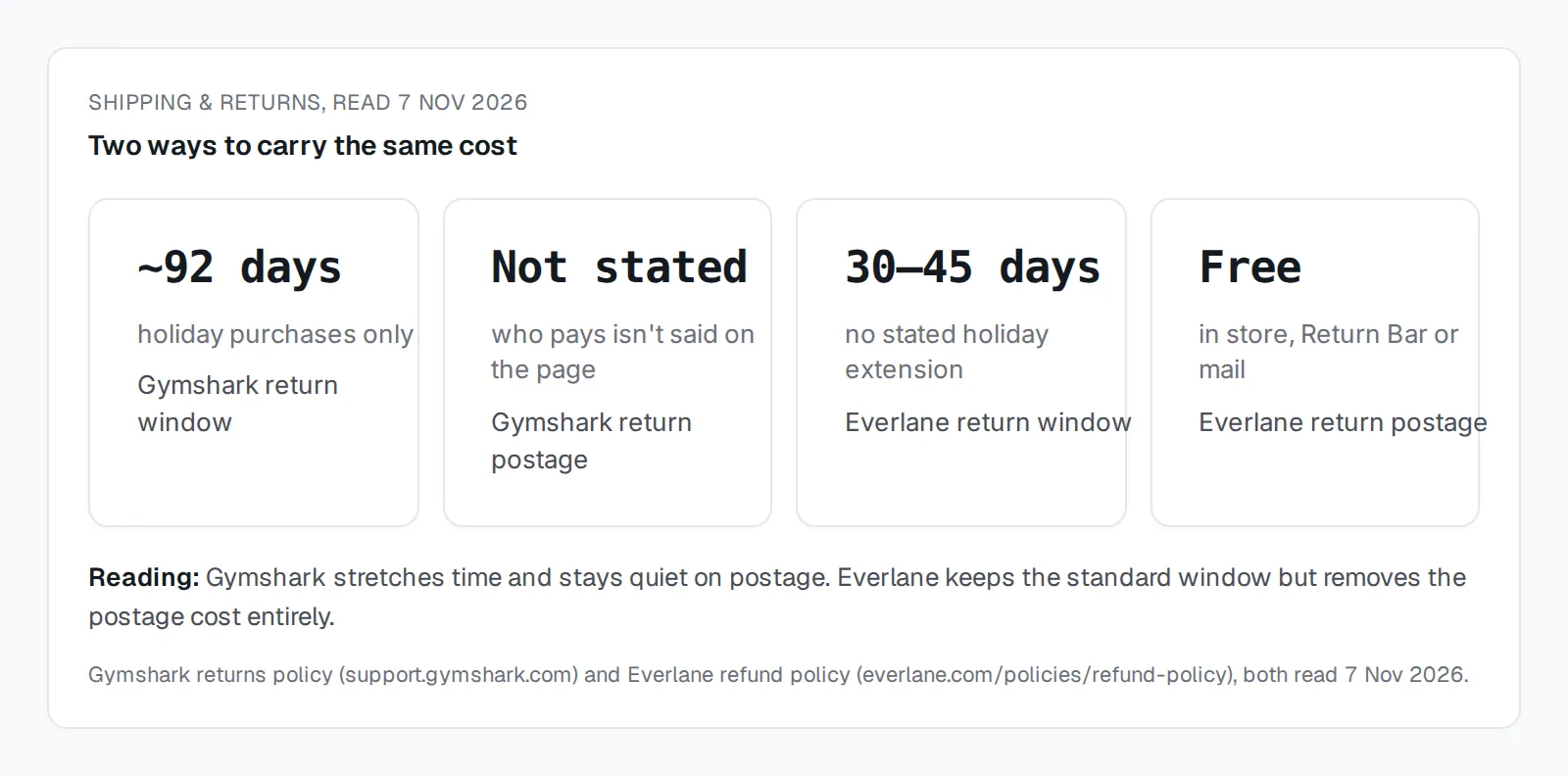
Read Gymshark's pair of rules that way. It extended the time, but did not loosen the discount exclusion. Everlane showed no holiday extension but took the postage cost off the shopper. Both are choices about the same cost, made in different places.
These are readings of a public page, not facts about the business. A generous window can be a gift-season promise more than a sign of risk appetite, especially if the exclusion quietly covers most of the sale.
What can't a policy page tell you?
A rival's policy page cannot show its return rate, what each return costs them in postage and handling, or how many returns they actually refund rather than refuse. Gymshark's page does not even say who pays return postage; it asks customers to "keep any proof of return postage receipts", which is not the same as saying the customer pays.
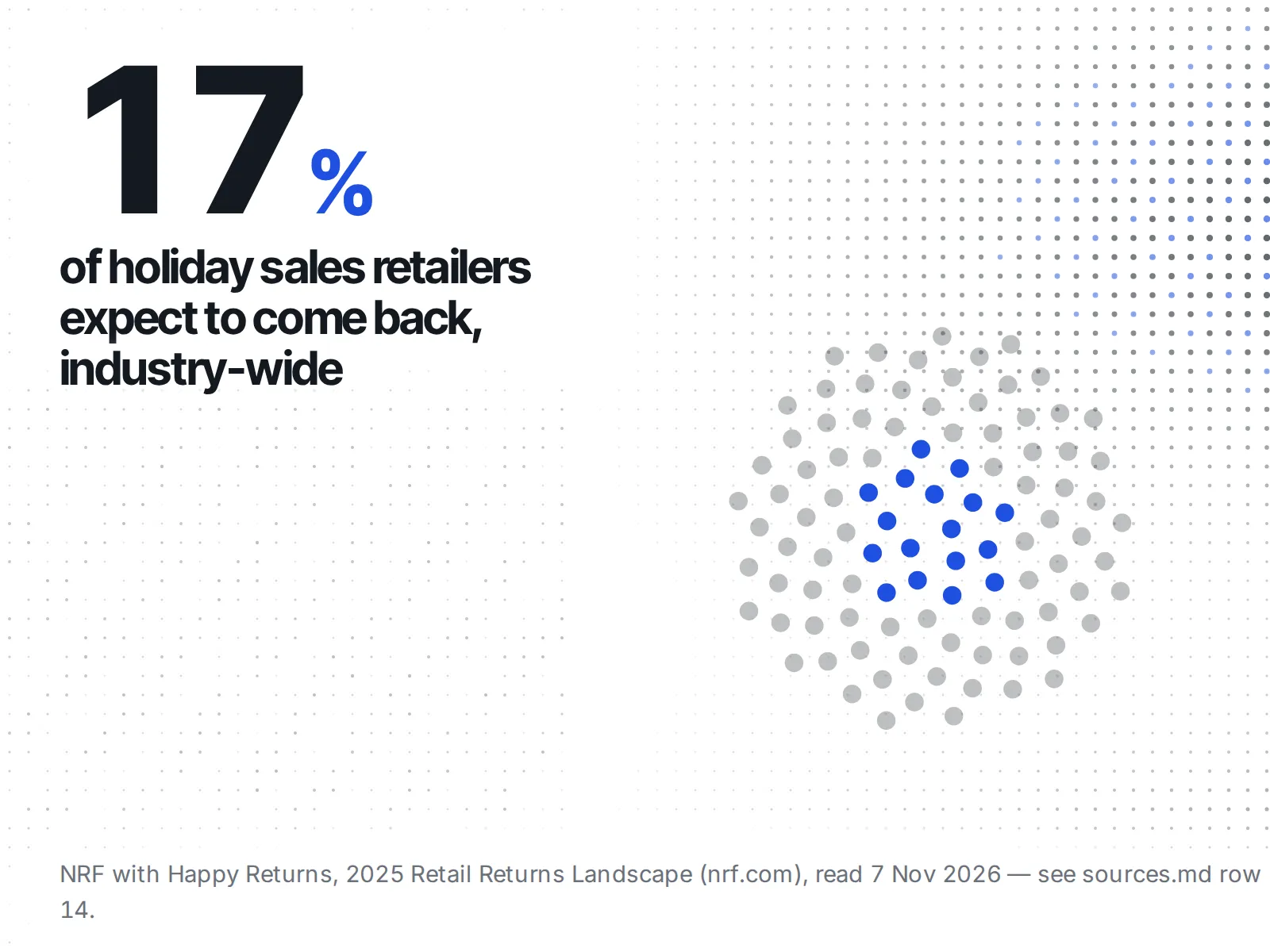
For a sense of the stakes, the US National Retail Federation (NRF), with Happy Returns, published its 2025 returns figures on 15 October 2025: "Retailers expect 17% of holiday sales to be returned, consistent with previous years." That is an all-retail expectation, not Gymshark's or Everlane's number, and not yours. Use it only to place your own holiday return rate: if yours runs well above it, a longer window costs you more than the average store.
Should you match a rival's threshold or return window?
Match only what your own margin and return rate can carry, and compete elsewhere if they can't. The decision splits into three: match the free-shipping threshold, match the return window, or hold both and win on something the rival cannot copy quickly, such as fit help, faster delivery or stock depth.
Work through it in this order:
- Threshold. If a rival lowers theirs for BFCM and yours sits above it, a shopper with a mid-sized basket sees a shipping fee from you and none from them. Matching costs you shipping on those orders; it does not touch returns.
- Return window. Extending your window costs you on every item that comes back late. If you extend, decide your own final-sale rule in the same sitting, the way Gymshark pairs its two.
- Delivery promise. If you match a rival's delivery estimate, the US Federal Trade Commission's Mail, Internet, or Telephone Order Merchandise Rule says you need a reasonable basis for any shipping time you state, and if you can't ship on time you must ask the buyer to accept the delay or cancel, refunding promptly for anything unshipped. Carrier deadlines are covered in holiday shipping cut-off dates for competitors.
- Discount depth. That is a separate call, covered in whether to match a rival's Black Friday discount in clothing. Make it before you set your final-sale cut-off, because one decides how much of the sale the other covers.
What would this look like for a small apparel brand?
Say a small swimwear brand's main rival announces a holiday return window running into January. Before matching it, open the rival's refund page and find the final-sale line. Suppose it excludes everything past a certain markdown, and their Black Friday collection is mostly past that line. Then the long window mostly protects full-price pieces bought as gifts.
Now look at yourself. If your BFCM sale is shallow and most of what you sell over the weekend is full price, a matching window covers far more of your sales than it covers of theirs. You could offer the same window on gift-wrapped orders only, or keep your window and put the money into free exchanges for size. Either way, you are answering the offer they actually made, not the headline.
How do you keep watching it through BFCM?
Re-read a rival's shipping and refund pages whenever its sale starts or deepens. That is the natural moment to check. You cannot refresh every rival's refund page daily, so watch for the trigger instead and keep your dated screenshots as the record.
ecvision watches the trigger, not the policy text. On a rival's This week sheet, the "Product changes" section lists catalogue moves with chips such as "Price cut" and "Sale started". Each change is dated by two reads of the store's catalogue: the last that still held the old state and the first that held the new one. ecvision does not read shipping or refund pages, so when a "Sale started" chip appears, that is your cue to open the rival's policy pages and take a fresh screenshot. Plans are on the ecvision pricing page.
For everything else to look at in the run-up, use the Black Friday competitor research checklist.
Your checklist before 27 November
- Screenshot each rival's
/policies/refund-policyand/policies/shipping-policy, dated. - Fill the seven-row table: threshold, shipping below it, delivery estimate, window, holiday extension, return postage, final sale.
- Compare each rival's final-sale cut-off with their BFCM discount depth.
- Set your own threshold, window and final-sale rule in one sitting, against your own margin and return rate.
- Re-read rival pages when a sale starts or deepens.