Traffic-analytics alternatives for ecommerce: 6 tools
A traffic estimate says how many people visit a rival's store, not what it sells. Six ecommerce tools, their prices, and which job each one does.
Thomas Pham · · 8 min read
If you're looking for an ecommerce alternative to a website-traffic analytics tool, first decide which question you want answered. A traffic tool estimates how many people visit a domain. An ecommerce competitor tool shows what one rival store is doing: its products, prices, ads and estimated sales. Six tools and one free ad library are compared below, from free to $599 a month as of 13 November 2026, by which of those two jobs each one does.
I'm the founder of ecvision, which is one of the six. It's judged by the same table and the same rules as the others: what each tool's own page says it does, and who it fits.
What's the difference between a traffic tool and an ecommerce competitor tool?
A traffic tool answers "how many people visit this site, and from where?" for any domain. An ecommerce competitor tool answers "what is this one store selling, at what price, and how is it advertising it?" Both are estimates from the outside. They solve different problems, and most tools are built for one of them.
Here's how that plays out. Say you sell scented candles and a rival you've watched for a year suddenly shows up everywhere in your feed. A visits estimate can tell you their traffic went up. It can't tell you why. The why is on their store and in their ads: maybe a new scent at a lower price, a bundle, or a fresh run of Meta ads pointing at one product page. That second picture is what you can act on, because it tells you what to match, what to ignore and what to test yourself.
One thing holds for every tool here, paid or free. A Shopify app can read a store's orders only through the read_orders access scope, and Shopify's own docs say "Merchants approve the scopes when they install it" (Shopify access scopes). A competitor never installs your tool, so any "sales" or "revenue" figure about their store is that tool's estimate, not their real number. Use it to compare direction and size, not to quote.
What do today's search results suggest instead?
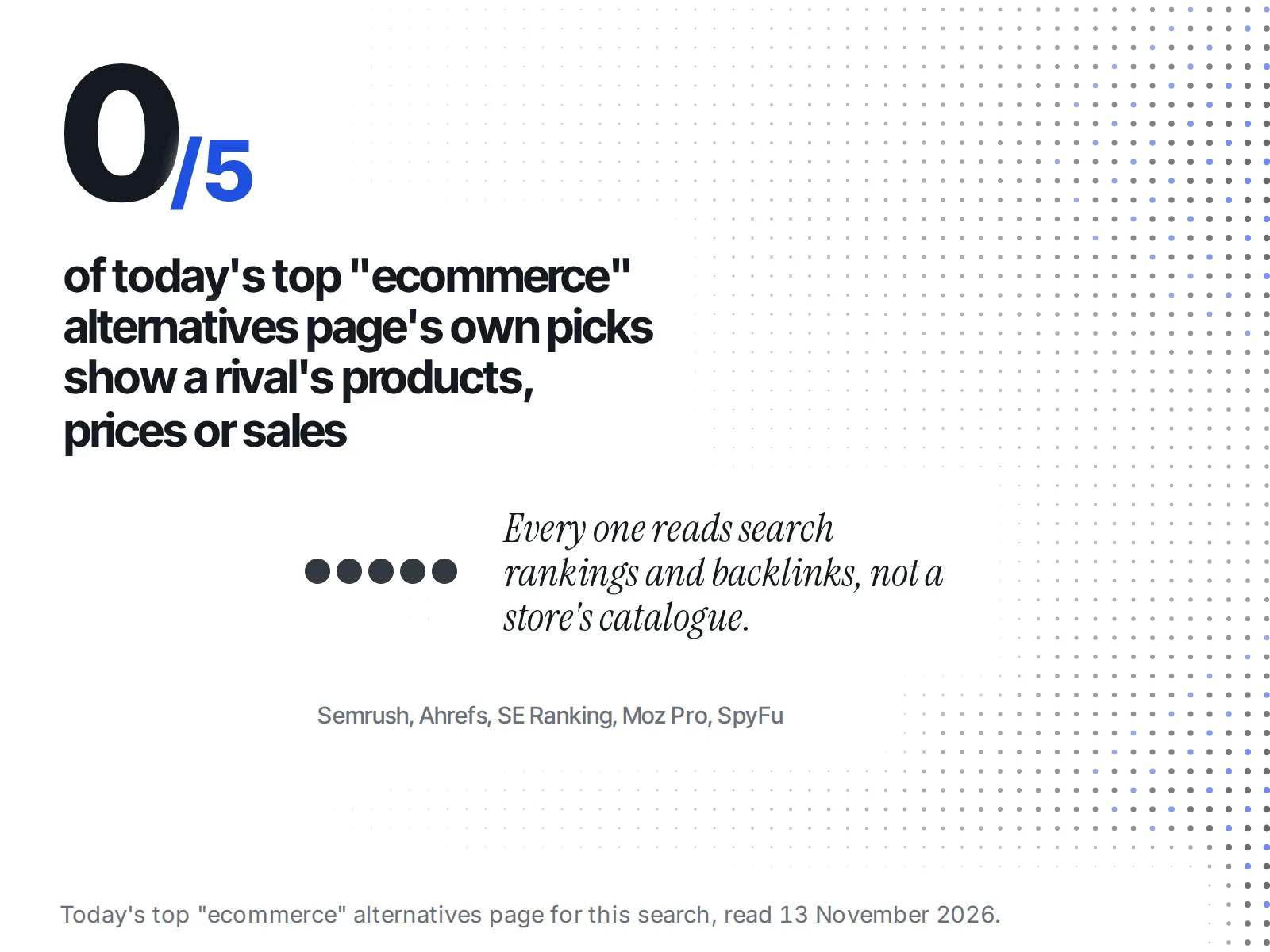
Mostly generic SEO tools. Today's top "ecommerce" alternatives page for this search recommends five tools, and every one is described in terms of website traffic, keywords or backlinks. None of the five is described as showing a rival's products, prices or sales, which is the gap the rest of this page fills.
The top results for this search, read on 13 November 2026, were general "alternatives" directories built for any website, or vendor pages naming themselves as the answer.
The method was simple: read the description that page gives for each of its five picks. Every description is about website traffic, keyword research, backlinks or paid search keywords. The page also says the traffic and audience data those tools give is less deep than the tool they replace. So the count is 0 of 5 for store data. That's not a knock on those tools: they're good at search marketing. They just answer the first question, not the second.
If your job is SEO, one of those is likely the right move. If your job is "what is this Shopify store doing?", read on.
Which tools show what a rival Shopify store is doing?
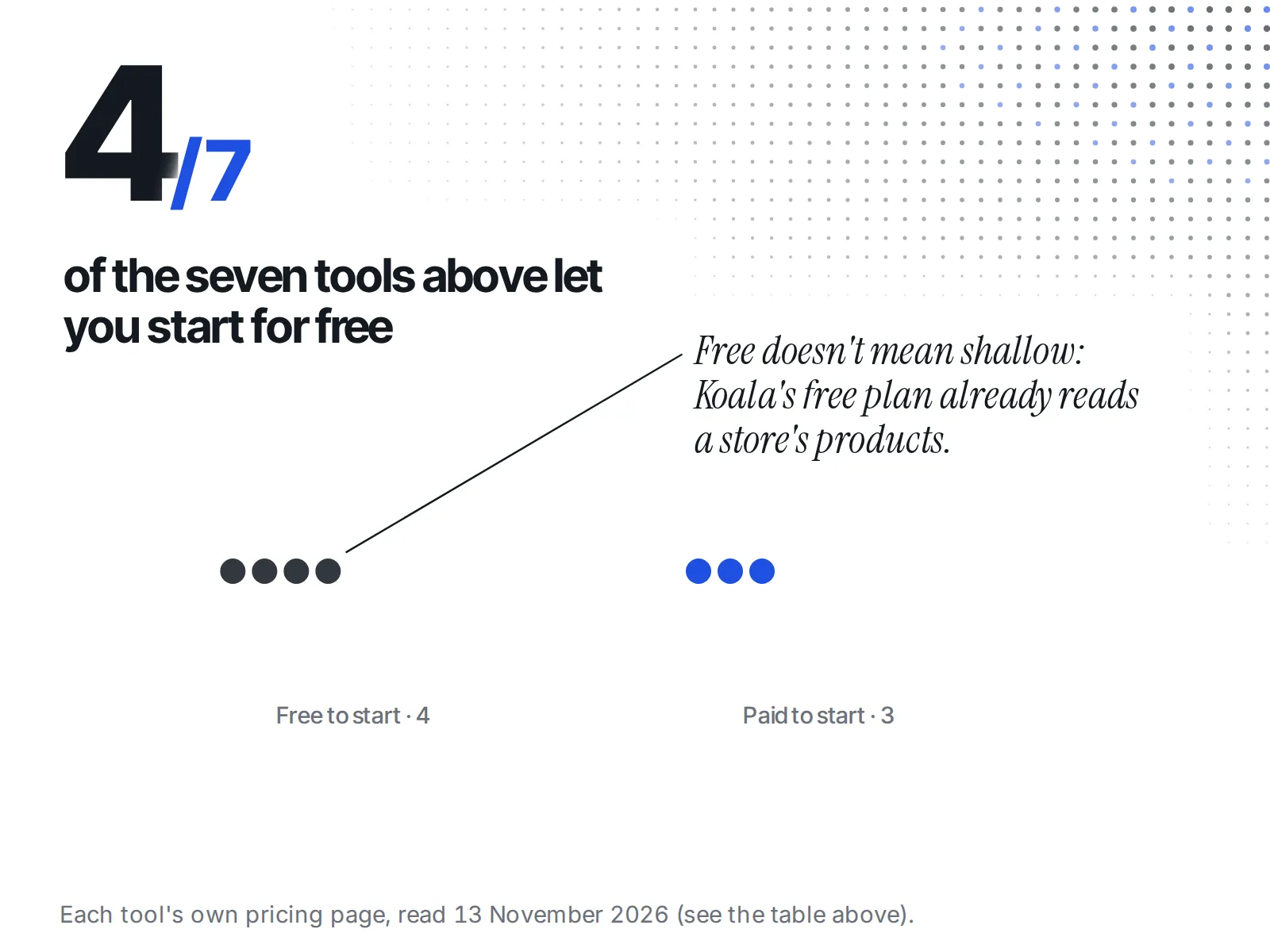
Six tools and one free ad library cover the store side. They split by what they read: products and estimated sales (Dropship.io, Trendtrack, Koala Inspector), marketing across channels (Panoramata), store search for developers (StoreInspect), or catalogue, prices and ads together (ecvision). Prices below are as of 13 November 2026, from each tool's own pricing page.
| Tool | Entry price | Top listed plan | Visits estimate | Sales estimate | Products | Ads |
|---|---|---|---|---|---|---|
| Meta Ad Library | Free | Free | Not offered | Not offered | Not offered | Meta ads |
| Koala Inspector | Free | $22/month | Traffic analysis, 3 tokens per use | Not stated | Product statistics, best sellers | Not stated |
| Dropship.io | $26/month, billed yearly | $49/month, billed yearly | Not stated | Estimated sales and revenue | 25 to 100 tracked | Ad Library |
| Trendtrack | $34/month, billed yearly | $111/month, billed yearly (Enterprise custom) | "Traffic evolution" in Shop Analytics | Not offered | Store database | Meta, TikTok and Google |
| Panoramata | $99/month | $399/month | Has a traffic section, plan not stated | Not stated | Not stated | Ads and emails |
| StoreInspect | Free | $599/month | Not stated | Not stated | Not stated | Not stated |
| ecvision | Free | $60/month | "Traffic" screen, estimated | "Sales Intelligence", "Est. sales" per product | Catalogue and prices | Every Meta ad |
"Not stated" means the tool's pricing page doesn't list it, not that the tool can't do it. ecvision's row comes from the app itself, not a pricing page. Check the tool's own docs before you rule one out.
Meta Ad Library: free, ads only
The Meta Ad Library is Meta's own ad archive. Meta says "People can search for all active ads running across products from Meta." It's free, and it's the first place to look when the question is "what is this brand running right now?" It shows ads, not products, prices or traffic. Our guide to finding a competitor's Facebook ads for free walks through it, and the comparison of Meta's, Google's and TikTok's ad libraries covers the other two.
Koala Inspector: a quick look inside one store
As of 13 November 2026, Koala Inspector's Free plan is $0 a month and lists "Shop structure - basic insights into any store," "Product statistics - initial performance data," "Newest Products & Best Sellers - a sneak peek at trends" and "Export CSV - lightweight data management." Premium is $22 a month with "220 renewing monthly tokens" and "tracking for up to 50 shops." Traffic analysis costs 3 tokens per use, and tracking a shop costs 15 tokens per shop per month. Token packs run "10 tokens for $3.99, 25 for $6.99, or 100 for $11.99."
It does well at the fast, one-store look: what's new, what sells, what the catalogue looks like. It fits a founder who checks a few stores now and then and wants to start free.
Dropship.io: tracked shops with sales estimates
Dropship.io's pricing page says its Basic plan lets you "Track Shopify stores and TikTok Shops with real-time insights into sales, revenue, top products, and growth trends." As of 13 November 2026, Basic is $26 a month billed yearly or $39 billed monthly, and "Tracks 10 shops and 25 products." Standard is $34 a month yearly ($59 monthly) for 25 shops and 50 products. Premium is $49 a month yearly ($99 monthly) for 50 shops and 100 products. Basic also includes "Competitor Research: 20 searches/day."
It does well at a running view of chosen shops and products, with an estimated sales line on each. It fits a seller who wants to watch a fixed list of stores and products over time.
Trendtrack: store database plus ads and emails
As of 13 November 2026, Trendtrack costs $34 (Starter), $62 (Pro) or $111 (Business) a month, billed yearly, with Enterprise quoted on request. Starter includes "Unlimited browsing of the store database, with all filters". Every plan includes Shop Analytics and Similar Shops, and Meta ad tracking refreshed every 24 hours. Brandtracker follows 2, 10 or 20 brands at once by tier, and brand "lookups" run 5 a week on Starter, 30 on Pro and unlimited on Business.
It does well at breadth: finding stores, then following a handful across ads on three networks and their emails. It fits a founder who is still working out who the competitors are.
Panoramata: marketing across channels
As of 13 November 2026, Panoramata has three plans. Startup is $99 a month: "track 20 competitors and unlock 6 months of history". Professional is $179 a month, marked "Recommended". Advanced is $399 a month. Its pricing page has a website traffic section but doesn't say which plan includes it.
It does well at following a rival's marketing as a whole: ads, emails, and on Professional, SMS and landing pages. It fits a marketing team that plans campaigns against rivals' calendars.
StoreInspect: store search and exports for builders
As of 13 November 2026, StoreInspect has a Free plan with "1 active signal" and "50 search results per query", and no API access. Pro is $99 a month ($948 a year) with "5 active signals" and "10,000 unique store exports per month". Business is $249 a month and Scale $599 a month. "REST API and hosted MCP access" is included from Pro up.
It does well at volume: from 50 search results per query on Free up to 500,000 unique store exports a month on Scale, pulled into your own systems. It fits an agency or a developer building lists or tools, more than a founder watching three rivals.
ecvision: catalogue, prices and ads for your set of rivals
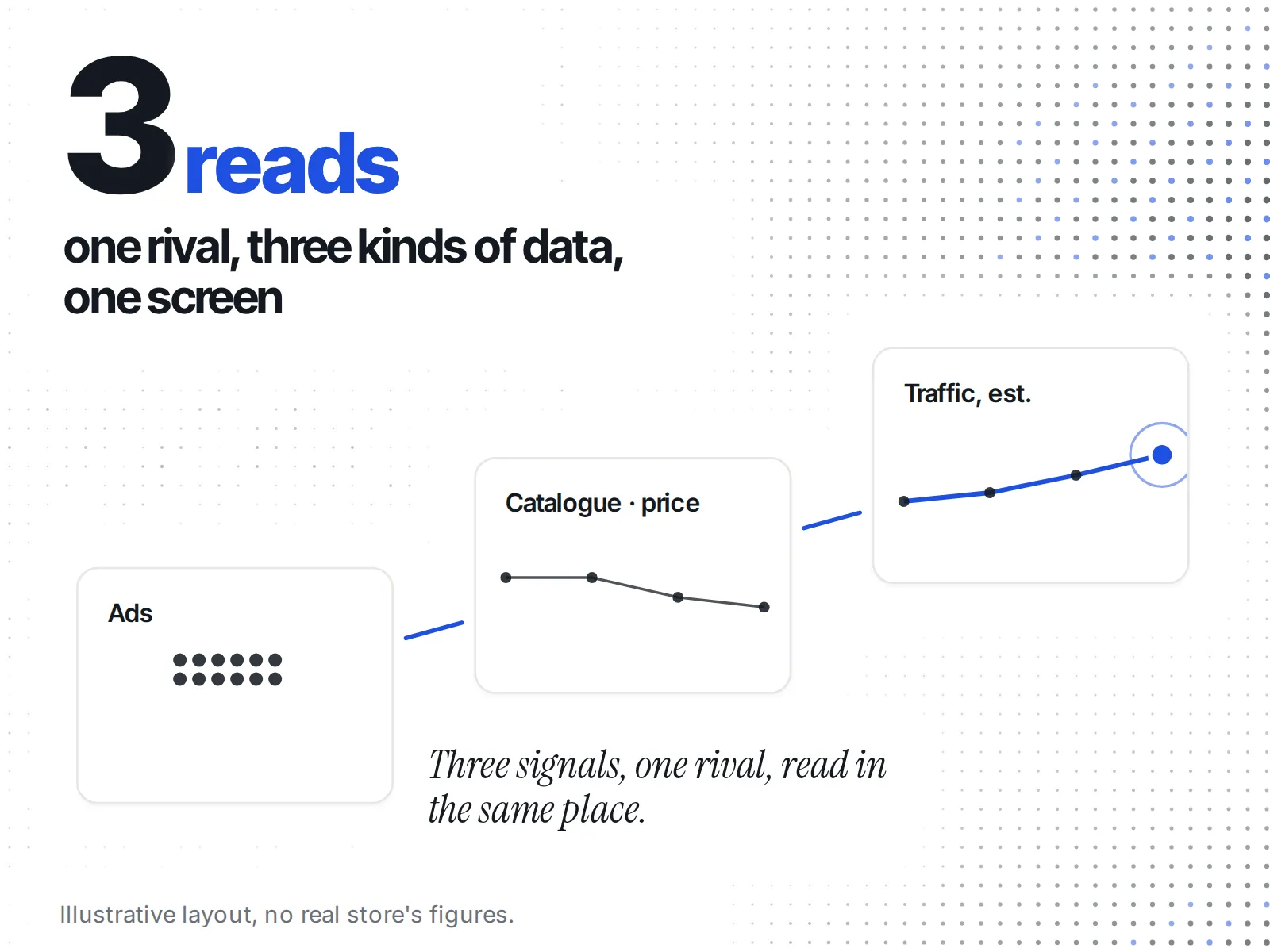
As of 13 November 2026, ecvision's pricing has three plans. Starter is $20 a month for "Your store plus 5 rivals", with "Every ad they run on Meta" and "Catalogue, prices and social accounts", plus "1 AI assistant connection". Growth is $60 a month for "Your store plus 10 rivals", "6 months of history" and "Scan as often as daily". Free covers "Your store plus 5 rivals, read for 7 days from setup", then pauses. The app also has a "Traffic" screen: "Visits across your set, by month and by week, estimated."
There's no self-serve sign-up yet. The button says "Book a call", and "On the call we set up your workspace on Free." It does well at putting one rival's ads, catalogue, prices and visits estimate in one place, and you can ask about them through your AI assistant. It fits a founder who watches up to ten named rivals. It doesn't fit someone who wants visits for any domain on the web: the traffic estimate covers your own set only.
So which one do you actually need?
Pick by the question you're trying to answer, not by the tool you're replacing. If you need visits for any website, a general traffic or SEO tool still does that job. If you need to know what a specific store sells, charges and advertises, pick from the six above by budget and how many stores you watch.
- "What ads is this brand running right now?" Start with the Meta Ad Library. It's free.
- "What does this one store sell, and what's new?" Koala Inspector's Free plan is a good first look.
- "How are these stores' sales moving over time?" Dropship.io or Trendtrack, if you're happy working with estimates.
- "Who else is in my niche?" Trendtrack's store database is built for that search.
- "What is my rival doing across ads, email and SMS?" Panoramata.
- "I need thousands of stores in a spreadsheet or my own app." StoreInspect.
- "I want my rivals' catalogue, prices, Meta ads and a visits estimate together." ecvision.
- "How does traffic compare across a whole market?" None of these six is built for that. It's a different job, and a general traffic tool is the honest answer.
If you want the full picture of what a store-focused tool should cover, there's a breakdown of the Shopify competitor-analysis tool by the job you need.
A last check before you pay for anything: open the plan page yourself on the day you buy. Every price above was read on 13 November 2026, and pricing pages change.