ecvision vs ShopVision: which competitor tracker fits you
ecvision and ShopVision both watch Shopify competitors. What each one tracks, how it connects, what it costs per rival, and who each suits.
Thomas Pham · · Updated · 8 min read
ecvision and ShopVision are two separate companies. Both watch what your Shopify competitors do, but they are built for different buyers. ecvision reads a short list of named rivals from their public pages and answers in your own AI assistant, from $20 a month. ShopVision is a Shopify app that connects to your store and matches competitor products to yours, from $1,200 a month (both prices as of 24 October 2026).
The confusing part is real: two tools with near-identical names, both promising to show you what rivals are doing, with entry prices of $20 and $1,200 a month. I build ecvision, so weigh what follows with that in mind. Everything below about either product comes from its own current page, read on 24 October 2026, and ShopVision's strengths are given in its own words.
How do ecvision and ShopVision compare at a glance?
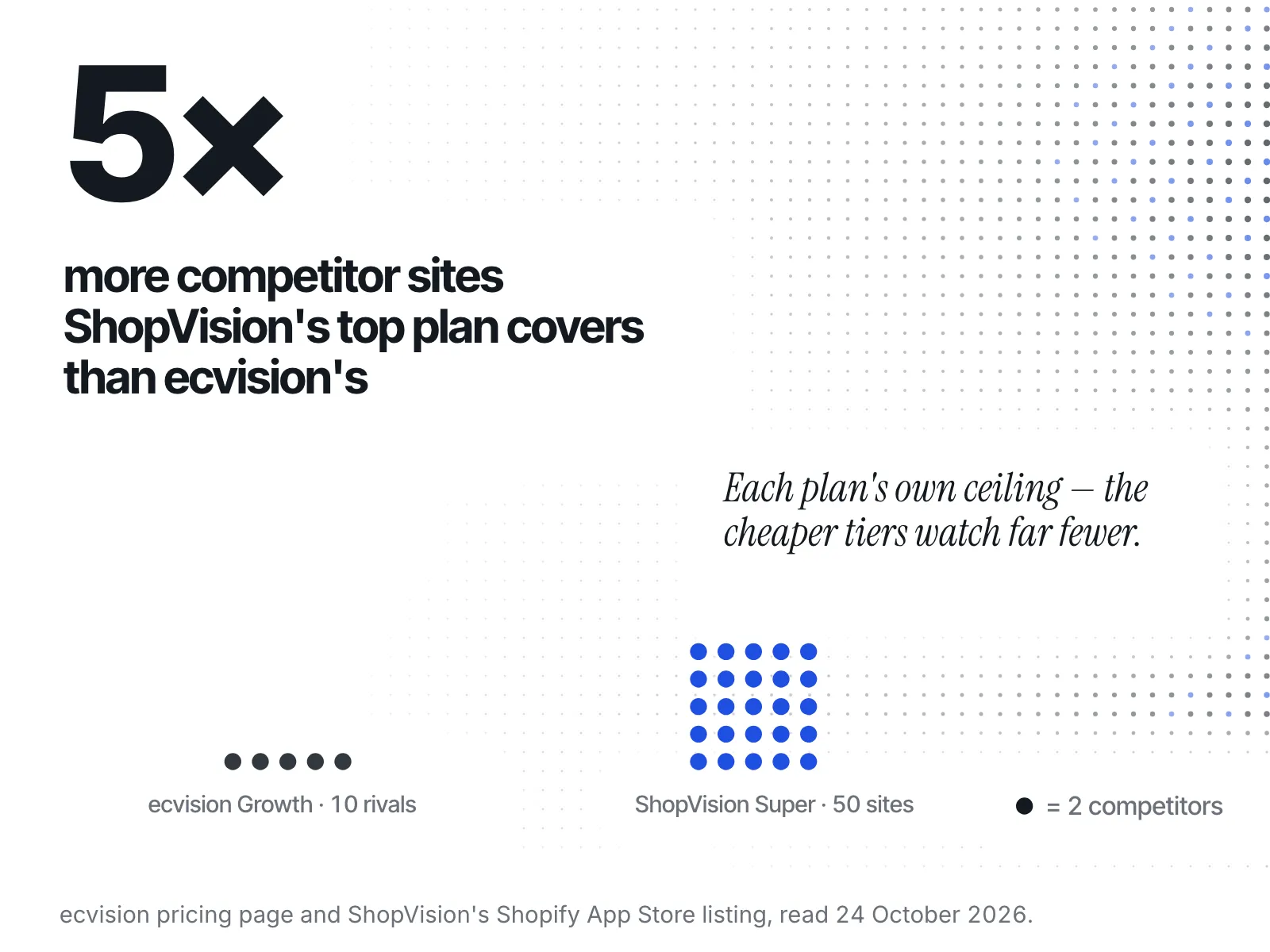
The short version: ecvision is priced for one person or a small team watching up to 10 named rivals. ShopVision is priced for a team of 5 to 10 seats watching 20 to 50 competitor sites, with automatic product matching and MAP monitoring. The table puts each vendor's own labels side by side.
| ecvision | ShopVision | |
|---|---|---|
| Plans and prices (as of 24 Oct 2026) | Starter $20/month, Growth $60/month (ecvision pricing) | Pro $1,200/month, Super $2,400/month (App Store listing) |
| How many rivals | "Your store plus 5 rivals" (Starter), "Your store plus 10 rivals" (Growth) | "20 Monitored Competitor Sites + Your Own" (Pro), "50 monitored competitor sites + your own" (Super) |
| Who the plan is for | "One operator watching a handful of rivals." (Starter), "A small team sharing one workspace." (Growth) | "5 Users / Seats" (Pro), "10 Users / Seats" (Super) |
| How it connects to your store | "Nothing to install, no Shopify Admin API" | A Shopify app: "Connect your store and ShopVision matches competitor products to yours" |
| Where you read it | Your own Claude or ChatGPT, plus a dashboard | Works with ChatGPT, Claude, Slack and Microsoft Teams, among others, per its listing |
| Product matching to your catalogue | Not on ecvision's plan cards | "AI product matching, exact and equivalent, with the reasoning shown" |
| MAP and reseller monitoring | Not on ecvision's plan cards | "MAP and reseller monitoring across channels" |
| Trial | No trial; you start on Free: "Your store plus 5 rivals, read for 7 days from setup" | No trial length stated on the listing |
Are ecvision and ShopVision the same company?
No. ecvision (ecvision.ai) and ShopVision (shopvision.ai) are unrelated products from different teams. They get confused because both sell competitor intelligence to ecommerce brands and both names end in "vision".
ShopVision describes itself on its Shopify App Store listing this way: "See every competitor's promo, price, launch, and channel move." ecvision's homepage puts it as "Their ads, catalogue, social and traffic. Ask your Claude or ChatGPT; every figure comes back dated." For the longer story of what ecvision is and how it differs from similarly named companies, see what ecvision is and who it is for.
What does each one track?
Both track competitor ads, social activity and product changes. ecvision reads ads, catalogue, social and traffic for each rival you name, every figure dated. ShopVision tracks prices, promotions, launches and stock against your own catalogue, plus ads, email and social, and adds MAP and reseller monitoring.
ecvision. Its FAQ answers "What do the numbers cover?" with: "Ads, catalogue, social and traffic, each dated with the day it was read. Traffic is an estimate and marked as one." Both paid plans list "Every ad they run on Meta" and "Catalogue, prices and social accounts". There is also an estimate of sales: "Estimated revenue for any Shopify store, and for every product in it." On ads, ecvision says plainly what it cannot know. Meta's library adds spend and reach "For ads about social issues, elections or politics", so for a store's ordinary ads ecvision has no spend or impressions to show, and describes each ad by how long it has run.
ShopVision. Its listing names five feature areas, quoted here as written:
- "Marketing Intelligence: competitor ads, email, and social as they go live"
- "Pricing Intelligence: competitor prices matched to your products, daily"
- "Assortment & Catalog Intelligence: competitor launches, drops, and restocks"
- "Wholesale & MAP Intelligence: MAP and reseller monitoring across channels"
- "AI product matching, exact and equivalent, with the reasoning shown"
MAP stands for minimum advertised price. The FTC's guidance on manufacturer-imposed requirements uses the term in this question: "I can't participate if I advertise a price that is below the supplier's minimum advertised price." ShopVision's listing uses the abbreviation without spelling it out. ShopVision also says you "Get alerts when something moves, see where you're over- or under-priced, and spot assortment gaps and MAP violations." Its Super plan adds "Paid Ads", "Daily Site Traffic" and "Real-Time Web Research".
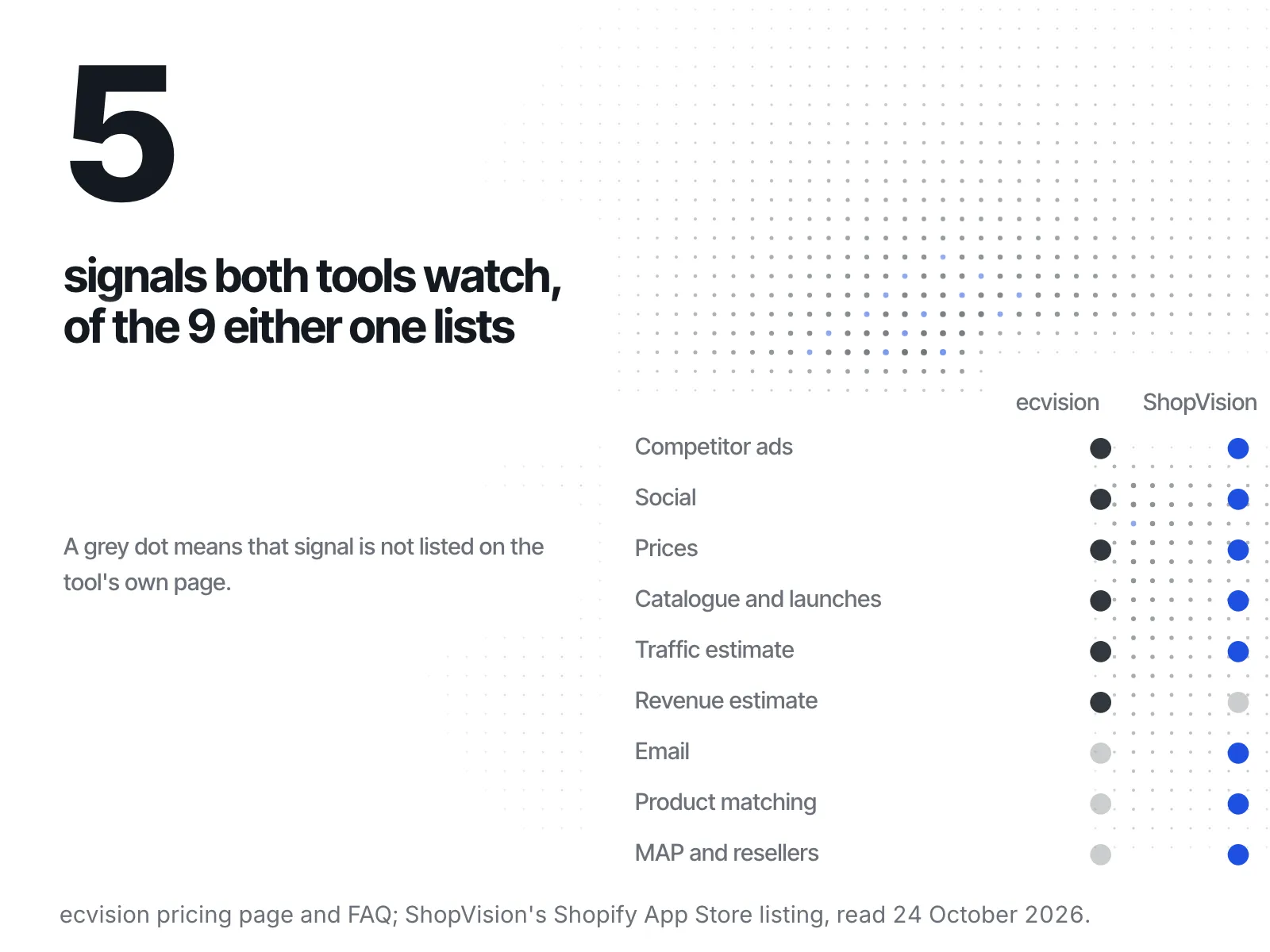
The real difference is the frame. ShopVision lines competitors up against your own products, product by product. ecvision reads each named rival as a whole store: what they sell, what they advertise, what they post.
How does each one connect to your store?
ShopVision connects to your store; ecvision never does. ShopVision is a Shopify app you install, and it matches competitor products to the ones you sell. ecvision has nothing to install and no Shopify access: it reads rivals' public pages and you read the results through your AI assistant or its dashboard.
ShopVision's listing puts its setup in one line: "Connect your store and ShopVision matches competitor products to yours, then tracks their prices, promos, launches, and stock changes daily." That connection is what makes the side-by-side price view possible. It knows your products, so it can say where you sit against each rival.
ecvision answers the question "Does it touch my Shopify store?" with: "Never. Nothing to install, no Shopify Admin API, no orders, customers or revenue. ecvision reads only the pages any shopper sees." Its site footer adds: "We never ask for your Shopify login." You connect your own Claude or ChatGPT once; in ecvision's words, "It can read your workspace and change nothing. There is a dashboard too, for the whole reading on one screen." Getting started is a call: the button reads "Book a call", and "On the call we set up your workspace."
What does each cost per competitor watched?
Divide each plan's monthly price by the number of competitor sites it covers. ecvision works out at $4 a rival on Starter and $6 on Growth. ShopVision works out at $60 a site on Pro and $48 on Super. Neither vendor publishes these figures; they are arithmetic on each one's own plan card.
Both vendors include your own store on top of the competitor count, so the division uses competitors only. Prices are as of 24 October 2026, monthly, in US dollars.
| Plan | Monthly price | Competitors covered | Cost per competitor per month |
|---|---|---|---|
| ecvision Starter | $20 | 5 rivals | $4 |
| ecvision Growth | $60 | 10 rivals | $6 |
| ShopVision Pro | $1,200 | 20 sites | $60 |
| ShopVision Super | $2,400 | 50 sites | $48 |
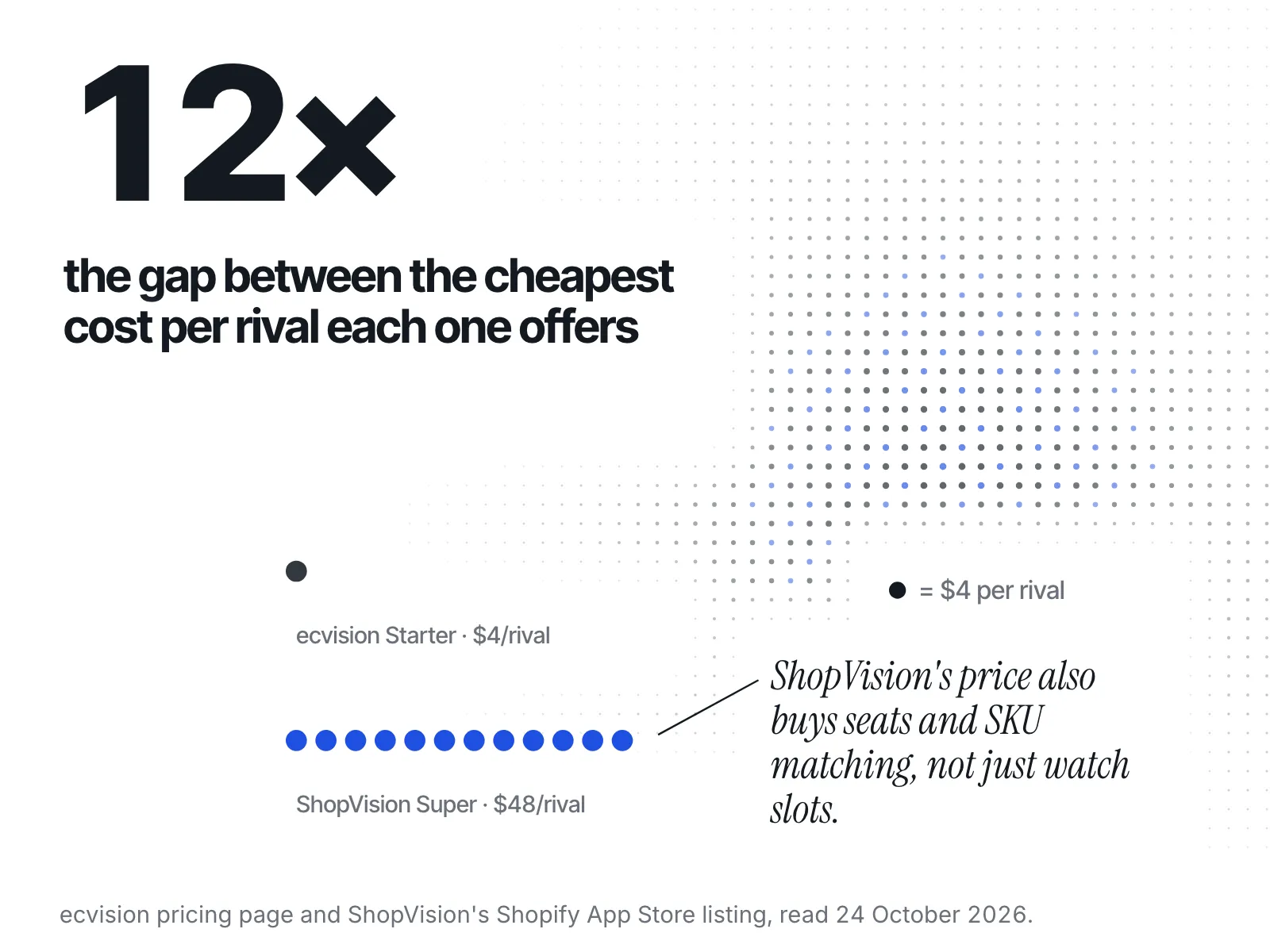
The per-rival number is not the whole story. ShopVision's price buys things ecvision's plan cards do not list: 5 or 10 seats, product matching against your catalogue, MAP and reseller monitoring, and a "Claude Connector" on Pro. What the table does show is the floor. The cheapest way into ShopVision is $1,200 a month; the cheapest paid way into ecvision is $20. ecvision bills monthly through Polar, its Merchant of Record. ShopVision notes on its listing that "External charges may be billed by ShopVision separately from your Shopify invoice."
Who is each one built for?
ecvision is built for a founder or a small team who can name the handful of rivals that matter and wants answers in an assistant they already use. ShopVision is built for brands and retailers with a team, a catalogue worth matching product by product, and resellers whose advertised prices they need to police.
ShopVision says so in its own words: it "shows brands & retailers what competitors are doing across pricing, promotions, assortment, and channels". Its promise is "Instead of raw data to sift through, you get what changed, what's happening now, and the next move." The seat counts and the wholesale and MAP features point to a business with several people and a reseller network.
ecvision's plan notes are explicit too. Starter is "One operator watching a handful of rivals." Growth is "A small team sharing one workspace." The design assumes you already know who your competitors are and want to watch them closely, not find new ones.
If you want more options than these two, our roundup of competitor price monitoring apps for Shopify stores covers the wider field.
Is ecvision.ai the same as ecVision S.A.?
No. ecVision S.A. is an unrelated Polish company that builds AI for transport, smart parking and chatbots; it has nothing to do with Shopify. Our plain explanation of what ecvision is covers the difference in full.
Which one should you pick?
Pick by three things: how many competitors you watch, whether you need them matched to your own products, and your budget. Up to 10 named rivals and a small team points to ecvision. Twenty or more sites, SKU-level matching, MAP alerts and a four-figure monthly budget points to ShopVision.
Say you run a small candle brand. Three rival shops keep turning up next to you in Instagram ads, and you want to know when they launch a new scent, change a price or start a new ad. You do not resell through retailers, and you have no MAP policy to enforce. Starter's "Your store plus 5 rivals" covers that, and you can ask your assistant "what did they change this week?" in plain words. ShopVision's matching and MAP features would sit unused.
Now flip it. You are a brand selling through dozens of retailers, with a pricing floor to protect and a team of five who all need to see it. That is the case ShopVision's "Wholesale & MAP Intelligence" and "5 Users / Seats" were written for, and ecvision's plan cards do not cover it. Pick ShopVision there; it is the honest answer.
A quick check before you decide:
- Count the competitors you actually watch today. Under 10, or 20 and up?
- Decide whether you need competitor products matched to your own, or just want to see what each rival does.
- Check whether you have resellers and a MAP policy to enforce.
- Decide whether a tool may connect to your Shopify store, or whether you want one that never does.
- Set the monthly budget: tens of dollars or thousands.
If the answers point to ecvision, see the plans on the pricing page and book a call. If they point to ShopVision, its App Store listing has the plans and the install button.