Jewelry price drop: a sale or a gold price move?
A rival's gold piece got cheaper. Here is how to tell a real markdown from a metal-rate reprice, and why a struck-through price doesn't settle it in jewelry.
Thomas Pham ·
A rival's gold hoops cost less this week than last. Do you match it, wait it out, or ignore it? Is a competitor's jewelry price drop a sale or a gold price change? From one look at the page, you can't tell. Even a struck-through "was" price doesn't settle it in jewelry, because the apps that reprice from metal rates can write that number too. The pattern across several readings is what tells them apart.
That matters because the two call for opposite moves. A sale ends, and if you match it you give away margin for as long as it runs. A metal reprice is the market moving under everyone, and it is probably coming for your price list too.
Why do jewelry prices move when nobody is running a sale?
In most verticals a price changes because someone decided to change it. In precious-metal jewelry, some stores tie the price to the metal itself, so it moves whenever the metal's market price moves, with no decision and no promotion behind it.
Shopify stores do this with apps. GoldSync, on the Shopify App Store, says it will "Price products from live gold, silver, platinum and palladium rates" and lets you "Create pricing formulas based on purity, weight, making charges, wastage, stones, taxes, and more." A second app, GPE (Live Gold Price Editor), says it "updates your product prices based on the Spot Exchange Price of Precious Metal (Gold, Silver, Platinum & Palladium), Metal Weight, Diamond Costs, Gemstone Charges, Labor Costs, Taxes, Markup, etc."
Founders keep asking for exactly this. In April 2024 a merchant on the Shopify Community asked for an app because "Gold and silver prices constantly change". In September 2025 a second poster wrote "They would like a solution where they can input the current price per gram (or carat/hour), and then have all product prices automatically update across the entire store with just one click."
So when you watch a gold or silver rival, a lower price on its own is weak evidence. It may be a markdown. It may be the store's formula meeting a cheaper metal.
Doesn't a compare-at price prove it's a sale?
Not in jewelry. On Shopify, a sale is normally shown by putting the old price in the Compare-at price field above the live price. But metal-pricing apps can fill that field from the same formula as the price, so a struck-through number can be generated, not chosen.
Here is how Shopify describes a sale. The merchant sets "the value of the Compare-at price field in your Shopify admin to the original price of the product", and makes sure it "is higher than the value in the Price field" (Shopify Help Center). Both amounts "can be displayed on product pages and collection pages, but only the sale price is displayed at checkout." The field is public too: Shopify's Storefront API documents compareAtPrice as a field that "can be used to mark a variant as on sale, when compareAtPrice is higher than price" (Shopify developer docs).
Most "is this a real sale?" advice stops there: a compare-at price above the price means a markdown. Jewelry breaks that. GPE's listing says "The app can calculate the 'Compare At Price' to show discounts & 'Item Costs' to track your profits based on the metal prices." GoldSync's listing, read on 8 October 2026, lists "Compare-at price automation" among the features of its Basic plan.
So a rival's page can show a "was" price and a lower "now" price that both came out of a formula, and both shift when the metal does. From outside, it looks exactly like a markdown someone chose.
How do you tell a sale from a metal reprice?
Watch the price over several readings, not one. A sale tends to hold still, sit in a gift window and hit a chosen set of pieces. A metal reprice keeps moving, shows up in any week, and touches everything made of that metal, often including the "was" price.
Three things to check:
- Does it hold still or keep moving? A timed sale usually sets a price and leaves it there until the sale ends, then the price goes back up. A metal-linked price ticks again with the next change in the metal. Check the compare-at price as well: a "was" price a person picked stays fixed, while a formula's "was" price moves with the "now" price.
- Is it one collection or every piece in that metal? A promotion is usually aimed at something: a collection, a gift edit, a set of bestsellers. A reprice hits every gold piece, or every silver piece, whatever collection it sits in, and leaves pieces in other metals alone.
- Is it in a gift window or any week of the year? Jewelry sales gather around gifting. In the National Retail Federation's 2026 forecasts, shoppers were expected to spend more on jewelry than on any other Valentine's Day gift (NRF), and "Jewelry leads Mother's Day spending" (NRF). A drop just before those dates, or around Black Friday, reads like a sale. The same drop in a quiet week, matched across a whole metal, reads like the market.
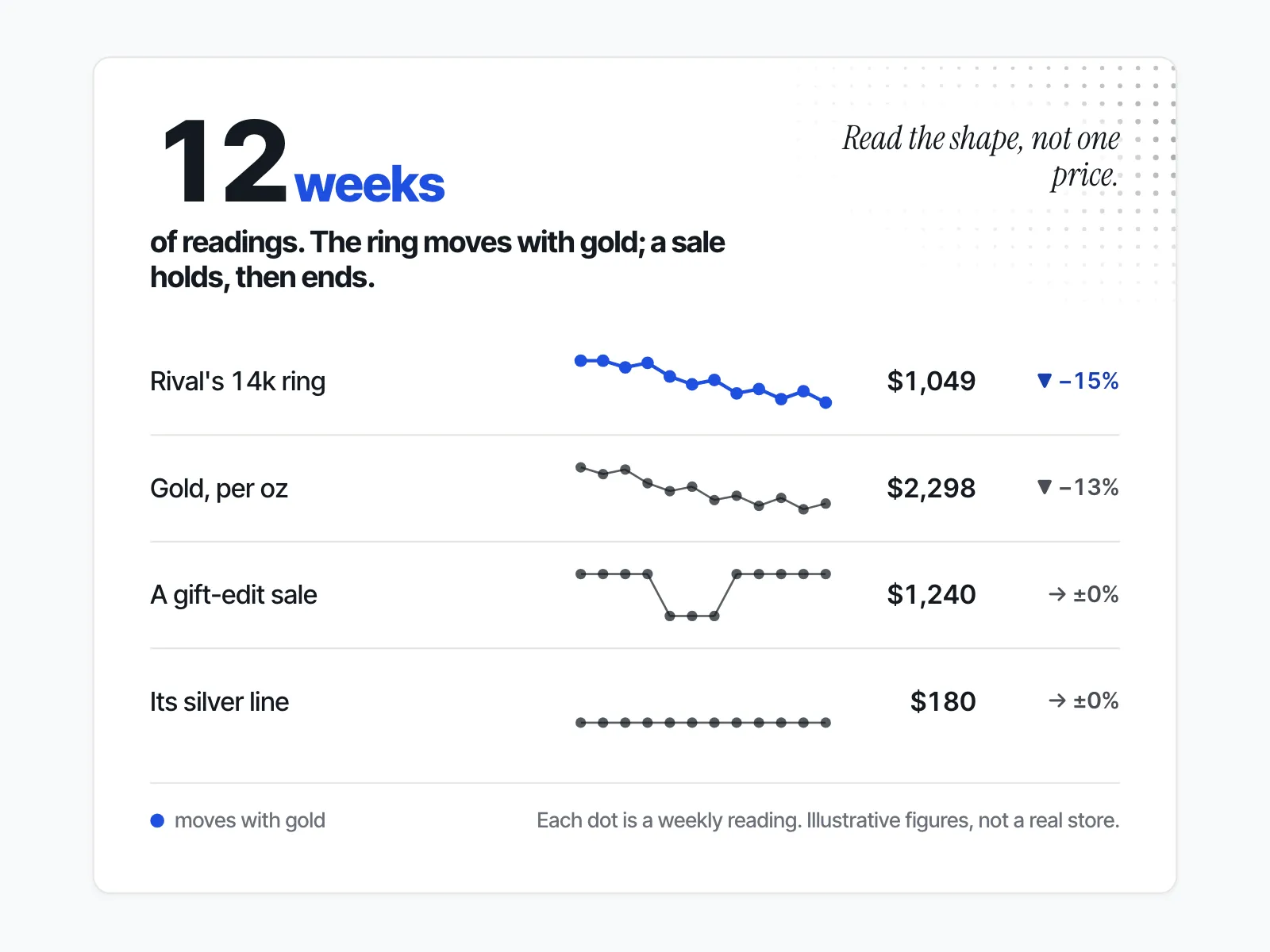
The ring's readings step down a week after gold's. The sale drops, holds for three weeks and comes back to where it was. The silver line never moves. None of these is proof on its own. Two or three pointing the same way is a strong read.
What does that look like for one rival?
Say you sell solid gold stacking rings and a rival you watch shows a lower price on its best-known ring, with the old price struck through. Your instinct is to match it.
Before you do, look at what happened around that ring. If the rival's other gold rings, chains and earrings all moved down together, the silver line didn't move, and the struck-through price shifted along with the new one, you are probably looking at a reprice. Your own metal costs are likely moving the same way, so the question is your formula, not their promotion.
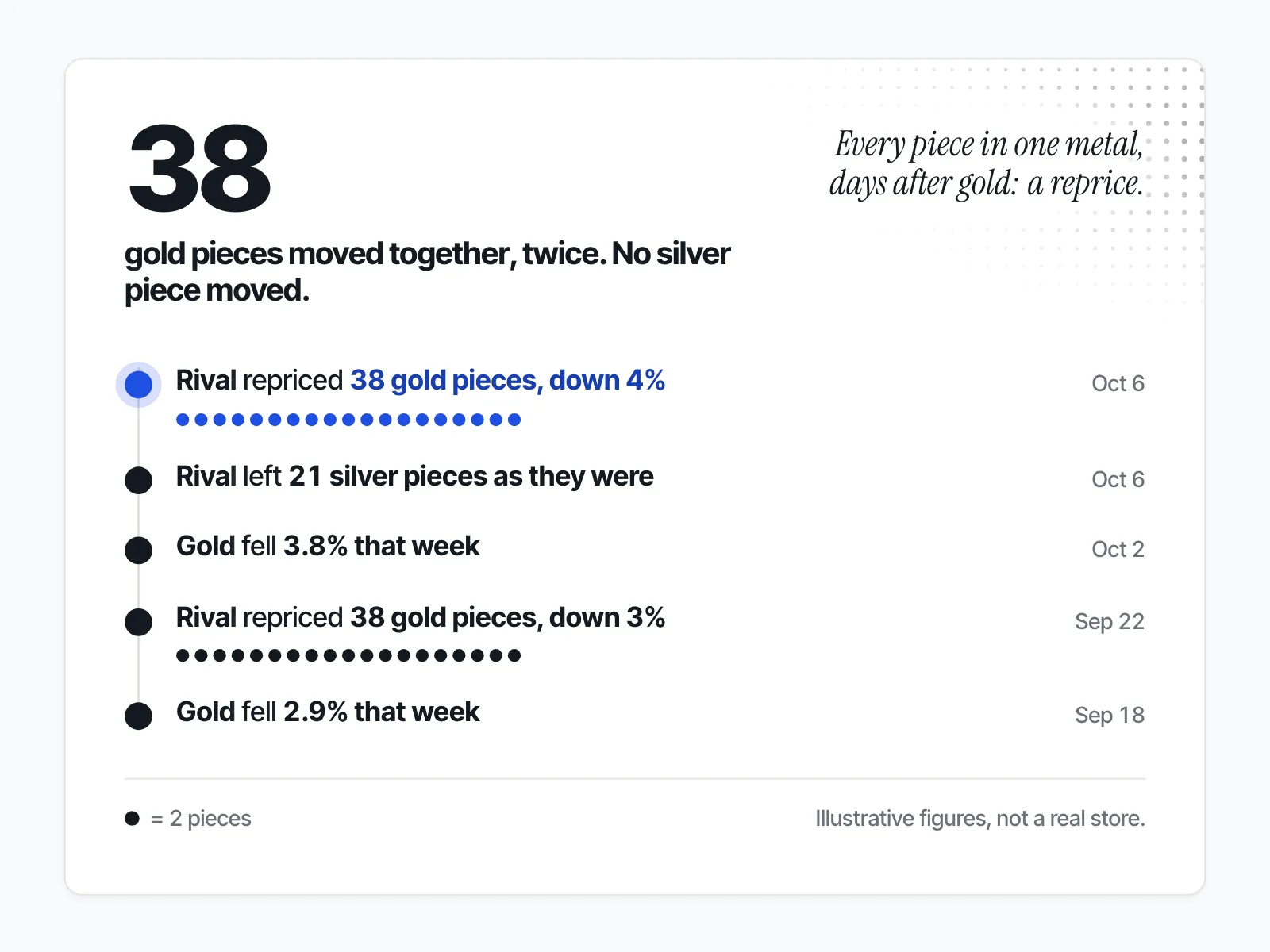
That is what a reprice looks like as a list of moves: every gold piece at once, a few days after gold fell, twice, and not one silver piece. No one picks 38 discounts to land on the same day as the metal.
If instead only the ring and two other pieces in its gift collection dropped, the "was" price stayed exactly where it had been, the drop landed a couple of weeks before Mother's Day, and a week after it all three went back up, you're probably looking at a sale. You can decide whether to answer it, knowing it has an end date.
When is it neither, or both?
This is not a reason to distrust every compare-at price in jewelry. The field was built to mark a sale, and a markdown set by hand still looks the way it always did. It is only a reason not to trust a single reading of one.
Some cases stay muddy. A store can run a sale on top of a metal-linked price, so the price moves with the metal and sits under a promotional "was" price at the same time. A store can reprice by hand every few weeks instead of with an app, which looks like a string of small sales. And a store selling plated or fashion pieces has less reason to tie prices to metal, so there a drop is much more likely to be a decision.
When the signals disagree, say so to yourself: "unclear" is a real answer. Guessing "sale" and cutting your price to match is the costly mistake.
What can't you tell from outside?
A storefront shows the prices and when they changed. It doesn't show the rival's formula, which app they use (if any), their margin, or whether a person chose the size of a discount.
You can't see the metal rate they plug in, or how often their app runs. Shopify's own docs show one more quirk: if a product's variants carry inconsistent compare-at values, "the collection page won't display the product as being on sale" (Shopify Help Center), so a collection page can hide a markdown that the product page shows. Read the product, not just the grid.
Everything above is a read of behaviour. It is usually a good one. It is never a look at their admin.
How does ecvision show a rival's price history?
In ecvision, the Products page's Sales Intelligence tab keeps the readings this method needs for every tracked rival: the price and the compare-at price at each reading, with every change marked. It doesn't label a change "sale" or "reprice". That read is still yours.
The Products page has three tabs: Sales Intelligence, Collections and Catalogue. In Sales Intelligence each product is a row. Its "Price · stock" column draws a small price line when the price changed or a compare-at price is set, says "Steady" when neither happened, and "One reading so far — a line needs two" while there is only one reading. The "Orders × price" column shows the price, the compare-at price struck through when it sits above the price, and the discount as a "−N%" badge.
Open a product with two readings or more and its price panel draws the price, and the compare-at price when there is one, as lines over the dates read, with a ↓ or ↑ at each change labelled from the old price to the new. When nothing moved it says "flat across N readings" with "on sale" or "no discount"; when the price did move it counts the changes and gives the low and the high. That is where you see whether the "was" price held still or moved with the "now" price. For building a rival's full promo calendar from the same history, see how to track a competitor's sales and discount calendar on Shopify. Plans are on the pricing page.
A quick check before you react
- Read the price more than once. One reading never tells you which it is.
- Watch the compare-at price: fixed points to a sale, moving with the price points to a formula.
- Look across the rival's pieces in the same metal, and at their other metals.
- Check the calendar against Valentine's Day, Mother's Day and Black Friday.
- Check the product page, not only the collection grid.
- If it still reads both ways, call it unclear and don't cut your price to match.